










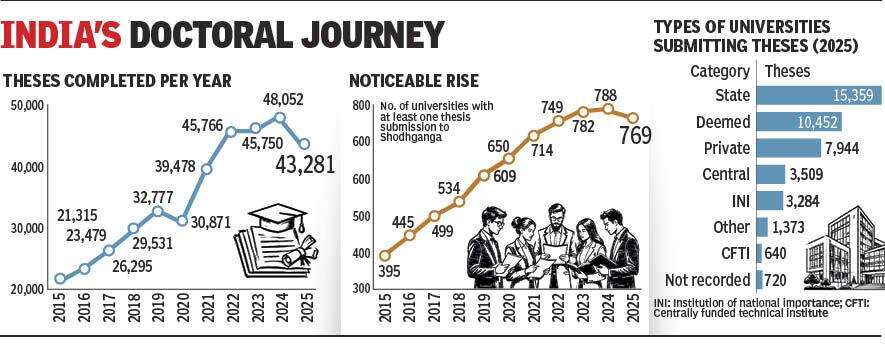
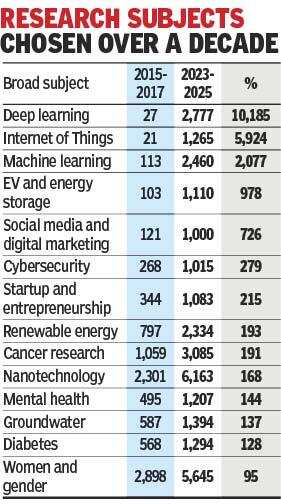
Doctoral research in India is being increasingly carried out in the fertile fields of futuristic endeavours. And the learning yield is rising by the year.In 2025, Information and Library Network (Inflibnet) Centre in Gandhinagar, an autonomous inter-university centre of University Grants Commission, uploaded 43,281 theses to its portal Shodhganga to help scholars on their PhD journey.It was the fourth consecutive year of 40,000-plus theses being submitted; in 2024, theses from across India hit the peak of 48,052. In 2025, that roughly translated to 118 theses daily, or one thesis every 20 minutes!Inflibnet officials said the number of theses submitted annually has doubled from 21,315 in 2015 to 43,281 in 2025. A major factor, according to officials, is the number of universities and institutions now offering doctoral programmes. The number of institutions with at least one thesis submitted to Inflibnet in 2015 was 395; it is now 769.Prof Devika Madalli, director of Inflibnet Centre, said that a PhD is a long pursuit, and changing trends take about a decade to reflect. “Shodhganga today is one of the major resources for budding researchers to understand what is done in their respective disciplines,” she said.Crux of the matter: What do scholars study?In the computing and AI segment, theses on deep learning increased from 0% of total theses submitted in 2015-17 to 2% in 2023-25. Machine learning’s contribution increased from 0.2% to 1.8% in the same period, Internet of Things’ from 0.03% to 0.9%, and AI’s from 0.08% to 0.6%.
India’s doctoral journey
Other topics that saw significant traction among students included cybersecurity, cloud computing, blockchain and cryptocurrency, big data and data analytics, natural language processing, robotics, and drones. Topics such as generative AI and large language models (24 theses) and quantum technology (86 theses) have just started gaining popularity, Inflibnet officials said. In the engineering segment, nanotechnology saw a rise from 3.2% of total theses to 4.5% in a decade, followed by renewable energy (1.1% to 1.7%), electric vehicles and energy storage (0.1% to 0.8%), and 3D printing and additive materials (0.01% to 0.2%). Space and satellites have remained at almost the same range at 0.1% of the total theses over the decade, according to analysis.Among other topics, cancer research has increased from 1.5% to 2.3% in a decade, with about 3,000 theses submitted in 2023-25. Theses in startup and entrepreneurship increased from 0.5% to 0.8%, and in social media and digital marketing they increased from 0.2% to 0.7%.
Research subjects chosen over a decade
No major spike was recorded in humanities, while women and gender studies accounted for about 4% of the total research output with Inflibnet across the decade; tribal studies remained stable at 0.7%, migration and diaspora at 0.4%, and Indian Knowledge System at 0.07%.While engineering, social sciences (general), and economics and business have the highest share of theses, the topics that saw five or fewer theses include acoustics (1), limnology (2), Slavic literature (4), mathematical psychology (5), allergy (5), geriatrics (5), and tropical medicine (5).One-third of submissions from state universitiesAn analysis indicates that 35% (15,359) of the total theses were submitted through state-run or funded universities, 24% (10,452) through deemed universities, 17% (7,944) through private universities, and 8% each through central universities (3,509) and Institutes of National Importance.Experts said funding availability and the exponential rise in seats offered are factors spurring thesis submissions. While all major institutions have started offering doctoral programmes, the baseline Junior Research Fellowship awarded to meritorious students pursuing a PhD has increased from Rs 25,000 per month to Rs 37,000 per month for the first two years, and then to Rs 31,000 per month. Earlier this year, Union minister of state for education Sukanta Majumdar said in Rajya Sabha that institutes of higher education have been told to focus on research and innovation. He said gross expenditure on research and development has increased from about Rs 60,000 crore in 2010-11 to Rs 1.27 lakh crore in 2020-21. His response also said Rs 99,000 crore was sanctioned from 2020-21 to 2025-26 for premier technical educational institutes for teaching, research, and innovation.
Who studied what
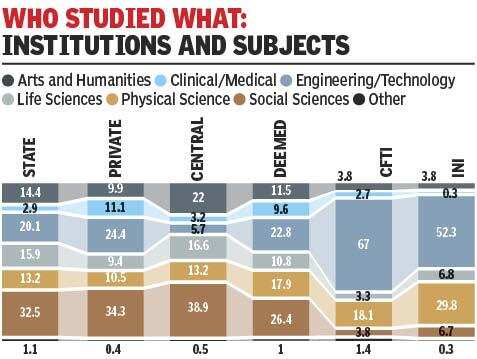
The Prime Minister’s Research Fellows scheme, which now has over 3,600 scholars, has an outlay of Rs 1,650 crore, according to govt releases.Inflibnet data also points to institution-specific research output. State and private universities had two prominent categories of social sciences (~30%) and engineering and technology (~20%) accounting for half the research. At central universities, social sciences (~39%) were followed by arts and humanities (~22%). For the Institutes of National Importance, engineering and technology was the biggest output category at 52%, as it was for centrally funded technical institutes at 67%.Engineering at the topAn analysis of thesis categories shows engineering subjects at the top, with 13.6% (5,855) of the total theses submitted in 2025, followed by social sciences (general) at 13% (5,566).

Top theses fields in 2025
Together, these two categories account for one-fourth of the total theses submitted, according to Inflibnet data. Other top categories comprise economics and business (12%), computer science (9.1%), and language and literature (8.7%).Among the sub-categories, electrical engineering and electronics have the most theses submitted at 2,004, followed by 1,556 for computer science, 1,304 for mechanical engineering, and 857 for civil engineering.In other categories with over 1,000 theses, accounting for over 2% of total theses submitted, 2,280 have come from management, 1,886 from literature, 1,779 from mathematics, 1,334 from language and linguistics, 1,247 from education and education research, 1,049 from applied chemistry, and 1,038 from pharmacology and pharmacy. The five largest categories account for 57% of the total research output, according to analysis.MSU plans PhD admissions thrice a yearMaharaja Sayajirao University of Baroda (MSU) is planning to conduct PhD entrance examinations three times a year, moving beyond its recently introduced biannual admission system, following a sharp rise in doctoral enrolment. Compared to 215 admissions in the academic year 2024-25, the current cycle of 2025-26 has seen a 43% increase to 308.Prof Bhalchandra Bhanage, vice chancellor of MSU, said that several reforms such as structured coursework, regulated supervisor-scholar ratio, research advisory committees, and continuous monitoring have been introduced to ensure a dynamic research ecosystem. MSU registrar Prof K M Chudasama said the university has also introduced supernumerary seats for foreign students.The ‘Doctoral Rush’Compared to 14 PhD degrees awarded in 2016 at IIT Gandhinagar (IIT-Gn), the doctoral cohort in 2026 convocation included 107, a rise of over seven times. In fact, it was the second consecutive year the premier tech institute awarded 100-plus PhD degrees.Senior academicians said that doctoral research is generally taken up for career prospects in academia.“The new rules for the assistant professorship in UGC-approved institutions require a doctoral degree or research track,” said a Gandhinagar-based senior scientist. “Moreover, published research also adds value to those seeking jobs in centrally funded institutions ranging from PRL to Isro.”

What they said
But some rue the empty pursuit of the “Dr” tag. A retired vice chancellor said, “Often, it is not about the research. It is about completing the requirements of a course by hook or by crook and getting the doctoral degree.” He added, “We have individuals with degrees who then have no research output.”One must look into the kind of topics chosen, said the senior academician. “In recent years, several checks and balances have been introduced to improve quality of research, but there is a long way to go,” he said.(With inputs from Prashant Rupera in Vadodara)