








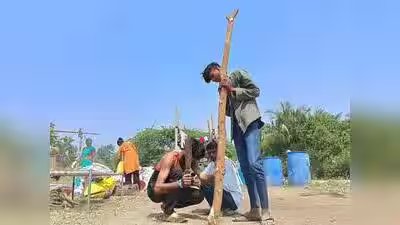
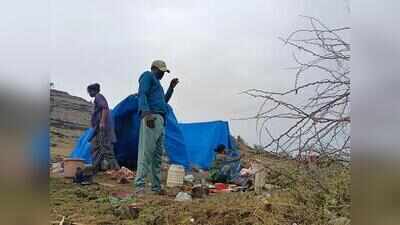
Pune: “We leave our villages and bring our children here hoping to earn enough to survive the year. But here, we live in places where even basic facilities are missing,” said Deepak Giridhar Bhill, a sugar cane worker, who is staying in a temporary hut set up at the foothills of a hillock in Khed tehsil, about 35 km from Pune.“Our children cannot go to school, we struggle to get food, and now we are being told that there may not be enough work for the entire season. If there is no sugar cane to cut, how will we feed our families?” he added.This is the predicament of thousands of migrant sugar cane-cutting workers who travel with their families to Maharashtra’s sugar belt every year. For them, the annual migration is not merely a search for employment but a struggle to keep their households afloat.This year’s season has brought another layer of uncertainty, with a drought-induced reduction in sugar cane availability threatening to shorten the period of employment. “The workers are confronting a double blow. While several families continue to live in extremely poor conditions at temporary settlements, the prospect of a shorter crushing season means fewer days of work and a further squeeze on already fragile household incomes,” said Sanjay Jadhav, a contractor who has brought workers from Beed district to Sangli district this season.This comes despite the sugar commissionerate having issued directives to sugar factories to ensure basic amenities for migrant sugar cane workers. State sugar commissioner Sanjay Kolte did not respond to calls and text messages to seek comments on the matter.The ground situation, however, indicates a considerable gap between official instructions and their implementation, with workers continuing to face inadequate housing, poor access to essential services, food insecurity and disruption to their children’s education. “This is not at all a new thing for us,” said Dashrath Jamble, another sugar cane worker. “We have been going through this condition for years and there has not been any improvement in it sadly. Neither authorities concerned nor sugar factories bother about our situation. They have simply ignored it,” he added.For families migrating from drought-prone parts of Maharashtra and other regions in search of seasonal work, the temporary settlements become their homes for several months. Yet, these settlements are frequently located in isolated areas, away from villages and the basic public infrastructure that local residents can access.The lack of basic amenities makes everyday life particularly difficult for women, children and elderly family members who accompany the workers. The isolation of these settlements is another major concern. “Being located away from residential areas and public facilities makes it difficult for families to access schools, ration shops, healthcare services and other essential infrastructure. Even where services exist in nearby villages, distance and lack of convenient transport can make them practically inaccessible,” said another contractor Shahaji Kale from Jalgaon.Children’s education takes a back seatOne of the most serious consequences of seasonal migration is the disruption of children’s education. Families generally migrate together because leaving children behind is often not a practical option for workers who have to remain at their workplaces for the duration of the crushing season.As a result, children accompany their parents to temporary settlements and cane fields. However, their education frequently suffers during this period. For them, the migration means missing several months of schooling every year, creating gaps in their learning and affecting their academic progress. “I can’t afford the hostel fees. Therefore, we had to stop my daughter’s education. Now, she is grown up and works with us in the field. Had she continued her education, she would have pursued education,” said Bhill.The problem is particularly acute for children who repeatedly move between their native villages and temporary settlements. Even when they return home after the crushing season, catching up with the curriculum can be difficult.The absence of an effective mechanism to ensure continuity in education for children of migrant workers further compounds the problem. “Unless arrangements are made to provide access to nearby schools, seasonal hostels or other appropriate educational facilities, these children risk remaining trapped in a cycle in which their parents’ livelihood requirements repeatedly interrupt their schooling,” said Jayaji Suryawanshi, an activist from Chhatrapati Sambhajinagar.For many families, education becomes a secondary concern when their immediate priority is earning enough to meet daily expenses. However, the long-term implications are significant, as children who repeatedly miss school have eventually been pushed out of the formal education system, he added.Ration access remains another hurdleFood security is another major challenge confronting migrant sugar cane workers. Although many families are eligible for subsidised foodgrain under the public distribution system, their migration from their native villages often creates practical difficulties in accessing ration supplies.The lack of convenient access to ration shops near temporary settlements adds to their difficulties. Families that have migrated for work are often left to make arrangements for food despite having limited and uncertain earnings.Portability of ration entitlements under the ‘One Nation One Ration Card’ system is intended to enable beneficiaries to access foodgrain outside their home locations. “But the actual benefit depends on the biometric authentication. They can do it in any village at the ration shop. Once their biometric is done, we can raise grains demand with the respective tehsil administration and get their additional quota here. Through this, such workers can get rations,” said Nilesh Nikam, who runs a ration shop in Khed tehsil.This exposes a larger weakness in the system of welfare delivery for seasonal migrant workers. “While their labour is essential to the sugar industry, their access to basic public services remains dependent on where they happen to be working during the season. This needs to be sorted out by the respective sugar cane factory management. If they help these workers, they would be able to get the basic services at their places only,” said activist Satyavan Navale from Khed tehsil.Drought threatens to shorten the employment seasonEven as workers struggle with these living conditions, the drought situation across several sugar cane-growing regions has created another serious concern.Reduced rainfall and inadequate water availability have affected sugar cane cultivation, resulting in lower availability of cane for crushing. This is expected to have an impact on the overall sugar cane-cutting season, with factories potentially having less cane to process than in a normal year, said an official of the sugar commissionerate.For sugar cane-cutting workers, the duration of the crushing season is directly linked to their livelihood. Their earnings depend on the quantity of cane they harvest and transport, as well as the number of days they remain engaged in the work.“A shorter season could therefore translate into fewer working days and lower overall earnings. Families that migrate after making arrangements for travel, food and temporary accommodation may find it difficult to recover these costs if employment ends earlier than expected,” said sugar cane activist Manikrao Patil from Sangli.The impact could be particularly severe for workers who depend almost entirely on seasonal sugar cane-cutting work to support their families through the year.“The uncertainty also affects the traditional migration cycle. Workers generally plan their household expenditure, repayment of loans and agricultural activities in their native villages around the expected duration and earnings from the sugar cane season. A reduction in the number of working days can upset these arrangements,” said Uddhav Ghodke, an activist from Beed district from where significant villagers work as sugar cane cutters in Western Maharashtra.