











‘Wealth, Hospital Type Drive C-Section Odds In India’Hyderabad: A new South Asia-wide study has flagged a growing inequality in maternal healthcare in India, revealing that a woman’s chances of undergoing a caesarean section are increasingly shaped by her income, education, location and choice of hospital rather than medical need alone.The study, ‘Trends and Determinants of Cesarean Section Deliveries in South Asia: A Comparative Study of Medicalisation and Socioeconomic Disparities’, published in the latest issue of ‘Health and Population: Perspectives and Issues’, found that while India’s overall C-section rate stands at 23.5%, access to and use of the procedure vary sharply across social and economic groups.
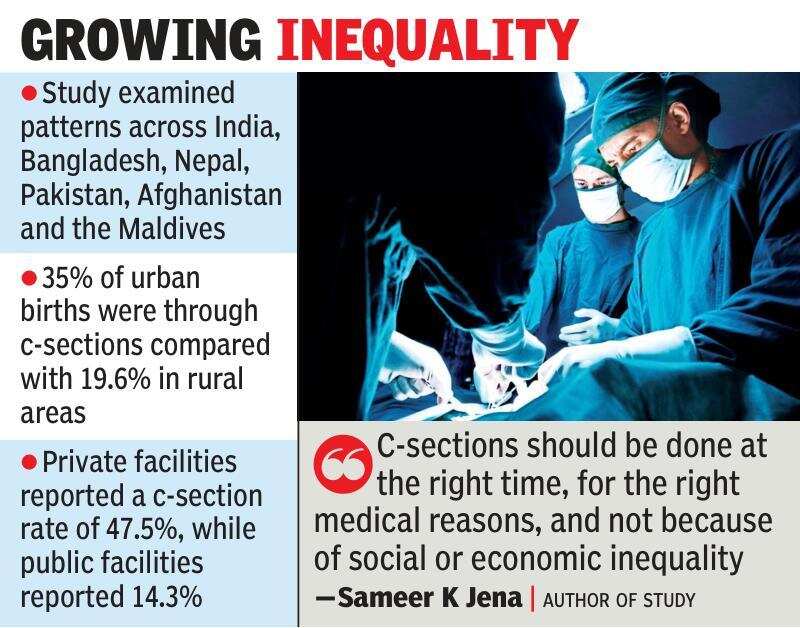
Conducted by Sameer K Jena and Liza K Gouda of Fakir Mohan University, Odisha; Moatula Ao of University of Hyderabad; and Jitendra Gouda of the Directorate of Census Operations, New Delhi, the study examined patterns across India, Bangladesh, Nepal, Pakistan, Afghanistan and the Maldives.Among the countries studied, Bangladesh recorded the highest prevalence of C-sections at 44.5%, followed by the Maldives at 42.6%. While India’s overall rate was lower, researchers found significant disparities hidden beneath the national average.Urban women were far more likely to undergo a caesarean delivery than their rural counterparts. Around 35% of urban births were through C-sections compared with 19.6% in rural areas.The gap was even more pronounced between private and public healthcare facilities. “Private facilities reported a C-section rate of 47.5%, while public facilities reported 14.3%,” said Sameer.Economic status emerged as another major determinant. The study found that 41.9% of women from the wealthiest households underwent a C-section, compared with only 8.4% among women from the poorest households.“This shows how economic status, education and access to healthcare strongly shape childbirth experiences,” Sameer added.The researchers said the findings point to a troubling trend in maternal healthcare. While caesarean deliveries can be lifesaving for mothers and newborns when medically necessary, unnecessary surgical interventions can expose women to avoidable health risks.“These include infections, excessive bleeding, longer recovery time and complications in future pregnancies. For newborns, early or unnecessary C-sections may increase the risk of breathing problems,” Sameer added.At the same time, the study cautioned that many disadvantaged women, particularly in rural areas, may not receive timely access to emergency caesarean services when complications arise during childbirth, potentially worsening maternal and neonatal outcomes.The researchers stressed that the concern is not the procedure itself but whether it is being used appropriately. They called for stronger monitoring and accountability in private hospitals, improved emergency obstetric care in public health institutions and greater reliance on evidence-based clinical decision-making.The study also recommended expanding access to emergency caesarean services in rural areas, improving counselling for pregnant women and their families, and regularly monitoring C-section rates across healthcare facilities.Emphasising the broader message of the research, Sameer said every woman should have access to safe and appropriate childbirth care irrespective of income, education or place of residence. “C-sections should be done at the right time, for the right medical reasons, and not because of social or economic inequality,” he added.