








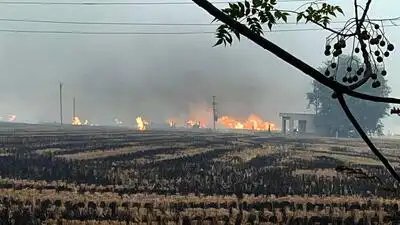
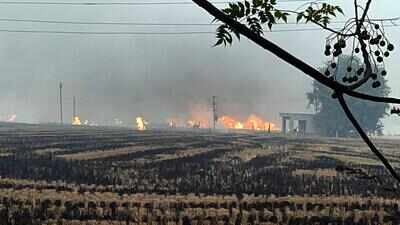
Bathinda: With farm-fire incidents rising in Punjab, the Commission for Air Quality Management (CAQM) has intensified its focus on the state. After a high-level team led by a member (technical) spent several days reviewing the situation, particularly in Tarn Taran and Amritsar, and urging field officials to step up efforts to curb stubble burning, CAQM chairperson Rajesh Verma remained in Punjab for a third consecutive day on Saturday.Verma chaired a meeting of officials from Punjab and Haryana in Chandigarh on Oct 22, visited Ropar, Hoshiarpur and Amritsar on Oct 23, and on October 24 reviewed paddy stubble management measures in Amritsar and Tarn Taran, the two hotspots of stubble burning in the state.Tarn Taran and Amritsar together accounted for more than 71% of Punjab’s stubble-burning incidents till Oct 23. Of the 542 cases reported across the state, 399 were recorded in these two districts, including 257 in Tarn Taran and 142 in Amritsar.Verma held review meetings with deputy commissioners and other officials concerned of both districts to assess the measures being taken for comprehensive management of paddy stubble and to further contain and eliminate burning incidents.The team reviewed in-situ and ex-situ stubble-management initiatives, as well as the available infrastructure and facilities in the two districts. Expressing concern over the rise in fire incidents, the commission directed officials to make all-out efforts to arrest the trend.CAQM emphasised maximising the use of paddy stubble as fuel in thermal power plants, brick kilns and industries where such use is feasible. It directed that sector-wise nodal officers be assigned responsibility for ensuring actual utilisation of paddy residue and for regularly monitoring and reporting compliance.The commission also asked officials to undertake regular visits to villages and engage directly with farmers. Rather than merely informing them about available stubble-management facilities, officers were directed to ensure timely access to machinery and other resources. District administrations were told to strengthen coordination among farmers, Custom Hiring Centres (CHCs), machinery providers and other stakeholders to ensure residue-management solutions are available without delay.During its visit to Tarn Taran, the commission warned that any laxity or failure in implementing effective measures would invite strict action and accountability. As the district continues to report the highest number of stubble-burning incidents, the deputy commissioner was directed to accord top priority to the issue and intensify field-level interventions.The high-level team also inspected facilities in Amritsar and visited an industrial boiler at an industrial complex to assess the utilisation of processed paddy residue and explore the potential for scaling up such end-use models.The commission reiterated that paddy stubble management should be approached as a comprehensive residue-management and resource-utilisation exercise, with a strong focus on facilitating farmers and providing viable alternatives to crop-residue burning.