







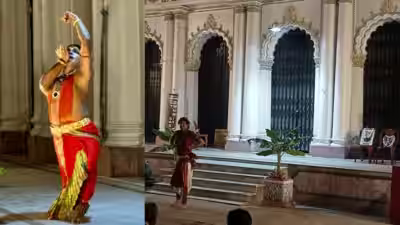
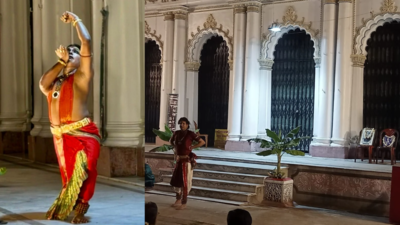
KOLKATA: A two-day cultural festival, Sovabazar Seni Sangeet Sabha 1970, which got underway on Saturday, is attempting to revive Pathuriaghata as a living cultural centre, drawing attention to one of North Kolkata’s oldest neighbourhoods and one of Bengal’s great centres of refinement, reform and the arts.Organised to mark the 160th birth anniversary of Sister Nivedita, the festival will present Dhrupadi Nrityotsav at Sovabazar Rajbari and Gopinath Bari. It will also pay homage to pioneering impresario Haren Ghosh, auteur Satyajit Ray and Bharatanatyam exponent T Balasaraswati.Pathuriaghata was once part of Sutanuti, the riverine settlement from which Calcutta grew. From the mid-eighteenth century, when families displaced by the construction of the new Fort William moved northwards, the area became home to some of Bengal’s most influential households.The Tagores of Pathuriaghata, beginning with Jairam Tagore and carried forward by Darpanarayan Tagore, helped shape the city’s mercantile, intellectual and artistic life. Tagore Castle, with its auditorium, became a landmark of nineteenth-century theatre. Jatindra Mohan Tagore and Shourendra Mohan Tagore patronised Banga Natyalaya, where Kalidasa’s Mālavikāgnimitram was staged in Sanskrit in 1859.The neighbourhood also nurtured print culture and public discourse. Jogendra Mohan Tagore supported Ishwar Chandra Gupta in publishing Sambad Prabhakar, which grew from a weekly in 1831 into a daily newspaper that influenced modern Bengali society.Around Pathuriaghata stood the mansions of the Mullicks and the Ghoshes, families remembered for their philanthropy, music, scholarship and civic patronage. Jadulal Mullick’s house, with its cast-iron artistry, statuary and stories of flamboyant carriages, remains part of Kolkata’s urban folklore. The Ghosh family mansion, rich in chandeliers, sculptures and paintings, recalls an era when domestic interiors doubled as salons of taste and culture.The festival began on Saturday with the golden jubilee screening of Bala, Satyajit Ray’s documentary on Balasaraswati, followed by a Bharatanatyam recital by Guru Aniruddha Knight, the legendary dancer’s grandson, and his troupe. Guru Knight will be honoured with the title of ‘Pandit’ for his contribution to the classical tradition.On Sunday, the festival will present a composite celebration of nine Dhrupadi dance forms, conducted by Dr Mahua Mukherjee and Pt Amitabho Mukherjee of Gaudiya Nritya Bharati. The performance will feature Manipuri, Sattriya, Gaudiya, Odissi, Kathak, Kuchipudi, Bharatanatyam, Mohiniyattam and Kathakali.The Felicitation 2026 Heritage Upkeep Honour will recognise living custodians of cultural continuity: Mrs Ratnaboli Ghosh, reviver of Alpona art; Mitra Cafe, guardian of Kolkata’s culinary cabin culture; K.C. Das, bearer of the city’s sweet-making heritage; Biswajit Roy Chowdhury, wildlife and tiger preservation activist; and Tulsi Charan Paul & Sons, a 150-year-old institution known for its earthenware.