








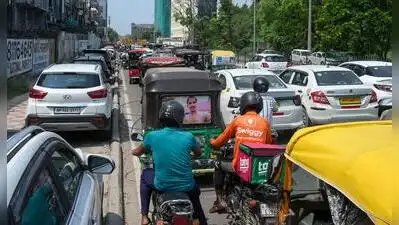
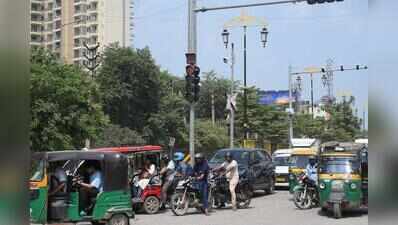
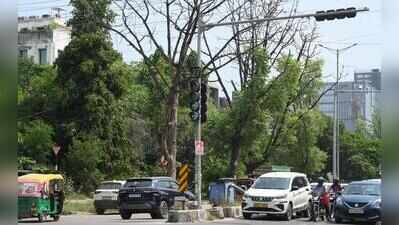
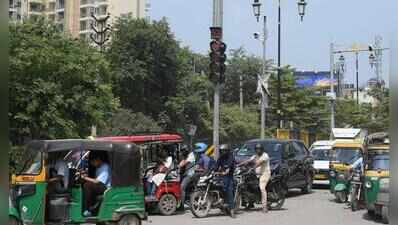
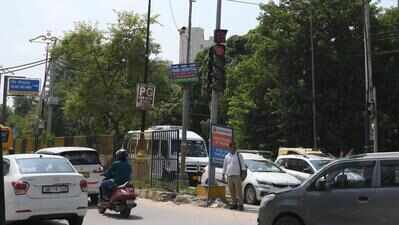
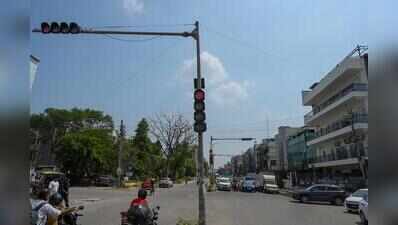
Gurgaon: The city has equipped 141 junctions with smart traffic signals, but the technology is facing a basic problem — there is simply too much traffic for the system to find a gap to exploit.A ground check at some of the city’s busy intersections found that commuters continue to face long waits and queues, with several signals operating on preset timings during the day. For office-goers heading towards Udyog Vihar, crossing Shankar Chowk Road is not just about negotiating heavy traffic but can also mean waiting through multiple signal cycles before getting through the junction.Under Phase 1, GMDA installed adaptive traffic control systems (ATCS) at 109 junctions, while another 32 junctions were covered under Phase 2. Together, both the phases cost more than Rs 21 crore to the metropolitan authority. The smart traffic management system was introduced to make signal timings responsive to traffic conditions. The signals use ATCS and vehicle-detector cameras to monitor traffic movement and regulate the duration of red and green phases. For commuters, the sophistication of the equipment matters little if they still have to sit through multiple cycles at a junction.According to GMDA officials, all 141 smart signals are technically capable of operating in adaptive mode. But that does not mean they operate adaptively throughout the day. At Shankar Chowk Road, a key junction connecting NH8 with Old Delhi-Gurgaon Road and catering to traffic heading towards Udyog Vihar phases 1, 2, 3 and 5, a queue of around 200 metres built up on the NH8 to Hanuman Chowk side during the ground check. The signal remained red for about 84 seconds and turned green for only 34 seconds. Vehicles could not clear the junction in one cycle and commuters had to wait through as many as four cycles to cross.The same 34-second green and 84-second red cycle was observed for traffic moving from Hanuman Chowk towards NH8, despite the fact that the traffic flow from NH8 towards Hanuman Chowk was visibly heavier. The junction has been under increasing pressure since the cut towards Udyog Vihar-3 road was closed and the stretch made one-way. Vehicles heading towards Udyog Vihar phases 1, 2 and 3 now converge at the junction, with many having to take a right turn or U-turn, adding to the traffic load.The situation was not limited to Shankar Chowk Road. On Old Delhi-Gurgaon Road, the traffic signal at Dundahera was found non-functional, while at Sector 17-18 junction, the signal was operating on its default timing. An official explained that adaptive control works best when the system detects a gap in traffic on one approach. It can then adjust the signal cycle and provide green time to another approach where vehicles are waiting. “When there is a gap of a few seconds on one side, the system can detect that no vehicle is coming and accordingly give green to another side where vehicles are waiting. That is how adaptive mode works,” the official said. The problem, according to officials, is that such gaps are difficult to find at many busy city junctions during the day.“In the city, there are situations where vehicles are continuously coming from all four sides. There is hardly any gap where no vehicle is coming. In such a situation, adaptive mode has very little scope to change the cycle,” the official said. As a result, preset timings are used during heavy-traffic periods, based on inputs from the traffic police.“During the day, we keep the default timings based on the inputs from the traffic police. When the traffic reduces in the night, the signals can operate in adaptive mode and adjust according to the movement of vehicles. We are using a combination of manual intervention by preset timing and ATCS, as per the directions of the traffic police,” the official said.GMDA officials said adaptive mode operates after 9 pm, when traffic begins to thin out. This means the system’s most dynamic feature is being used when traffic demand is lower, while during the busiest part of the day, commuters at several junctions continue to experience predetermined signal cycles. However, the preset timings are not permanent. Traffic police can assess traffic movement and vehicle counts and change the signal timings remotely from the control room, the official said. “The timings can be changed from the control room setup at traffic tower. If the traffic count shows that the timing needs to be changed, the police team can make the change remotely,” the official said.When asked about signal breakdowns, GMDA officials said that the system is monitored through the traffic tower monitored by cops, while maintenance teams are deployed to respond to signal failures and technical issues. “Two maintenance personnel are stationed for coordination and also ground teams regularly patrol the field. If a signal goes down, the traffic control room receives information from personnel at the junction and maintenance team is sent to the location,” the official said.“The matter will be examined by the concerned technical team, which will assess the situation,” a senior traffic cop said.Rajat Srivastava, who regularly uses SPR-Tulip Chowk junction, said peak-hour traffic often forces motorists to wait through multiple signal cycles. “During peak hours, it can take at least 10-15 minutes to cross the signal. The traffic becomes so heavy that I have had to call the traffic helpline several times to get the congestion cleared,” Srivastava said, adding that traffic police are often deployed to manually regulate the junction when the congestion becomes severe.“They switch off the signal and manage the traffic manually, giving more time to the direction where the flow is heavier and holding back traffic from the other side. If the signal is supposed to adjust its timing according to traffic, but it is not happening here. If traffic police still have to manually manage the junction during peak hours, then what is the purpose of having a smart signal and spending so much on creating infrastructure?” he asked.Vivek Prakash, a resident of Sector 86, said, “Dadi Sati Chowk is one of the badly managed junctions. During peak hours, it can take three to four cycles to cross the junction. I have never seen signal automatically adjust its timing according to the traffic flow; rather, it is fixed. So even when traffic builds up on one side, the signal does not appear to give additional green time to that direction.”