









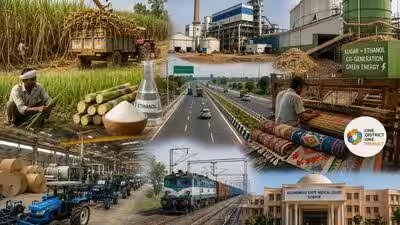
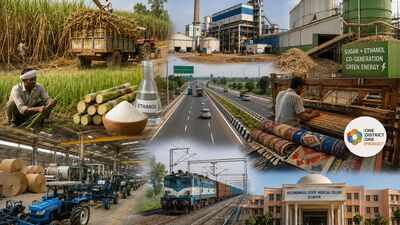
Sitapur district in Uttar Pradesh has witnessed a gradual but significant transformation in its economic profile during the last nine years. Traditionally known for its agriculture, sugarcane cultivation, handloom products and rural economy, Sitapur is increasingly emerging as a more diversified agro-industrial district.The transformation has been supported by the broader economic and infrastructure push of the Uttar Pradesh government since 2017, alongside investments in roads, connectivity, industrial modernization, agro-processing, renewable energy, healthcare and traditional industries.At the heart of Sitapur’s economy remains agriculture. The district has extensive fertile land and a large population dependent directly or indirectly on farming. Wheat, paddy and sugarcane continue to dominate agricultural activity, but the character of the rural economy has been changing. The emphasis has increasingly moved from simply producing agricultural commodities to creating greater value through processing, storage, industrial use and market linkages. Commercial horticulture, dairy activities and crops such as mentha have also contributed to diversification of rural incomes.This transition is particularly visible in Sitapur’s sugar industry. The district is one of Uttar Pradesh’s important sugar-producing regions, and its sugar mills have increasingly evolved into integrated agro-industrial complexes. Major establishments associated with the district include Hargaon Sugar Mill of Oudh Sugar Mills and Dalmia Sugar units at Ramgarh and Jawaharpur, along with the Biswan sugar factory. Over the past several years, modernization and capacity enhancement in the sugar sector have strengthened the district’s industrial base while creating downstream economic activity for farmers, transporters, workers and ancillary businesses.The most important change in the sugar economy has been the growing integration of sugar production with ethanol and co-generation. As India has pushed towards higher ethanol blending in petrol, sugar mills have increasingly diversified into ethanol and industrial alcohol production. This has created an additional revenue stream for sugar companies while giving greater value to sugarcane. Bagasse, a by-product of sugar production, is also being used for co-generation of electricity. Thus, the traditional sugar mill is gradually becoming part of a broader bioenergy ecosystem, linking agriculture, manufacturing, fuel production and renewable power. For Sitapur, this has the potential to make the sugar economy more resilient while contributing to the state’s clean-energy objectives.The district’s industrial transformation, however, extends beyond sugar. Sitapur has a long tradition of handicrafts and handloom production, particularly its famous durries and flat-woven carpets. The inclusion of Sitapur’s durrie industry under Uttar Pradesh’s One District One Product (ODOP) programme has provided an institutional framework for strengthening this traditional sector. The ODOP approach has helped focus attention on artisan training, product quality, branding, finance, market access and promotion. Clusters around Khairabad, Biswan and Sitapur have consequently gained greater opportunities to connect traditional craftsmanship with contemporary domestic and international markets.The significance of ODOP goes beyond the direct income generated by artisans. By encouraging local production, design development, branding and marketing, the initiative can create a wider ecosystem involving raw-material suppliers, traders, transporters, packaging units and exporters. For a district like Sitapur, where a substantial section of the population has historically depended on agriculture and informal activities, strengthening traditional manufacturing provides an important avenue for non-farm employment.Alongside traditional industries, newer manufacturing activities have been developing in and around Sitapur. Industrial pockets along the Sitapur-Lucknow corridor have supported activities such as paper and kraft-paper manufacturing, plywood and plyboard production and agricultural machinery-related enterprises. These sectors are particularly relevant because they create linkages with both agriculture and construction. Agricultural machinery supports farm productivity, paper products benefit from commercial and industrial demand, while plywood and related products are connected with housing, infrastructure and urban expansion.Connectivity has been one of the most important foundations of this economic transition. Sitapur’s location between Lucknow and northern Uttar Pradesh gives it considerable logistical advantages. The modernization and widening of the Lucknow-Sitapur-Bareilly corridor has improved road connectivity and reduced travel time between the district and the state capital. Better highways have strengthened the movement of agricultural produce, industrial goods and people while creating opportunities for warehousing, transport and logistics-related businesses.Improved connectivity has also strengthened Sitapur’s potential to function as an economic extension of the Lucknow region. As Lucknow expands as a major administrative, commercial, educational and service centre, neighbouring districts with good road connectivity can benefit through industrial decentralisation, logistics and labour-market linkages. Sitapur is well placed to benefit from this process because of its relatively large land base and established agricultural and industrial ecosystem.Rail connectivity has complemented road infrastructure. Improvements and gauge-conversion projects on important routes have enhanced passenger and freight movement, helping facilitate the transportation of commodities such as sugar, foodgrains and manufactured products. Better multimodal connectivity is particularly important for agro-industries, where transportation costs and timely movement of commodities directly influence competitiveness.The district’s service economy has also expanded alongside infrastructure and industrial development. The establishment and operationalisation of the Autonomous State Medical College, Sitapur, represents an important addition to the district’s social and economic infrastructure. Besides improving access to medical education and healthcare, such institutions generate employment and stimulate demand for housing, transport, retail, hospitality and other services. This illustrates the broader shift in Sitapur’s economy, where agriculture and industry are increasingly being complemented by education, healthcare, trade and other service activities.The changing employment structure reflects this transformation. Agriculture continues to be the largest economic base, but employment opportunities are increasingly emerging in processing, manufacturing, transport, retail, healthcare, construction and other services. This diversification is important because a modern district economy cannot depend exclusively on primary production. The objective is increasingly to create value chains in which farmers, manufacturers, artisans, traders and service providers participate in a connected economic system.Sitapur’s transformation should therefore be understood not as a shift away from agriculture, but as the industrialisation and diversification of an agriculture-based economy. Sugarcane is being connected with sugar, ethanol and power; agricultural production is generating demand for processing, machinery and logistics; traditional durrie-making is being linked with ODOP branding and markets; and improved roads and railways are connecting local producers with larger regional markets.There are still challenges, including the need for greater private investment, modern storage and cold-chain infrastructure, higher productivity, skill development, better branding of local products and stronger export linkages. But the direction of change is increasingly clear. Over the last nine years, Sitapur has moved beyond the image of a predominantly agrarian district and begun developing the foundations of a diversified agro-industrial economy. With its agricultural strength, sugar and ethanol ecosystem, ODOP-based handicrafts, emerging manufacturing, improved connectivity and expanding service infrastructure, Sitapur is positioning itself as an important economic centre of central Uttar Pradesh.