









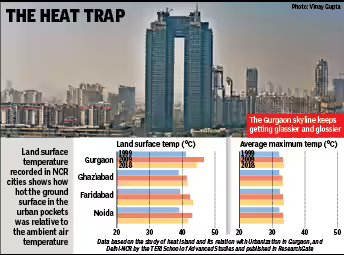
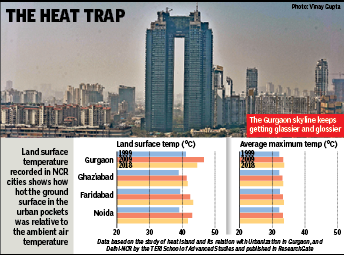
Heat bubble
How glass heats a cityGlass buildings heat urban environments through two simultaneous mechanisms. On the outside, reflective glass surfaces bounce and amplify sunlight, effectively doubling solar intensity at street level. Inside, solar heat is trapped greenhouse-style, forcing air-conditioning systems to work at full capacity. Air conditioning is, at its core, a heat exchange process: the hotter a building’s interior, the more heat it expels into the ambient air outside. The city absorbs what the building discards.India’s climate makes this a particularly damaging equation. Annual average temperatures are already high, and glass facades — designed for cooler, cloudier European climates — function as greenhouse chambers here, trapping heat rather than moderating it.Proponents, however, argue that floor-to-ceiling glass maximises natural daylight and reduces the need for artificial lighting. Experts counter that the energy saved on lighting is easily outstripped by the energy consumed in cooling the resulting heat trap.A medical emergency hiding in plain sightThe consequences at street level are not abstract. The human body begins to struggle at a wet-bulb temperature of 37 degrees Celsius — a measure that factors in both heat and humidity — and sustained exposure beyond 15 minutes can cause heat stroke and, in vulnerable individuals, death. Under urban heat island conditions, such temperatures are increasingly common in Indian cities.At Atal Bihari Vajpayee Institute of Medical Sciences, attached to Dr Ram Manohar Lohia Hospital in Delhi, internal medicine specialists report that heat stroke carries a grim survival rate. Only 64% of patients admitted with the condition last year survived, despite full medical support. “Heat-related illness spans a wide clinical range, from prickly heat and cramps at the milder end to heat oedema, hyperventilation and sudden drops in sodium levels in severe cases. Outdoor workers, who have little access to shade in glass-and-concrete commercial districts, are disproportionately at risk.” he said.Regulation absent and overdueIn 2024, the Central Pollution Control Board surveyed all 36 states and union territories to determine whether any had regulations or guidelines governing glass facades in buildings. Twenty-seven responded. Not one had any rules in place. Nine states, including Bihar, Tamil Nadu and West Bengal, did not respond at all. Delhi, Haryana, Uttar Pradesh and Rajasthan, the core NCR states, are among those with no regulation.However, a legal framework to act exists. Section 15 of the Energy Conservation Act, 2001, empowers state govts to amend building energy codes to reflect local and regional climatic conditions. None has used it for this purpose.The National Green Tribunal took cognisance of the issue in Jan 2025, when its southern zonal bench directed the ministry of environment, forest and climate change to constitute an expert committee and develop national guidelines on glass facade usage within three months. The order also required regulatory bodies to factor in energy conservation norms before granting environmental clearances to glass-heavy projects.More than a year on, the compliance report has not been filed. The committee has not been constituted. The hearings have been adjourned six times. Meanwhile, the buildings keep going up — and the cities keep heating.