







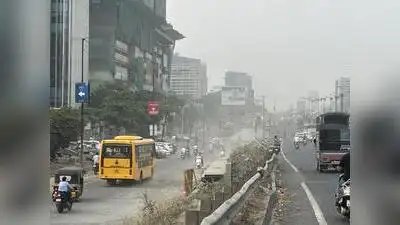
Pune: On Tuesday, while Pune region’s overall air quality remained in the “moderate” category, several monitoring stations in Pune and Pimpri-Chinchwad recorded pollution levels in the “poor” category, registering sharp spikes in concentrations of PM2.5, hazardous particles so small they travel deep into lungs and in some cases, even into the bloodstream.According to the AIRWISE forecast by IITM Pune, the city’s five-station average PM2.5 concentration was 79.2 micrograms per cubic metre (µg/m³) at 9am on Tuesday, exceeding the prescribed 24-hour national standard of 60 µg/m³. The average was still in the “moderate” category, but individual stations in Shivajinagar (98.6 µg/m³), Pashan (76.9 µg/m³), Lohegaon (74.9 µg/m³), Katraj (73.6 µg/m³) and Hadapsar (72.2 µg/m³) all read worryingly high pollution levels, well in the “poor category”.Pollution burden was higher in Pimpri-Chinchwad where the four-station average stood at 96.9 µg/m³. Bhosari recorded the highest 24-hour average at 114.2 µg/m³, followed by Bhumkar Chowk at 109.3 µg/m³ and Pimpri at 100.9 µg/m³. Nigdi recorded 63.1 µg/m³. All four locations recorded concentrations above the prescribed national 24-hour standard.Hourly observations revealed sharp spikes in PM2.5 concentrations during the night and early morning. Bhumkar Chowk recorded the highest hourly concentration of 232.7 µg/m³ at 8am on Tuesday, followed by Bhosari at 201.3 µg/m³ at the same time. Pimpri recorded 181.8 µg/m³ at 3am, while Shivajinagar touched 159.8 µg/m³ at 1am.Among monitoring locations in the wider Pune region, Bhosari, Pimpri and Bhumkar Chowk recorded the highest midnight-to-9am averages at 168.8, 156.8 and 139.6 µg/m³, respectively.An IITM scientist said the AIRWISE forecast indicated moderate air quality for Thursday and Friday, but warned individual locations could continue to experience higher pollution.“Air quality varies across monitoring stations. Low wind speeds and reduced atmospheric mixing during winter can cause pollutants to accumulate close to the ground. Localised burning and firecracker emissions could also add to the pollution load. But available observations do not establish the exact contribution of these individual sources,” he said.Residents have already begun experiencing health effects. Kavita Patil, a resident of NIBM road, said: “There is soot in the air, and people here are facing considerable problems. Security guards at a neighbouring society have been lighting bonfires at night to keep themselves warm. The fires continue till 4am, leaving the entire area polluted with smoke and a burning smell. We cannot open our windows. Some people I know are experiencing sinus problems.”Patil said the problem was reported to PMC. “Officials from the Garden Department told the guards to stop burning the fires. We told the society to give the guards blankets, instead of letting them burn trash. It has become a problem this winter, particularly after temperatures dropped,” she said.Radheshyam Kulkarni, a resident of Vimannagar, said: “It’s not just bonfires. Many are still bursting firecrackers here. Winter air seems suffocating rather than pleasant. People prone to breathing problems are unable to step out without masks.”