






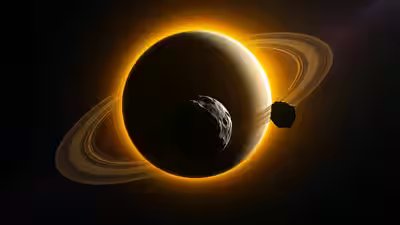
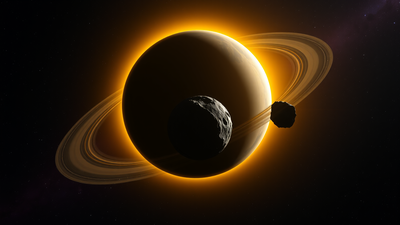
Since the first planet beyond our solar system was confirmed in the 1990s, astronomers have gone on to catalogue more than 6,000 exoplanets, yet not a single moon orbiting any of them has ever been confirmed. That long, frustrating gap in the search for exomoons may have just gotten stranger rather than simpler. While studying an unusual star system called CD-35 2722 using the Very Large Telescope in Chile, a team of astronomers has discovered an object that could be the first confirmed exomoon, though it may instead force scientists to rethink what the words moon and planet actually mean.
A strange three-body system 73 light years away
The star CD-35 2722 sits roughly 73 light years from Earth and carries about half the mass of the Sun. According to the peer-reviewed study titled A wide-orbit giant planet possibly bound to a young brown dwarf, published in the journal Nature, this star is orbited by a brown dwarf, an object sometimes called a failed star because it forms the same way stars do but never gathers enough mass to trigger hydrogen fusion in its core. Brown dwarfs typically carry between 13 and 80 times the mass of Jupiter, placing them in an awkward middle ground, heavier than the largest gas giant planets yet lighter than the smallest true stars.
A newly found object that orbits the brown dwarf itself
What makes this system especially unusual is the newly discovered object at its centre of attention, which orbits the brown dwarf rather than a star directly, unlike every moon in our own solar system, which orbits a planet that in turn orbits the sun. According to a statement released, team leader Kevin Hoy of the Universidad Diego Portales and the Millennium Nucleus of Young Exoplanets and their Moons in Chile explained that the system is difficult to define using solar system based terms like planet and moon, since the newly found object is clearly massive enough to qualify as a planet in its own right, yet it does not orbit a star directly, yet also orbits an object that itself orbits a star.
Why scientists are hesitant to call it a true exomoon
Despite the excitement around the find, the research team has stopped short of definitively labelling this object an exomoon. According to the same statement, team member Alice Zurlo of the Universidad Diego Portales explained that the object under study is a giant gaseous body orbiting a companion several times the mass of Jupiter, and that while the boundary between planets and the sun in our own solar system is straightforward, defining similar categories becomes far more complicated in a system where the lines between stars, planets and moons are already blurred.
A confirmed first even without a final label
Regardless of how it eventually gets classified, researchers say they can confidently describe this discovery as an exosatellite, a term broad enough to sidestep the unresolved question of whether it functions more like a moon or a planet. Hoy noted that being the third body in this particular system makes the team want to call it a moon, even though it bears little resemblance to the small, rocky moons found throughout our own solar system, marking it as a genuinely first-of-its-kind detection regardless of what label scientists eventually settle on for it.
Why finding exomoons has proven so difficult until now
The persistent absence of confirmed exomoons has remained something of a puzzle for astronomers, since planets throughout the solar system all host natural satellites of their own, making it seem statistically unlikely that none exist around any of the thousands of exoplanets discovered so far. Detecting an object as small and faint as a typical moon from many light years away, however, is technically far more difficult than spotting the planet it might orbit, which helps explain why this search has remained one of the more stubborn unsolved challenges in modern exoplanet science.
How future telescopes could help settle the question
Researchers are hopeful that the Extremely Large Telescope, currently under construction in Chile, will play a significant role in resolving cases like this one in the future. With considerably more sensitivity than existing instruments, the observatory is expected to improve the odds of detecting both genuine exomoons and unusual exosatellites like the object found around CD-35 2722, potentially helping astronomers build the kind of dataset needed to settle exactly where the boundary between moon, planet and something else entirely should be drawn.
A reminder that the universe rarely fits neatly into old categories
Whatever this object eventually turns out to be, its discovery adds to a running theme that has followed exoplanet research since its earliest days, that planetary systems throughout the galaxy frequently defy the categories built from studying our own solar system alone. As astronomers continue refining their tools and expanding their search, discoveries like the one at CD-35 2722 suggest that some of the universe’s most interesting finds may keep arriving in forms that existing scientific vocabulary is not yet fully equipped to describe.