







Nearly 400 fossils discovered in southern France are giving scientists a detailed view of marine life that lived close to the South Pole about 470 million years ago. The fossils belong to the newly described Cabrières Biota, an Early Ordovician fossil site in the Montagne Noire that preserves both hard-bodied animals and delicate soft tissues. The discovery is particularly important because most ancient fossil communities with soft-tissue preservation come from tropical or temperate regions, leaving polar ecosystems poorly understood. The Nature Ecology & Evolution study describes a remarkably varied community. Some specimens even preserve structures such as guts, body segments and soft tissues. Together, these fossils provide a rare glimpse of a polar marine ecosystem and suggest that high-latitude waters may have offered a refuge for diverse life during the unusually warm Early Ordovician world.
How these 470-million-year-old fossils discovered in southern France
The fossil-bearing sites are located within about 1 kilometre of the village of Cabrières in southern France. According to the study, the search for exceptionally preserved fossils in the Early Ordovician rocks of the Montagne Noire had been gaining momentum for years. The first potential soft tissues were identified in 2018, followed by further discoveries from the area known as the ‘écailles de Cabrières’. More than 400 fossils have now been collected and registered in the Monceret collection at the University of Lyon. The study explains that the specimens were examined using microscopes photography, while some were investigated with multispectral imaging. These techniques helped researchers distinguish features that could be difficult to see under ordinary light. The discovery transformed what had previously been known mainly as a site containing mineralised fossils. The Cabrières Biota instead revealed a much broader community, including organisms whose bodies were not fully mineralised.
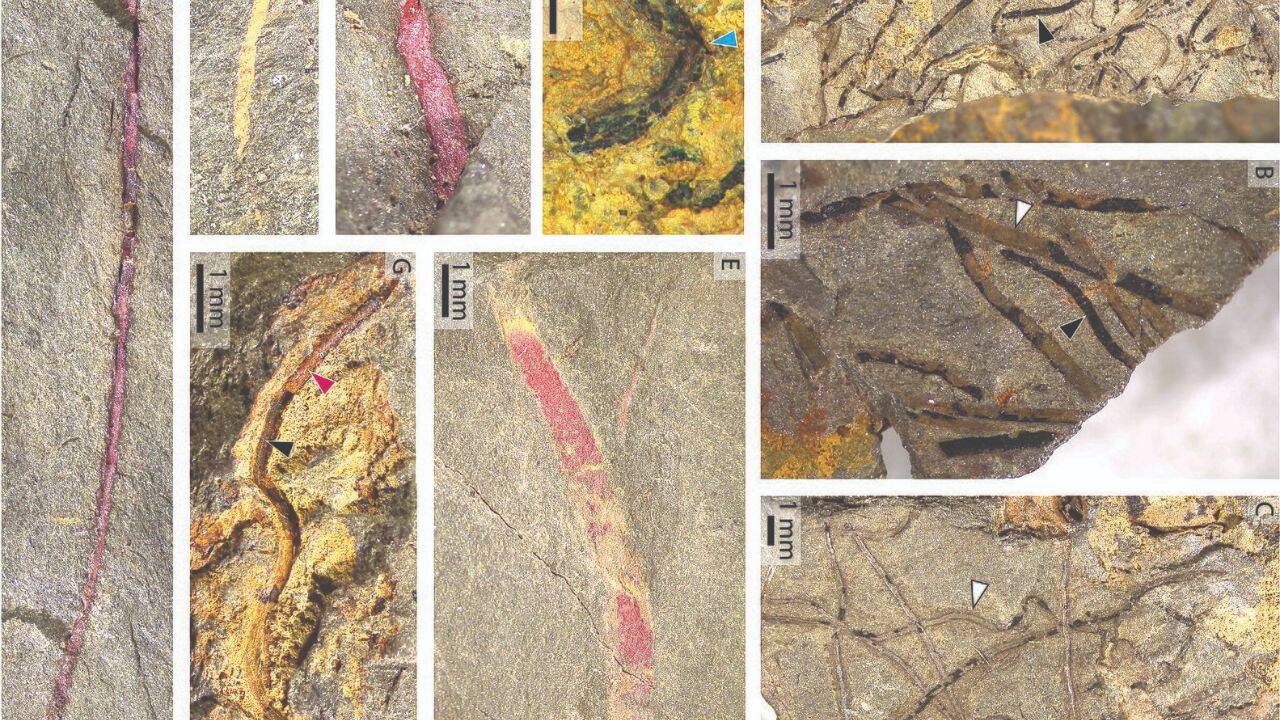
Algal filaments from the Cabrières Biota. Image Credit: Wikipedia
Nearly 400 fossils revealing ancient marine life near the South Pole
The fossils show that the ancient marine community was remarkably diverse. Trilobites made up about 12% of the identified fossils, while molluscs accounted for 14%, brachiopods 9%, hyoliths 7% and cnidarians 6%. Sponges and branching algae were particularly common, together representing about 26% of the identified fossils. The community also included bivalved arthropods, non-mineralised arthropod fragments, worms and possible hemichordates. Among the more unusual finds were fossils resembling armoured lobopodians(small, soft-bodied animals with protective plates). Their presence is significant because these organisms are strongly associated with Cambrian ecosystems, yet the Cabrières fossils show that they survived into the Ordovician. Echinoderms, meanwhile, were surprisingly scarce. Only three specimens were identified. The researchers suggest that their rarity may be linked partly to the ecological conditions of this particular polar environment and the high diversity of other organisms competing for space and resources.
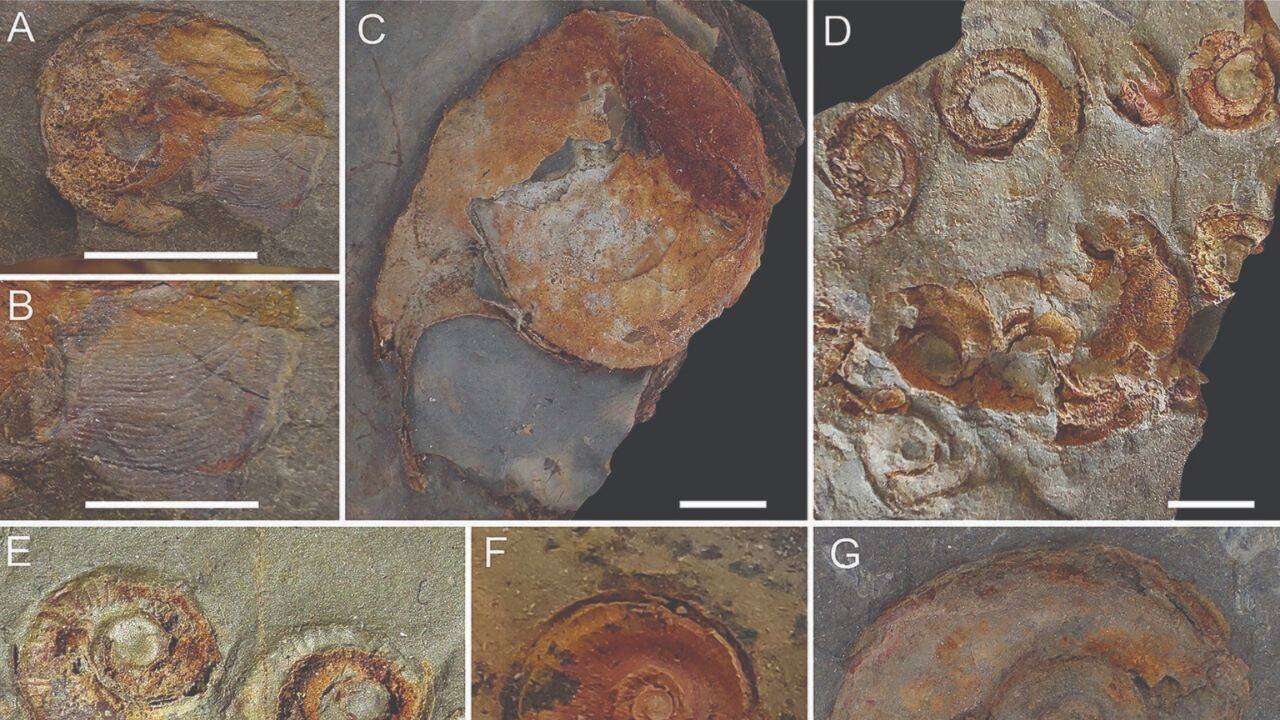
Cabrières Biota, Floian, Ordovician, France. A-C. Thoralispira laevis. D-G. Carcassonnella vizcainoi. Image Credit: Wikipedia
Why are soft tissues so important to this discovery
Ordovician fossils with preserved soft tissues are rare, making Cabrières especially valuable. Many fossils preserve features beyond hard shells or skeletons, including toughened outer coverings, cellular structures and other delicate anatomy. One hyolith specimen appears to preserve possible internal organs, probably part of its gut. Some worm-like fossils retain gut remains, while other specimens preserve detailed body ornamentation. Arthropod fossils show fine features such as closely spaced lines and ornamentation on segmented bodies. The sponges are particularly striking. Some reached more than 10 centimetres in size, and certain specimens preserve enough detail for researchers to distinguish their soft tissues from their mineralised skeletons. The study found that the fossils were commonly preserved through iron oxides and hydroxides, with some also retaining carbon-rich films. This unusual preservation effectively provides a snapshot of organisms that would normally have disappeared without leaving much behind.
What does the discovery reveal about the ancient South Pole
During the Early Ordovician, the area that is now southern France was not where it is today. The Montagne Noire lay in the Southern Hemisphere at high polar latitudes on the edge of the supercontinent Gondwana. The fossil-bearing rocks were formed in an open marine environment. That setting makes the Cabrières Biota particularly important. The researchers describe it as potentially one of the closest known fossil communities to the South Pole from this period. Most fossils preserving soft tissues come from lower latitudes, so this discovery fills a major gap in the record of ancient polar life.The study suggests that the polar setting may actually have helped the community thrive. Early Ordovician waters were extremely warm, meaning high-latitude regions could have been less extreme than lower-latitude environments. Organisms may have moved towards cooler southern waters from warmer areas, creating an unusual mixture of species. The researchers also found similarities between the Cabrières fossils and modern polar communities. Today’s polar ecosystems can be rich in algae and sponges, and the same groups dominate parts of the Cabrières assemblage. This resemblance suggests that some basic ecological patterns may have existed even when the planet’s climate was very different from today.
Could this fossil site change the story of early animal evolution
The Cabrières Biota does more than reveal what lived in one ancient sea. It also provides clues about how marine ecosystems changed between the Cambrian and Ordovician periods. The presence of armoured lobopodians shows that elements of the classic Cambrian animal world persisted into the Ordovician. At the same time, the site contains a mixture of organisms characteristic of both earlier and later fossil communities.The researchers argue that discoveries such as Cabrières help connect the Cambrian Explosion with the later Great Ordovician Biodiversification Event, when marine animal diversity increased dramatically. The unusual combination of organisms offers a glimpse of an ecosystem during an important stage in the history of animal life. The study says that the Cabrières Biota represents a distinctive Early Ordovician polar ecosystem, with its location, diversity, abundance of algae and sponges, and scarcity of some groups all supporting that interpretation. Further collecting will be needed to understand exactly how the fossils were preserved, but the more than 400 specimens already recovered have opened a window into life near the South Pole hundreds of millions of years ago.