









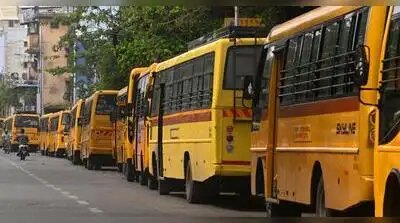
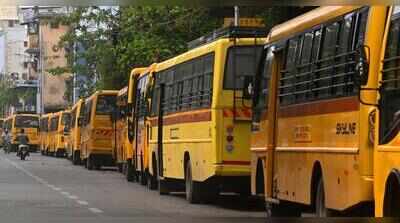
Mumbai: School bus operators on Sunday opposed the mandatory seat belts and panic buttons under Maharashtra’s newly notified School Bus Policy, citing practical challenges in implementation.At the same time, parents have voiced concerns about older buses remaining on the roads, with the new rule extending the permissible lifespan of school buses from 15 to 20 years, saying this could compromise bus and student safety. Mumbai, which is in BMC limits, however, has a rule of strictly phasing out school buses after eight years as per court orders. The 20-year rule applies to districts such as Thane and Navi Mumbai.Another key point in the policy was the Regional Transport Authority (RTA) fixing a base fare per km per student. The fees decided by bus operators cannot exceed or fall below the RTA fare by more than 10% and this will keep in check any arbitrary fare hikes.On mandatory seat belts, the School Bus Owners Association (SBOA) said it is difficult to design seat belt systems suitable for all age groups. Ramesh Manian of SBOA pointed out that existing regulations permit four children below the age of 12 to occupy seats designed for three adults and three children on seats meant for two adults. “Seat belts designed for adults cannot practically accommodate children ranging from pre-primary to Class X. A belt suitable for a class V student may not be safe for a preschool child or comfortable for an older student,” he said.SBOA president Anil Garg echoed the concerns, saying school buses carry students of widely varying ages and sizes. “Besides, students may misuse seat belts, play with them or get into fights using the belts, which could cause injuries.”Operators have also expressed reservations about the mandatory installation of panic buttons. Manian said authorities should first ensure adequate infrastructure, monitoring systems and response mechanisms (from police) for a panic switch before enforcing the provision. He noted that most school buses already have GPS tracking systems costing between Rs 3,000 and Rs 5,000, allowing parents to track vehicles in real-time.School bus operator Radhakrishnan Nair warned that panic buttons could trigger frequent false alarms if accidentally pressed by children. “Before introducing new rules, authorities should address blatant violations already visible on the roads, including overcrowded vans carrying as many as 18 children,” he said.On the bus lifespan being extended from 15 to 20 years outside Mumbai, Pratima Dey, a parent from Thane, said that older buses could be in bad condition and unsafe for students. “Who will guarantee that the buses are properly maintained after 15 years,” she asked.Bus operators, however, backed the government decision. Garg said school buses undergo rigorous fitness checks. “Most buses cover only around 3.5 lakh kilometres in 15 years against an engine life of nearly five lakh kilometres. Annual fitness tests are mandatory and even minor defects are not overlooked by RTO authorities,” he added.Maharashtra’s School Bus Policy# Fare Regulation: Regional Transport Authority will fix a base fare per km per student# Digital Safety Monitoring System: GPS tracking, CCTV cameras, integration with the state’s monitoring platform, parents to receive live bus location and CCTV access through certified apps# 30-Day CCTV Footage Storage: Schools must preserve CCTV recordings for at least 30 days; footage to be provided to transport, education, or police authorities when required# Seat Belts & Panic Buttons: Seat belts for all seats, vehicle location tracking device, panic button, fire detection and alarm system or approved fire-safety equipment# Digital Attendance System: Daily digital records of every student’s boarding time and de-boarding time# Additional Safety: Lady attendant or a designated staff member on board# Children With Disabilities: Mandatory accessibility features, trained attendants for children with special needs# School Transport Committees Get More Powers: Verify whether operators charge RTA-approved fares; address complaints regarding safety, fares and service quality; submit quarterly compliance reports to District School Bus Safety Committees# Mandatory Staff Verification: Drivers, attendants and transport staff can be appointed only after background verification and medical fitness certification; records must be maintained and made available for inspection by transport authorities and police# School Bus Lifespan Extended: Maximum permissible age of buses increased from 15 to 20 years