






Dhaval Lakshmi Olive Ridley turtle
MUMBAI: Almost six months after an Olive Ridley turtle was released from Dahanu with a satellite transmitter on her back, she has returned to Indian waters after a 3,500km round trip across the Arabian Sea, nearly reaching the coast of Oman.Dhaval Lakshmi, the turtle, is the only one among the state’s eight satellite-tagged turtles to take this deep-sea route. The others largely moved along the west coast. She is also the only one to have been treated for injuries before release, making her journey a testament to the rehabilitation efforts of the Dahanu Turtle Rescue Centre. “We usually don’t know what happens to injured turtles that are treated and released,” says Suresh Kumar, a scientist with the Wildlife Institute of India (WII), which partnered with the state’s Mangrove Foundation on the satellite tagging project. “This is a success story,” adds Manas Manjrekar, a deputy director with the foundation.Olive Ridleys are among the smallest and most abundant marine turtles in the world, but vulnerable to injuries from boats and fishing nets, and not much is known about their movements in the Indian Ocean. Tagging projects are helping to fill this gap.The turtle’s story began last Aug, when she was found injured on Dhakati Beach in Dahanu and taken to the rescue centre. She was treated for three months and released into the sea on Nov 20 after being fitted with a satellite tracker attached to her shell. She was named after Dhaval Kansara, the late wildlife activist who helped found the centre. At first, the turtle stayed close to shore, perhaps re-acclimatising to the ocean. Then she struck out west. By Christmas, she had reached waters 200km west of Dahanu and 80km south of Somnath. She was evidently healthy. “It was good to see her moving far and wide,” said Kumar.After that, there was no stopping her. By mid-Jan, she was well into the open sea, over 700km from the Dahanu coastline. By early Feb, she was closer to Oman than to Mumbai. On Feb 26, she was located just 160km off Oman’s Masirah Island, a known turtle nesting site.Researchers were agog. “We were excited to see if she would migrate from the continental shelf of India to that of Oman,” says Kumar. A few tracking studies had shown turtles from Oman travelling up to Pakistani waters, but no farther. But Dhaval Lakshmi made a U-turn and moved northeast. For a while, she remained in the middle of the Arabian Sea, occasionally diving for food such as jellyfish and algae. She then began moving back towards the Indian coast. Kumar says the U-turn does not mean west coast Ridleys never reach Oman or other areas across the ocean: “Only a very small sample of turtles has been tracked, so there’s a lot we don’t know.”Last April, for instance, a turtle that had been marked on its flippers by researchers in Odisha in 2021 was found on a beach in Ratnagiri, also journeying 3,500km. The finding showed that east coast Ridleys can range beyond the Bay of Bengal and have connections to the west coast.In Maharashtra’s project, apart from Dhaval Lakshmi, researchers placed satellite transmitters on seven other turtles in 2022 and 2023, all in the southern coastal districts. The transmitters are less than 2% of the animals’ body weight and do not harm them, says Manjrekar.
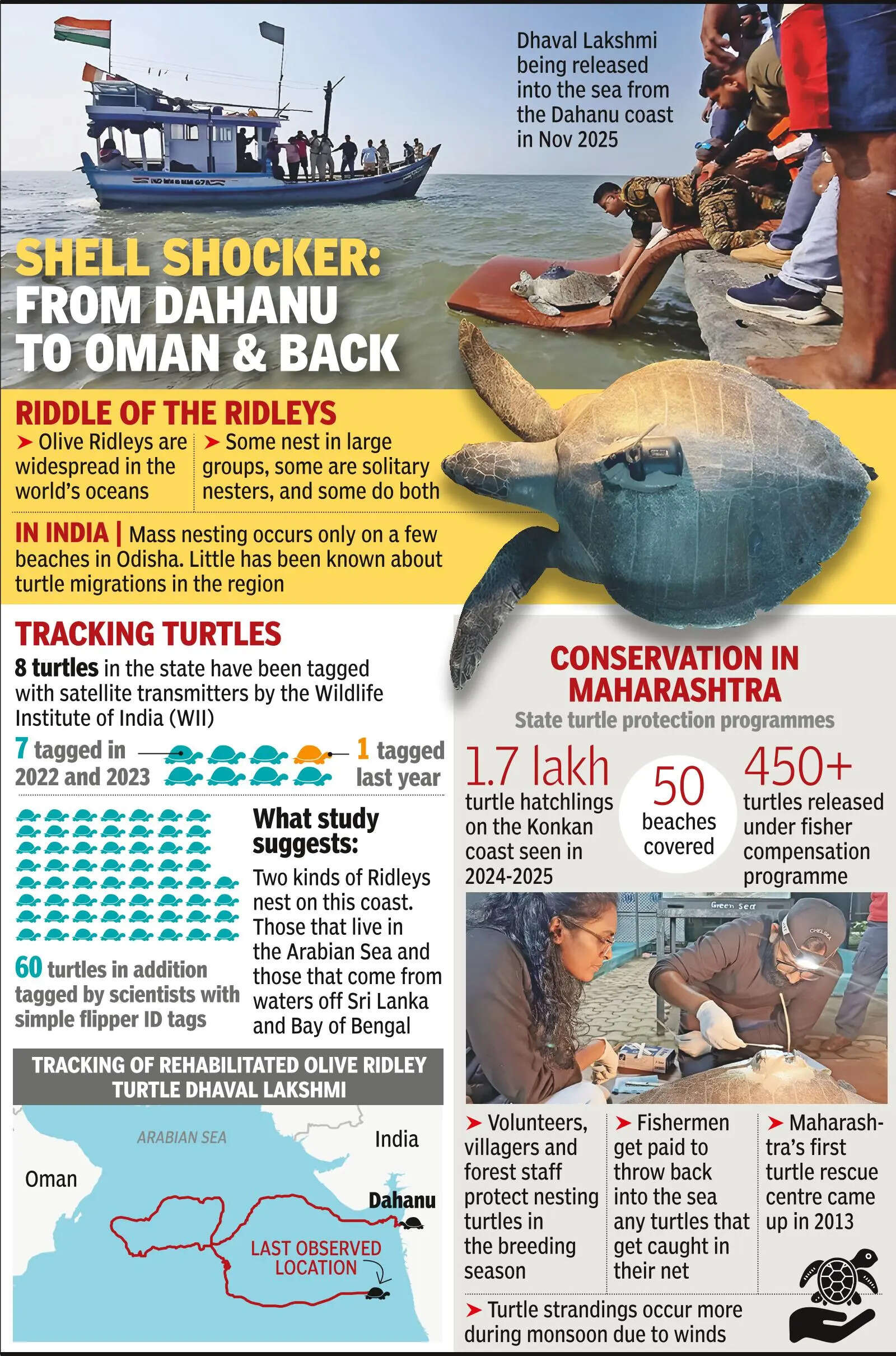
These turtles travelled mostly south, covering between 1,015km and 5,267km at a median speed of 1.1km a hour. One turtle reached Lakshadweep; another, called Bageshree, crossed Sri Lanka into the Bay of Bengal. The transmitters also record depth, showing the turtles diving up to 40 metres near the shore and up to 400 metres in the open sea. Ridleys dive to forage, sleep and avoid choppy surface waters. They do not go very deep, says Kumar, and must surface periodically to breathe.Dhaval Lakshmi’s latest tracks show her heading toward the Maharashtra coast. Kumar does not expect her to come ashore, as this is not the nesting season. More likely, she will move south along the edge of the continental shelf, drawn by the Malabar upwelling current, which brings nutrient-rich waters up from the deep ahead of the monsoon. Manjrekar says, “We’ll have to wait and see what happens.”