








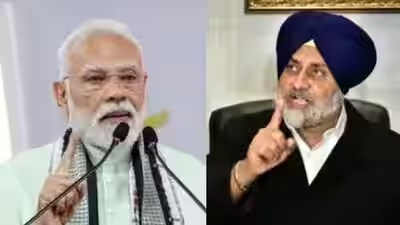
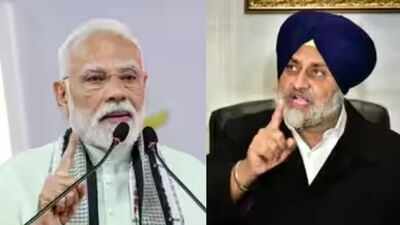
CHANDIGARH: Poll arithmetic seems to have trumped ideology in the reunion of SAD and BJP barely two months ahead of assembly elections.Both sides had criticised each other after the falling out over farm laws, but couldn’t ignore the writing on the wall, and it’s Prime Minister Narendra Modi who is believed to have nudged the former allies to come together.Competing claims over constituencies and reservations within sections of BJP and RSS in Punjab have been pushed aside for now, but seat-sharing is going to be tricky. In the 2024 Lok Sabha election, BJP flexed its maximum strength while Sukhbir Singh Badal-led SAD was at its lowest ebb. Their combined vote shares put them above Congress and AAP – and this was the biggest logic of their coming together.
There are reports of internal resistance within BJP regarding this alliance.
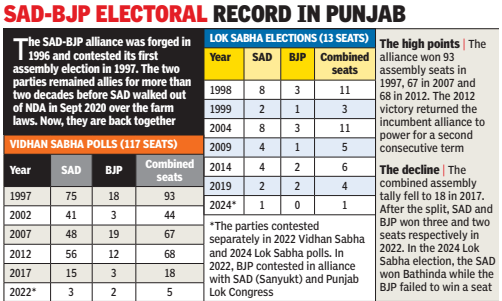
Congress and AAP were neck-and-neck with 26.3% and 26% vote shares. BJP, with maximum consolidation of upper-caste Hindu voters, grabbed a vote share of 18.5% while SAD’s share was 13.4%. BJP took the lead in 23 assembly segments, and was runner-up in another seven. SAD led in nine segments and was runner-up in six.Congress won seven Parliament seats and led in 38 assembly segments, while AAP could win only three seats and led in 32 segments.As allies, BJP and SAD did not fare well in the 2014 and 2019 Lok Sabha elections, and the 2017 assembly elections. But at that time, a strong anti-incumbency factor worked against them, and Badals faced backlash over the sacrilege and police firing cases.For Akalis, the alliance now offers an opportunity to regain political ground with the backing of BJP-led Centre. For BJP, SAD remains a channel into sections of the Sikh and rural electorate where the party has struggled to make inroads.Now, BJP’s claim for a larger seat share rests on its performance in the 2024 Lok Sabha elections and its claim that its electoral footprint in Punjab has expanded since the two parties parted ways in Sept 2020. According to functionaries of both parties, BJP is eyeing around 45 of Punjab’s 117 assembly seats, almost double the 23 it traditionally contested under its alliance with SAD.The larger allocation is understood to have come with the acceptance that the chief minister’s post would go to SAD. Sources say the seat-sharing formula has been broadly worked out, but both sides stake claim to around 10 constituencies.The LS vote-share figures provide BJP and SAD with an argument that their combined vote base is substantial, though the two parties’ performance when contesting separately cannot automatically be treated as an indication of how their votes would transfer in an alliance.Under the old arrangement, SAD contested 94 seats and BJ. While the Akalis would continue to have the larger share, conceding around 45 seats could be difficult to explain to the party cadre, particularly after SAD president Sukhbir Singh Badal invoked the party’s 106-year legacy at the alliance announcement. There is speculation that SAD may have agreed to an even larger allocation for BJP but would prefer the actual numbers not to be made public at this stage.A senior BJP functionary said Amit Shah’s declaration that SAD would remain ‘bada bhai’ had itself come as a surprise to the Akali leadership. Asked who would play the role, Sukhbir had initially described the two parties as ‘jurve bhai’ (twin brothers). Shah, however, immediately stepped in to clarify that SAD would be the elder brother, adding that ‘bada bhai’ was always the chief minister.According to the BJP functionary, Shah’s public assertion also dashed the hopes of some BJP stalwarts who were aspiring to emerge as the party’s chief ministerial face in Punjab.BJP’s demand for a larger share has not been without resistance within its own ranks. The party leadership in Delhi had sought lists of potential candidates from all 117 constituencies as part of its poll preparations. Now, a section of state leadership is apprehensive that those who spent years building their political base may have to make way for Akali candidates. To an extent, SAD may also encounter the same issue. One party functionary claimed BJP had potential candidates in at least 89 constituencies, with as many as three contenders in some seats. Several of these constituencies are also being claimed by the SAD. A BJP functionary from a semi-rural constituency, who is keen to contest, argued that the party has been expanding its presence in Punjab and has little to lose by fighting independently. He also claimed that RSS was not enthusiastic about the alliance.There was also resistance from sections of Punjab BJP and RSS, who feared that SAD’s “baggage” could weigh down BJP. Modi, however, was keen to bring the two parties together, say sources. His meeting with Sukhbir on Aug 7 set the ball rolling for negotiations.The alliance talks were not confined to seat-sharing. There were discussions on farmers’ concerns and the role of the two parties in a possible NDA govt.The SAD-BJP reunion takes place against the backdrop of efforts by other Akali and Panthic groups to explore a separate electoral understanding. Akali Dal Waris Punjab De, led by jailed MP Amritpal Singh, SAD (Punar Surjit), headed by Giani Harpreet Singh, Simranjit Singh Mann-led SAD (Amritsar) and BSP have meetings to explore an alliance for the 2027 assembly elections. There are also discussions on bringing farm unions on a common platform, tentatively discussed as a broader ‘Punjab Sanyukt Morcha’.Tata Sons weighs stake purchase, buybacks to unlock liquidity for SP | page 23Mumbai: Tata Sons chairman N Chandrasekaran is likely to weigh three options to give its largest minority shareholder, the Shapoorji Pallonji Group, much needed liquidity. These include a Tata Group entity buying part of SP’s 18.4% stake; a proportionate buyback open to all shareholders; or Tata Trusts chairman Noel Tata’s proposal for a selective capital reduction of SP’s shares.The first option would leave controlling shareholder Tata Trusts’ 66% stake unchanged. Either of the others would raise its holding in Tata Sons for the first time in three decades.The first two options only require board approval. The selective capital reduction needs a special resolution of shareholders, then creditor and NCLT approvals. A shareholder meeting currently faces a quorum hurdle and the process could take nearly a year.A Tata SPV could buy SP’s shares, provided it is not a subsidiary of Tata Sons, because section 19 of the Companies Act bars a subsidiary from holding shares in its parent. The purchase would lift the combined holding of Tata companies from the current 13%. An external investor could also buy the shares with Tata Sons board approval. The SPV could fund the deal through internal accruals, debt or equity, people familiar with the matter said.