







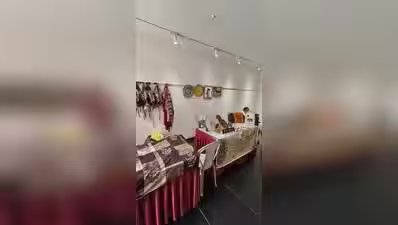
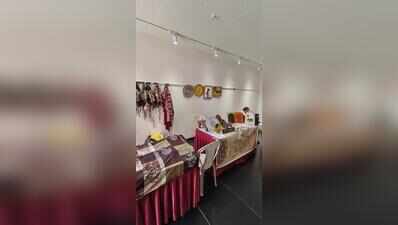
Rajkot: Art galleries are meant to offer an immersive aesthetic experience where every canvas tells a story, connoisseurs linger over creative works, and conversations revolve around imagery and creativity.That was widely believed to be the vision when Rajkot Municipal Corporation (RMC) refurbished Dr Shyama Prasad Mukherjee Art Gallery at a cost of Rs 6 crore and reopened in June 2025, declaring it the new address for the city’s artist community.Today, the ground reality paints a drastically different picture.Instead of sculptures and framed paintings, the centrally air-conditioned, two-storey facility is routinely filled with lingerie, ethnic wear, cosmetics, toilet cleaners, and stain removers. Makeshift stalls, food counters, and hawkers pitch assorted household goods across the halls, effectively turning the premier cultural venue into an indoor shopping bazaar.The commercialisation of the space recently came into the spotlight through an Instagram reel. In the clip, a breathless woman hurries inside the newly renovated gallery, telling an interviewer she ran there to shop for the upcoming Navratri festival. The video then pans across bustling retail counters selling traditional Navratri attire, accompanied by a food joint catering to hungry shoppers.The situation has sparked deep anger among local painters, sculptors, and creative practitioners.“This remains less of an art gallery and more like a mela (fair),” said Umesh Kyada, head of Rajkot Visual Art Society, emphasising that an art gallery carries a certain decorum that must be preserved.Artists are demanding that RMC strip the word “Art Gallery” from the building’s name if it intends to use the taxpayer-funded space primarily to hawk apparel and FMCG products.The shift, however, is neither accidental nor unauthorised.On the civic body’s official booking portal, RMC has formalised this dual identity by offering applicants two explicit categories: “Art-related activity” and “commercial exhibition and sell.” The gallery is split into three sections, with daily rentals for commercial sales ranging from Rs 7,000 to Rs 16,000 per section. In contrast, art-related bookings range between Rs 2,800 and Rs 7,500 per day—both rates excluding additional charges for cleaning, maintenance, security, and GST.“RMC does not see what is being put up for exhibition; it allows everything, whether it is a painting, a chaniya choli, or a saree,” lamented artist Sanjay Koriya.Local artists say that the gallery was specifically refurbished upon their persistent demands to give the fraternity a collaborative home—a space where creators could gather, debate new initiatives, showcase their craft, and engage with collectors. Instead, many now feel displaced by retail stalls, though several artists hesitate to speak on record, fearing retaliation or future booking rejections from the civic administration.Defending the policy, mayor Nehal Shukla maintained that commercial rentals were introduced to ensure the infrastructure does not remain idle. “In order to make maximum use of the gallery, we have framed rules allowing it to be rented for art-cum-commercial activities,” Shukla said. “We have not received any complaints regarding rule violations. However, we will stop bookings if any selling or marketing of objectionable items is found.”Defending the policy, mayor Nehal Shukla maintained that commercial rentals were introduced to ensure the infrastructure does not remain idle. “In order to make maximum use of the gallery, we have framed rules allowing it to be rented for art-cum-commercial activities,” Shukla said. “We have not received any complaints regarding rule violations. However, we will stop bookings if any selling or marketing of objectionable items is found.”