









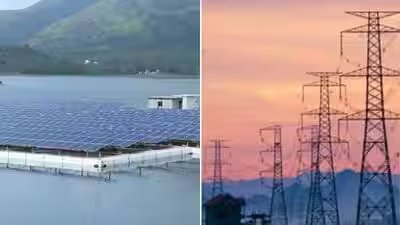
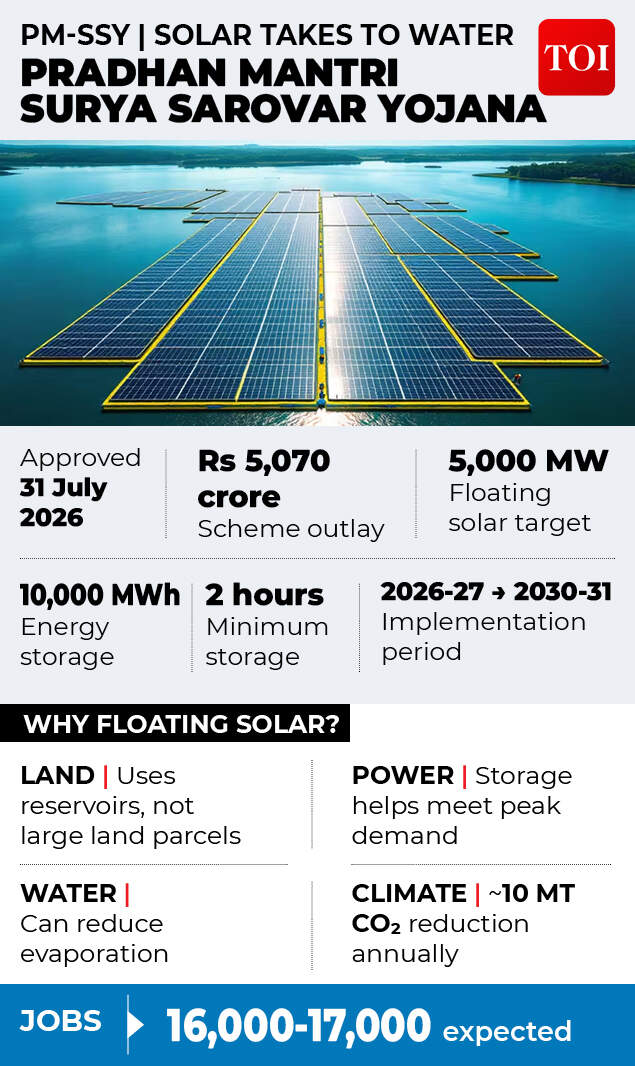
India’s solar energy expansion is entering a new phase, with floating photovoltaic projects emerging as a potential answer to two of the country’s biggest renewable energy challenges: limited land availability and the need for more reliable power generation.The Union government’s approval of the Pradhan Mantri Surya Sarovar Yojana (PM-SSY) on July 31, 2026, marks a major push in that direction. According to the Press Information Bureau (PIB), the scheme will support 5,000 MW of floating solar photovoltaic capacity on reservoirs and other suitable inland water bodies, backed by energy storage systems with a minimum two-hour storage capacity.With an overall financial outlay of ₹5,070 crore, the scheme will be implemented from financial year 2026-27 to 2030-31. The government says the programme could help reduce pressure on land resources, improve grid reliability and open another avenue for India to expand its renewable energy capacity.
From solar experiment to energy powerhouse
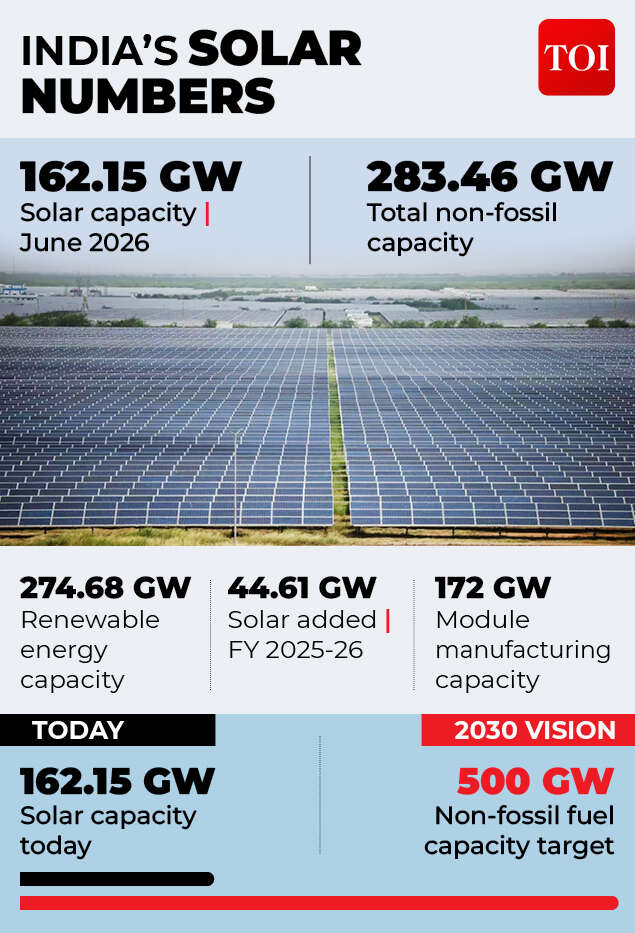
India’s solar sector has undergone a dramatic transformation over the past decade. According to government data, installed solar capacity has risen from approximately 3 GW in 2014 to 162.15 GW as of June 30, 2026, representing more than a fiftyfold increase.The expansion has been supported by large-scale solar parks, rooftop installations, solar-powered agricultural pumps, competitive bidding and policies designed to strengthen domestic manufacturing.
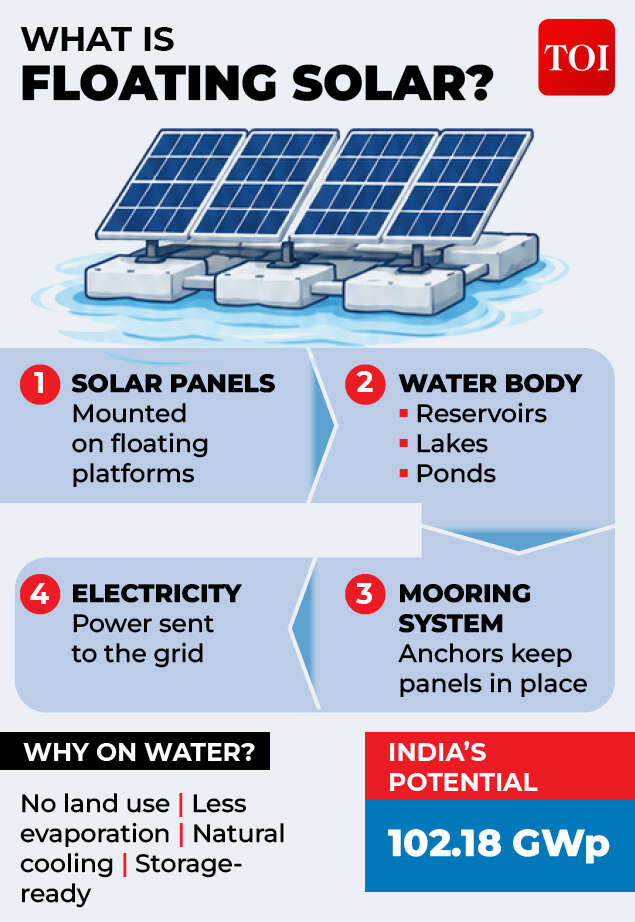
Floating solar opens a new frontier for India’s clean energy push.
The government said India added 44.61 GW of solar capacity in FY 2025-26, almost twice the 23.83 GW added in the previous financial year. During the same period, total non-fossil fuel capacity reached 283.46 GW, including 274.68 GW from renewable energy sources.The latest policy push towards floating solar builds on this broader expansion, while attempting to use a resource that conventional solar projects do not require: water surfaces.
A 5,000 MW floating solar bet
The PM-SSY is designed to support 5,000 MW of Floating Solar Photovoltaic projects with co-located Energy Storage Systems, according to the PIB.The storage component will have a minimum capacity of 10,000 MWh, equivalent to two hours of storage for the planned 5,000 MW floating solar capacity. This is intended to help states manage periods of peak electricity demand and address one of the central challenges associated with solar power, its variability.
Floating solar could turn India’s water bodies into power hubs.
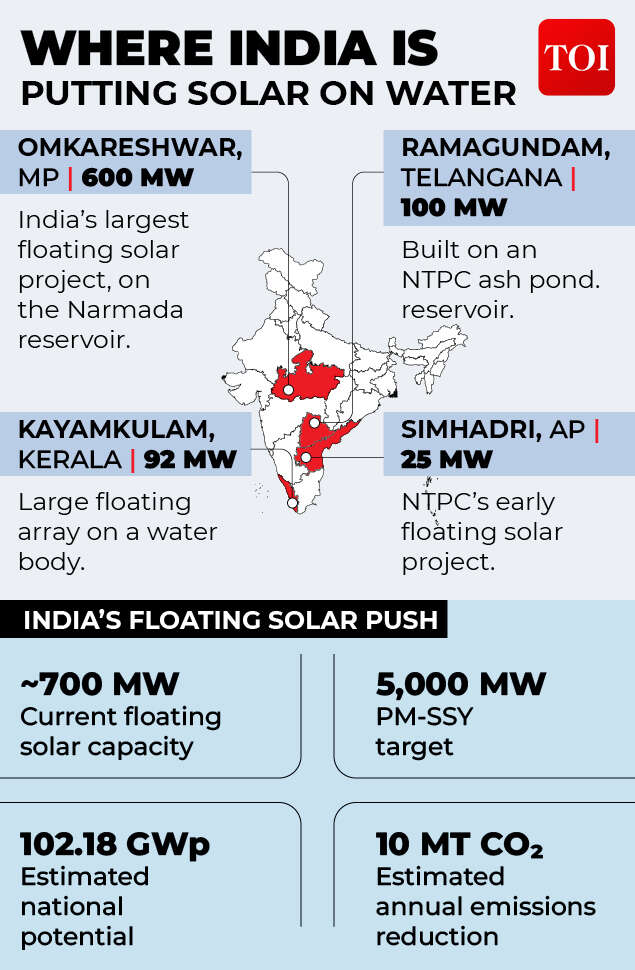
Floating solar panels are mounted on buoyant structures and deployed on reservoirs, lakes, ponds and other suitable water bodies. Instead of competing with agriculture, settlements, forests or other land uses, the technology allows electricity generation from water surfaces.The government estimates that India currently has around 700 MW of floating solar capacity. The PM-SSY would therefore represent a substantial increase in the country’s floating solar footprint.The scheme is based on an assessment by the National Institute of Solar Energy (NISE), which estimates that India has around 102.18 GWp of floating solar potential across reservoirs and suitable inland water bodies.
Why put solar panels on water?
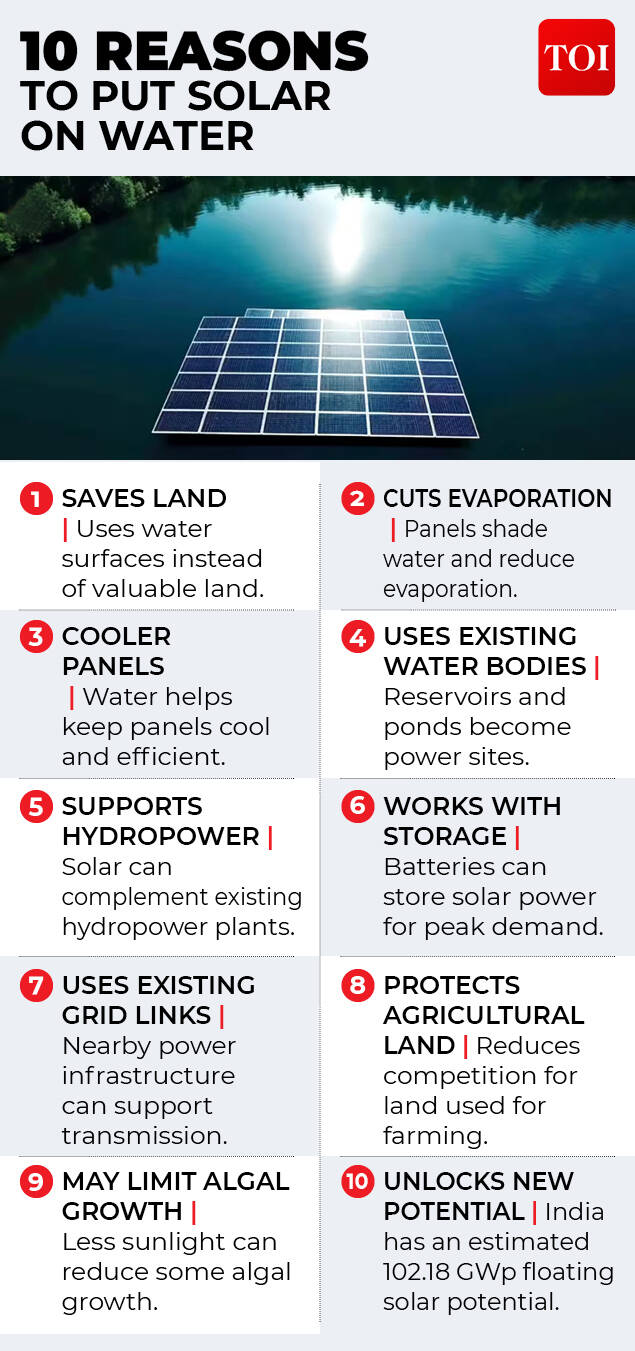
The attraction of floating solar goes beyond saving land. Floating photovoltaic systems can benefit from the cooling effect of water, which can improve the operating efficiency of solar panels compared with installations exposed to higher temperatures on land. Research cited in the supplied material indicates that floating systems can generate between 0.6% and 4.4% more energy than comparable land-mounted installations, although actual performance varies according to site and technology.The panels can also shade portions of water bodies, reducing exposure to sunlight and potentially lowering evaporation. This could be particularly relevant in water-stressed regions where reservoirs are used for irrigation, drinking water or hydropower.
From reservoirs to renewable power, India’s solar shift is going afloat.
The scale of the potential benefit depends on factors such as climate, the percentage of the water surface covered and the characteristics of individual reservoirs.Floating solar can also be paired with existing hydropower infrastructure. Solar generation can use existing transmission connections, while hydropower or pumped-storage facilities can provide a means of balancing variable solar output.This combination could become increasingly important as India adds more renewable capacity to its electricity grid.
India already has floating solar experience
India is not starting from scratch. Some of the country’s largest floating solar installations are already operating or under development. The Omkareshwar floating solar project in Madhya Pradesh, located on the Narmada River reservoir, is designed for a capacity of 600 MW and is among the country’s most prominent floating solar developments.Other major installations include NTPC’s 100 MW floating solar project at Ramagundam in Telangana, built on an ash pond near its thermal power station, and a 92 MW project at Kayamkulam in Kerala.These projects demonstrate how floating solar can be deployed on different types of water bodies, including reservoirs and water surfaces associated with existing industrial infrastructure.The experience is particularly relevant as the government seeks to expand floating solar beyond individual projects and create a larger national programme.
A global technology moving rapidly
Floating photovoltaics are no longer a niche technology. The first floating solar installation was developed in Japan in 2007, while larger projects began appearing during the following decade. Global installed capacity expanded rapidly, rising from around 1 GW in 2018 to 13 GW in 2022, according to figures cited in the supplied material.Asia has been at the forefront of this expansion, with China developing some of the world’s largest floating solar installations.In 2022, China added a 320 MW floating photovoltaic facility in Dezhou, Shandong, developed by Huaneng Power International. Earlier large projects included installations at reservoirs and former mining sites.
The technology has also expanded beyond inland water bodies. Offshore floating solar remains comparatively young, but pilot projects have been developed in marine environments, including installations in the Maldives and the North Sea.The economics of floating solar have also improved. While floating projects once carried a substantial cost premium over conventional solar, costs had moved closer to land-based systems by 2020. However, the supplied research indicates that installation costs remained around 10-25% higher in 2023, largely because of additional anchoring and mooring requirements.
The land question gives floating solar an edge
Land availability is becoming an increasingly important consideration as India expands renewable generation.Large solar parks require substantial tracts of land, and acquiring suitable land can involve competing demands from agriculture, settlements, conservation and other economic activities.Floating solar offers an alternative by allowing electricity generation on existing reservoirs, industrial ponds, irrigation basins and other artificial water bodies.
Harnessing sunlight without consuming precious land.
India’s conventional solar expansion has already demonstrated the scale required to meet national targets. Large projects account for 118.79 GW of installed solar capacity, while grid-connected rooftop systems contribute another 27.88 GW, according to the government.Floating solar can add another layer to this mix without necessarily requiring comparable amounts of terrestrial land.The potential is especially significant around existing hydropower reservoirs, where solar generation can potentially share transmission infrastructure and complement hydropower generation.
Storage could solve solar’s biggest problem
The PM-SSY’s storage component is particularly significant because India’s solar expansion is moving into a phase where generation capacity alone will not be enough.Solar power is produced primarily during daylight hours, while electricity demand can remain high after sunset. Energy storage can help shift some of that generation to periods when it is needed most.Under PM-SSY, every supported floating solar project is expected to be associated with energy storage of at least two hours. The government expects this to help states manage peak demand while improving the reliability of renewable power.The combination of floating solar, existing reservoirs and energy storage could therefore create a model that goes beyond simply adding more generation capacity.In locations with hydropower or pumped-storage infrastructure, the relationship could become even more valuable. Water reservoirs can potentially function as part of an integrated renewable energy system, allowing solar generation to be balanced through stored water or battery systems.
The environmental equation remains complex
Floating solar’s environmental advantages need to be considered alongside its potential risks.Partial coverage of water surfaces can reduce evaporation and sunlight penetration, potentially helping to conserve water and limit some forms of algal growth. However, extensive shading can also alter aquatic ecosystems.The environmental impact depends heavily on the type of water body, the percentage of its surface covered, the depth and movement of the water, and the design of the floating system.Marine floating solar presents additional challenges. Anchoring, mooring and installation activity can disturb sediments and potentially affect benthic ecosystems. Large installations can also alter the amount of sunlight reaching seagrass or coral habitats.This means floating solar cannot simply be treated as a zero-impact alternative to land-based solar.For India, where reservoirs can serve multiple purposes including irrigation, drinking water, fisheries and hydropower, careful site selection and long-term ecological monitoring will be important as deployment expands.
Floating solar joins a much bigger solar ecosystem
The government’s floating solar push comes against the backdrop of a broader policy architecture that has driven India’s solar growth.The National Solar Mission, launched in 2010, helped establish long-term targets, while the Solar Parks Scheme and Green Energy Corridor programme addressed infrastructure and transmission challenges.The Solar Parks Scheme has supported 54 parks with a combined sanctioned capacity of 39,188 MW, according to government data as of February 2026.The Green Energy Corridor, meanwhile, is intended to move renewable electricity from generation-rich regions to major demand centres. The programme had enabled evacuation of 24,567.8 MW of renewable energy through strengthened transmission networks as of February 2026.Competitive bidding has also transformed the economics of solar power. The government says solar tariffs fell from around ₹18 per unit in 2010 to ₹2.44 per unit at the Bhadla Solar Park auction in 2017.The expansion is now increasingly being supported by domestic manufacturing. Solar module manufacturing capacity grew from 2.3 GW in 2014 to around 172 GW as of March 31, 2026, according to the PIB.
Rooftops and farms are driving the next wave
India’s solar transition is also becoming increasingly distributed. The PM Surya Ghar: Muft Bijli Yojana, launched in February 2024 with an outlay of ₹75,021 crore, is aimed at expanding rooftop solar among households. More than 43 lakh households had been solarised by June 2026, according to the government.In agriculture, PM-KUSUM supports solar pumps, decentralised solar generation and feeder solarisation. Nearly 11.49 lakh off-grid solar pumps had been installed, while more than 15.89 lakh agricultural pumps were covered through feeder-level solarisation, according to government figures cited in the supplied material.Together, rooftop solar and PM-KUSUM contributed substantially to distributed solar capacity additions during FY 2025-26.Floating solar now offers another form of distributed geography, not necessarily through small installations, but by making productive use of water bodies that already exist.
The next test is scale
India’s solar story has moved from building capacity to integrating that capacity into a more complex electricity system.The country’s Panchamrit commitments include achieving 500 GW of non-fossil fuel capacity by 2030, alongside the longer-term goal of reaching net-zero emissions by 2070.Floating solar is unlikely to replace conventional ground-mounted or rooftop solar. Instead, its significance lies in expanding the range of locations where solar generation can be developed.The government’s estimate of 102.18 GWp of floating solar potential suggests that water bodies could become an important part of that expansion. PM-SSY’s 5,000 MW target is only a fraction of the assessed potential, but it could provide a large-scale test of the technology.The scheme is also expected to create 16,000-17,000 full-time equivalent jobs and support domestic manufacturing of floating structures, photovoltaic cells and modules and energy storage systems, according to the PIB.
Share your thoughts in the comments
Be respectful · TOI community guidelines
If the technology can deliver reliable generation while limiting ecological disruption and managing its higher installation costs, floating solar could become an important component of India’s renewable energy mix.For a country attempting to add hundreds of gigawatts of clean capacity while balancing land, water, transmission and reliability constraints, the next solar frontier may not necessarily be another field of panels on land.It could be the reservoirs already sitting at the heart of India’s power and water infrastructure.