








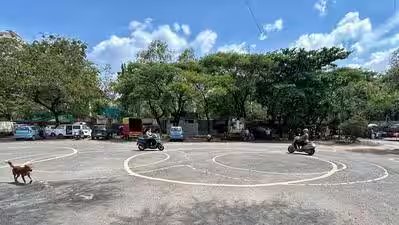
Pune: Road safety experts demanded stricter and transparent driving tests by Regional Transport Office (RTO) to ensure only a competent driver take to the road amid deteriorating traffic discipline in the city.Harshad Abhyankar, a member of the Save Pune Traffic Movement, told TOI that poor testing standards were allowing poorly skilled drivers onto the roads. “Driving has been a skill. Everyone should have the opportunity to learn it. The problem was the terribly low level of testing. If knowledge and skills were not properly assessed, there was little incentive to learn them. More than 90% of candidates pass in their first attempt. That was the real issue, and it needed to be addressed at both the state and national levels,” he said.Pune deputy regional transport officer (RTO) Swapnil Bhosle said driving tests have been conducted at the Alandi Road test track and the Institute of Driving Training and Research (IDTR) as per prescribed norms. “Around 10% of applicants fail the test on their first attempt. They can reappear after a week. The tests are stringent and conducted according to regulations and there is no question of giving away licences without ensuring that applicants are competent,” he told TOI.RTO data showed that in fiscal year 2025-26, 1,86,824 driving licences were issued, up by 21% from FY 2024-25 when the number stood at 1,56,638. The rise is even steeper than in FY 2023-24, when 1,32,940 licences were issued. It marks a rise of 40% in just two years.On average, 400-450 applicants appear per day for two-wheeler and four-wheeler driving tests in Pune. At the Alandi Road facility, 180-200 candidates participate in the test per day. Two-wheeler applicants must navigate an 8-like track while demonstrating balance, braking and indicator usage. Car drivers are assessed on figure-eight, H-shaped and gradient tracks.An RTO official admitted that manually monitoring every applicant remained challenging because of the high volume of candidates. “A modern sensor-enabled track with AI cameras was under construction, which would improve monitoring at Alandi Road. Until then, inspectors have been doing their best to observe every applicant,” the official said.Road safety experts, however, believed the issue was not the number of licences being issued but the quality of testing.Sanjay Sasane, principal of the IDTR, told TOI that structured training for two-wheeler riders was essential. “Over 70% of two-wheeler licence applicants already know how to ride and simply appear for the licence test. The lack of discipline started with this. Many countries follow graduated licensing systems where young drivers remain under supervision for years before receiving a full licence. India should consider adopting a similar model,” he said.Transport department officials agreed. “Rule 15 (3) of the Central Motor Vehicle Act stated that during the test of competence to drive, applicants must demonstrate control, compassion, road sense and vehicle handling. How was that possible by driving on a test track? Tests needed to be harsh and on the roads for applicants to get a better sense. Also, the learner licence tests needed to be far stricter,” said an official requesting anonymity.Shweta Vernekar, senior programme associate at Parisar, said licensing reforms must be accompanied by stronger enforcement. “Many countries suspend or permanently revoke licences for repeated traffic violations. In India, even recovery of e-challans has been poor. Technology and AI can help, but only if implemented with clear objectives,” she said.