









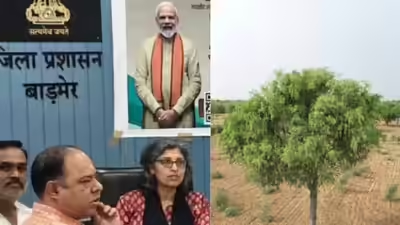
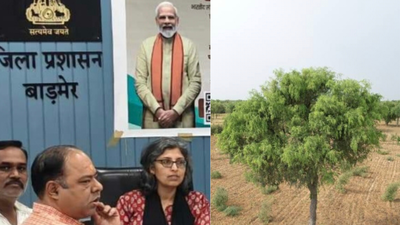
JAISALMER: In a major push towards climate-resilient agriculture and sustainable rural livelihoods, Barmer District Collector Chinmayee Gopal has launched a series of innovative initiatives aimed at strengthening fodder security, conserving the iconic Khejri tree, promoting climate-smart farming and enhancing the resilience of the district’s agricultural ecosystem.The comprehensive programme includes the distribution of 7,000 grafted ‘Thar Shobha’ Khejri saplings, plantation of 10,000 Thornless Cactus plants, promotion of medicinal and aromatic crops, and supply of certified seeds of improved climate-resilient varieties of cumin and isabgol to farmers.District Collector Chinmayee Gopal said the initiatives have been designed to address the growing challenges of climate change, erratic rainfall and declining fodder availability in the arid region while improving the long-term sustainability of agriculture and livestock farming.Under the programme, the Panchayati Raj Department will distribute around 7,000 grafted ‘Thar Shobha’ Khejri saplings, developed by the ICAR-Central Arid Zone Research Institute (CAZRI), Jodhpur.Unlike traditional Khejri trees, the ‘Thar Shobha’ variety grows to a comparatively shorter height, develops a dense canopy and produces significantly higher yields of sangri, the nutritious pods that are an important source of food and income in the Thar Desert.The initiative aims to conserve, rejuvenate and expand the population of Khejri, regarded as the lifeline of the desert due to its ecological, agricultural and cultural significance.The tree enriches soil fertility, provides shade, supports biodiversity and serves as an important source of fodder during drought years.To further strengthen fodder security, the district administration will introduce 10,000 Thornless Cactus plants, which will be planted along farm boundaries and field bunds.This marks the first large-scale introduction of Thornless Cactus in Barmer. Free from spines and highly nutritious, the cactus serves as excellent green fodder, particularly during drought conditions when conventional fodder becomes scarce, thereby improving livestock nutrition and resilience.The administration is also promoting crop diversification through medicinal and aromatic farming.Selected farmers from Barmer will undertake an exposure visit to the CSIR-Central Institute of Medicinal and Aromatic Plants (CIMAP), Lucknow, under the ATMA Project.During the programme, farmers will receive practical training on scientific cultivation techniques, value addition, post-harvest processing, marketing and modern production technologies for medicinal crops.Departmental officials and field staff will undergo orientation before the exposure visit to ensure effective extension support.In another major intervention, the district administration, under the Pradhan Mantri Krishi Dhan-Dhaanya Yojana with support from Corporate Social Responsibility (CSR) funding, will provide certified seeds of improved varieties of cumin and isabgol that are better adapted to changing climatic conditions and possess greater tolerance to high-speed winds.Farmers will also be encouraged to cultivate other climate-suitable, high-value crops to diversify farm incomes and reduce production risks.District Collector Chinmayee Gopal said that agriculture and animal husbandry are deeply interconnected in Barmer, and sustainable development requires scientific interventions that simultaneously improve crop productivity, conserve native species and strengthen fodder resources.She expressed confidence that the integrated initiatives would enhance farmers’ resilience to climate change, improve livestock productivity, strengthen ecological balance and contribute to a more sustainable and prosperous agricultural economy in the desert district.