








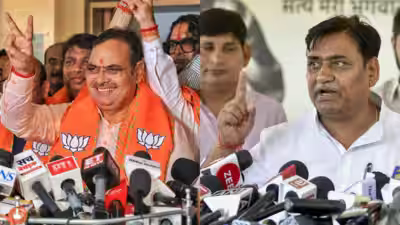
JAIPUR: The BJP may have emerged as the clear winner in Rajasthan’s urban local body polls, but the verdict has also triggered a political row over ward delimitation, razor-thin victory margins and the gap between ward wins and vote share.Chief minister Bhajanlal Sharma on Monday described the BJP’s performance as a “historic victory”, saying the results reflected people’s faith in the party and its development model.Addressing the media at the BJP state headquarters in Jaipur, Sharma thanked voters and party workers and said the result was a “victory of the people’s trust.”He said the people of Rajasthan endorsed the work of the BJP government during the last two-and-a-half years under Prime Minister Narendra Modi’s central leadership.The ruling BJP increased its lead over the Congress in the Rajasthan urban local body elections on Monday, winning over 4,171 wards against the opposition party’s 3,597 as results for at least 10,200 wards were declared.Of the 10,244 wards where counting was held, results for 10,210 were declared till 5.45pm.But while the BJP’s ward tally gave the ruling party reason to celebrate, the Congress sought to challenge the broader electoral picture, pointing to a vote-share gap of less than one percentage point and alleging that delimitation had significantly influenced the results.State Congress president Govind Singh Dotasra said the BJP had traditionally enjoyed an advantage in urban local body elections, particularly when in power, but claimed Monday’s results showed that the party had failed to retain that edge by a wide margin.Dotasra said the BJP had a vote-share lead of 8.12 percentage points over the Congress during the 2014-16 urban polls under the Vasundhara Raje government, while the Congress had a 2.2 percentage point lead over the BJP during the 2019-21 polls under the Ashok Gehlot government.“In this election, the BJP’s lead over the Congress is less than one per cent,” he said.The Congress leader claimed that the party could have won around 1,500 more wards but for what he described as irregular and “unfair” delimitation of wards.The delimitation argument, he said, was also reflected in the performance of the two parties in reserved wards.Dotasra said the Congress won 542 wards reserved for Scheduled Castes, compared with 350 won by the BJP. In SC women-reserved wards, the Congress won 261 seats against the BJP’s 186, while in ST women-reserved wards, the Congress won 53 against the BJP’s 39.He also alleged that the BJP government used the administrative machinery during the elections and deliberately delayed results in some wards where Congress candidates were leading.The Congress leader further claimed that delimitation had resulted in wide variations in the number of voters across wards, potentially affecting the electoral arithmetic.One of the strongest points in his argument was the number of closely fought contests.Of the 4,097 wards won by the BJP, Dotasra claimed, the victory margin was less than 100 votes in 1,316 wards and less than 50 votes in 772 wards.The BJP won 13 wards by a margin of just one vote, he said, attributing the pattern to delimitation.The Congress also pointed to several major urban centres where its ward performance did not mirror the BJP’s overall statewide lead.In Ajmer, Dotasra said the Congress won 37 of 80 wards, compared with 32 won by the BJP.In Pali, the BJP state president’s home turf, the Congress won 29 of 65 wards, while the BJP won 21, he claimed.In Bikaner, the Congress won 42 of 80 wards and was set to form the board, he said.In Jodhpur, the Congress won 45 wards, one more than the BJP, and secured 42.7% of the votes against the BJP’s 39.8%, according to Dotasra.Jaipur offered another example cited by the Congress to question the relationship between ward victories and the overall vote count. Dotasra said the Congress polled more than 10,000 votes more than the BJP despite the BJP winning more wards, attributing the pattern to delimitation.The Congress also highlighted the BJP’s performance in Bharatpur, the chief minister’s home district, where it won only 20 of 65 wards, Dotasra said.According to the Congress leader, the party also performed well in areas associated with senior BJP leaders and ministers, including Sikar, Jhunjhunu, Bikaner, Hanumangarh and Churu.The BJP, however, presented the results as a broad endorsement of the state government’s performance and its development agenda.Sharma said the government’s focus on development in rural and urban areas, along with the BJP’s outreach to people, strengthened the party’s connect with voters.He claimed that 78% of the commitments made by his government were fulfilled.The chief minister said his government would work with greater focus on “village development and ward development” and fulfil the promises made to the poor, youth, women, and senior citizens in its urban development manifesto.Sharma also claimed that his government’s public hearing and grievance-redressal initiatives recorded an 84 per cent success rate.The poll verdict, he said, also reflected the faith of young people in the vision of “Viksit Bharat-Viksit Rajasthan” under Modi’s leadership.“The BJP’s public outreach model, its approach of listening to common people and resolving their grievances has been accepted by the people,” Sharma said.The contrasting interpretations leave Rajasthan’s urban poll verdict with two competing narratives.For the BJP, the numbers represent a decisive ward-level victory and an endorsement of its government. For the Congress, the narrow vote-share gap, a large number of closely fought wards and the alleged impact of delimitation suggest that the ward tally alone does not tell the complete story of the contest.