








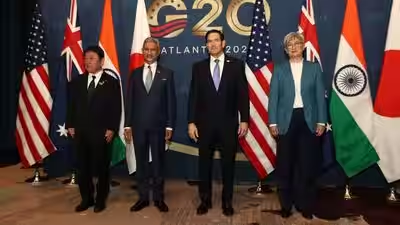
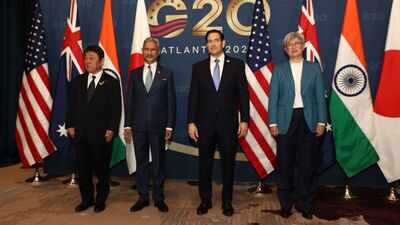
External Affairs Minister S Jaishankar on Saturday highlighted freedom of choice, secure supply chains and tackling non-market practices as key areas of focus for the Quad, while calling for a modern and action-oriented approach to the grouping’s priorities.In a post on X after the Quad foreign ministers’ meeting in Atlanta, Jaishankar outlined the major issues discussed with US secretary of state Marco Rubio, Japanese foreign minister Toshimitsu Motegi and Australian foreign minister Penny Wong.“Maintaining stability, driving prosperity and ensuring freedom of choice as our continuing commitments in the Indo-Pacific,” Jaishankar said, describing these as the grouping’s ongoing objectives.He stressed the importance of deeper cooperation to develop resilient supply chains and strengthen security in the technology, critical minerals and energy sectors.The external affairs minister also highlighted the need to address “non-market practices and increased economic stresses in the Indo-Pacific” as part of the discussions. However, he did not name any country or elaborate on the specific practices being referenced.On regional security, Jaishankar called for greater progress on existing cooperation agreements covering counter-terrorism, maritime security and capacity building, with the aim of strengthening regional resilience and promoting peace and stability.He also emphasised the importance of “developing a more contemporary QUAD agenda with a practical approach”.
Quad announces initiatives on AI, critical minerals
The joint statement issued after the meeting outlined several measures to expand economic and security cooperation among the four countries.The ministers expressed their intention to provide more than $85 million in technical and financial support to improve access to trusted artificial intelligence across the Indo-Pacific region. The initiative will also be supported through the Quad AI Accelerator.The statement also mentioned “Super Intelligence”, with a footnote explaining that the term refers to artificial intelligence in India, Australia and Japan.The ministers welcomed the US commitment of $10 million towards developing facilities in India and ASEAN countries to recover critical minerals from waste. The funding is intended to support facilities across the region and is not exclusively earmarked for India.The four countries are looking to recover valuable minerals from discarded electronic equipment and scrap materials to reduce reliance on individual suppliers. They will also examine ways to simplify cross-border transportation of recyclable materials.
Maritime security and regional cooperation
As part of their maritime collaboration, officials from all four Quad countries undertook a voyage aboard an Indian Coast Guard offshore patrol vessel from Chennai to Perth between September 25 and October 7.The partners are also working towards their first exercise under the Indo-Pacific maritime surveillance collaboration initiative, scheduled to take place during Sea Dragon 2027. A maritime domain awareness symposium is additionally planned for early next year.The ministers also committed to tackling online scam networks and ensuring accountability for transnational criminal organisations. They condemned groups involved in human trafficking and forcing victims to participate in fraudulent activities.Another major announcement was the launch of the first Quad Business Leaders’ Forum, which aims to deepen commercial engagement and create fresh business opportunities across strategic sectors.The meeting in Atlanta took place on the sidelines of the G20 foreign ministers’ meeting and marked the third Quad ministerial engagement this year, following earlier gatherings in New Delhi and Manila.The Quad comprises India, the United States, Japan and Australia. Its areas of cooperation include maritime and transnational security, economic development, critical and emerging technologies, humanitarian assistance and disaster response.