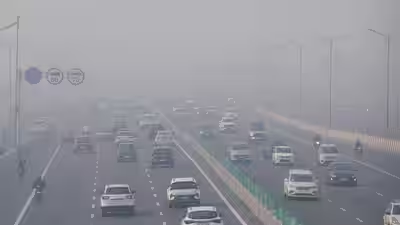











New Delhi: The declining trend in stubble burning incidents has been interrupted this season, with Punjab recording 5,002 farm fires from Sept 15 to Nov 10, compared with 4,195 during the corresponding period last year. Official data shows more than 91% of the crop has been harvested in Punjab. While Haryana, where 77% of the crop has been harvested, has witnessed 206 paddy residue burning events this time compared to 363 last year, UP’s count this season is 689 compared to 1,902 last time, as per satellite data compiled by Indian Agricultural Research Institute.However, the contribution of farm fires to Delhi’s air pollution has remained low this season. Between Sept 15 and Nov 9, stubble burning accounted for 5% or more of Delhi’s PM2.5 levels on only 13 days. Of these, the contribution crossed 10% on just three days.In previous years, stubble burning’s share in Delhi’s PM2.5 levels had touched 30% on certain days. This season, however, the peak contribution was 16.3%, recorded on Nov 4, according to the data of Decision Support System, which estimates the contribution of stubble burning to Delhi’s PM2.5.However, according to experts, the daily contribution may be higher. Gufran Beig, founder of System of Air Quality and Weather Forecasting and Research (SAFAR) and chair professor at National Institute of Advanced Studies (NIAS), said, “It is known that satellites do not capture the stubble burning counts which happen after 4pm. To estimate the share of stubble burning to Delhi’s PM2.5, DSS relies on the official stubble burning incidents, which is not accurate. Hence, the contribution has been low this season.”TOI in 2024 reported that farmers had shifted the timing of stubble burning to avoid satellite overpass times and escape detection of farm fires.In 2025, the share of farm fires in Delhi’s air quality surpassed 10% on eight days, including over 20% on only one day. In 2024, the contribution of stubble burning was above 20% on 14 days, according to DSS data. However, the peak single-day source of stubble burning in Delhi’s PM2.5 was 35.2% in 2024, 35.4% in 2023, 34% in 2022, 48% in 2021, 42% in 2020, 44% in 2019 and 58% in 2018.Beig said the share of paddy residue burning events has been low from Sunday to Tuesday due to a change in wind direction to easterly.“Due to an approaching feeble western disturbance, the wind direction was changed. However, as western disturbance is weak, rain, which could have provided temporary respite, is unlikely. As wind direction is again expected to change to north-westerly which aids in transfer of smoke from burning sites to Delhi, the intrusion of stubble is expected to be more from Wednesday evening,” said Beig.Sunil Dahiya, founder of think tank Envirocatalyst, said, “The modelling to calculate the contribution of farm fires to PM2.5 is done using the official stubble burning counts and does not consider the burnt area. However, multiple sources have confirmed the actual incidents are higher than the reported.”