






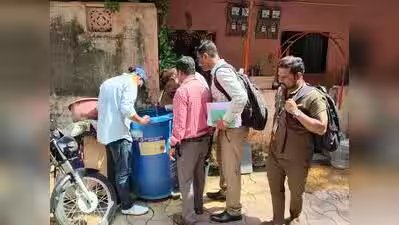
Pune: Housing societies and highrise complexes, rather than slum settlements, have emerged as major breeding grounds for dengue-carrying mosquitoes, a joint survey by state health department and PMC carried out in the third week of Oct has found.The findings have prompted civic and state health teams to intensify inspections across cooperative societies and under-construction buildings as dengue cases surge. Stagnant water stored in household containers, air conditioner trays, planters, and other domestic spots is believed to be driving the outbreak.Surveys conducted in the slums of Ramtekdi and Wadgaonsheri-Vaiduwadi recorded fewer mosquito larvae than anticipated. Conversely, wards with a higher density of high-rise buildings, such as Dhanakwadi-Sahakarnagar, Aundh-Baner, Kothrud, Yerawada, and Nagar Road, have reported a significantly higher number of dengue patients. PMC officials stated that lack of cooperation from housing society residents has severely hampered surveillance, forcing the civic body to issue notices or seek intervention of local corporators to gain access to residential premises.Dr Nina Borade, chief health officer, PMC, said, “The state survey was conducted across roughly 160 homes in the slums of Vaiduwadi and Ramtekdi. Surprisingly, they found only two containers with larvae and eggs. On the contrary, our field teams have found that the majority of patients are coming from housing societies, and we have detected larvae and eggs inside these plush homes.”In addition to serving as active breeding grounds, several housing societies are interrupting govt operations and obstructing Pune Municipal Corporation’s (PMC) surveillance and fogging measures, according to Dr Rajesh Dighe, assistant health officer and head of vector-borne infection control.“We frequently face difficulties conducting awareness programmes or mosquito breeding control measures in housing societies and townships, as management committees often refuse permission for our staff to enter the premises,” Dr Dighe said.Recalling a recent incident, Dr Dighe noted that a housing society adjacent to a large plot of land serving as an active breeding ground had barred field staff from entering. “The land parcel, located in Aundh, was filled with materials dumped by encroachment department, creating an ideal habitat for mosquito breeding. When we approached the neighbouring housing society, the chairperson refused us entry. We ultimately had to reach out to the local corporator, who helped our team gain access,” he added.Dr Dighe said extensive pre-monsoon surveillance typically prevents major outbreaks during rainy season. “Our teams conducted intense vector control drives in slums before the monsoon, where we discovered and eliminated many discarded containers holding larvae and eggs. We followed this up with awareness programmes, which proved highly successful in containing the spread in those areas this season. Currently, the highest number of patients are being reported from wards with maximum number of high-rise buildings and construction sites. For instance, in Kothrud, where multiple redevelopment projects are underway, adjacent residential societies have reported a cluster of cases.”According to PMC data, Aundh-Baner reported the highest number of cases at 280 between Jan and Oct 21 of this year, followed by Nagar Road-Wagholi (267), Yerawada-Wadgaonsheri (201), and Kothrud (171). These areas feature significantly more high-rise buildings and under-construction sites compared to slum areas.