







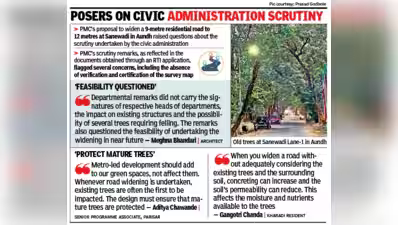
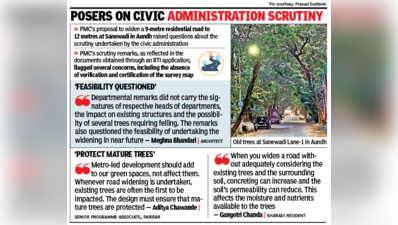
Pune: Aundh residents vehemently opposed the PMC’s proposal to widen a 9-metre residential road to 12 metres in Sanewadi, alleging that it could facilitate redevelopment and help a housing society use additional floor space index (FSI) rather than addressing any pressing traffic requirement.Residents questioned the need to widen an internal residential street without significant traffic congestion. They also raised concerns about the potential impact on the neighbourhood’s mature trees, some estimated to be between 50 and 80 years old, open spaces and residential character.Pune Municipal Corporation (PMC) issued a public notice on Nov 4 under Section 210 of Maharashtra Municipal Corporations Act, proposing to modify the road width along Sanewadi Lane 1, between ITI Road and Priyadarshan Apartments. It invited objections within a month and made the existing and the proposed road-line plans available for public inspection at its land acquisition and management department.Kharadi’s Gangotri Chanda, who filed a Right to Information (RTI) application with PMC to obtain records related to the proposal, said the issue went beyond the widening of a road. “Our objection is to the practice of widening an entire lane when there is no demonstrated need for it, simply because a building wants to utilise additional FSI. People use this stretch for walking. Widening it could change the character of the entire neighbourhood,” she said.According to Chanda, the housing society’s application to PMC sought a 12m road to facilitate redevelopment. The application included a map showing the plot’s location in relation to the Metro corridor, indicating its eligibility for additional development potential under the transit-oriented development (TOD) provisions, she said.Aditya Chawande, an architect and urban designer, and senior programme associate at Parisar, said the issue highlighted a larger conflict that could emerge in several neighbourhoods following the expansion of Metro infrastructure and the increased redevelopment potential around its stations.“This area is within the Metro’s TOD influence zone, where plots can become eligible for additional FSI. The ability to utilise that development potential is linked to the width of the adjoining access road under the development regulations,” he said.Chawande explained that plots within the prescribed distance of Metro stations could be eligible for higher FSI, subject to applicable conditions. Since the existing road is 9m wide, the additional development potential may not be fully utilised. The proposal to widen it to 12m could, therefore, make redevelopment using additional FSI possible.He said, “The housing society’s application did not explicitly state that the road widening was being sought for additional FSI. But its redevelopment demand and the accompanying map indicated the society could seek to utilise the development potential.”Architect Meghna Bhandari, who examined the RTI documents and the proposal, questioned why the widening should be undertaken when other buildings along the road had undergone redevelopment without the road being expanded. “Why is there a need to increase the width of a road that does not lead to a congested area? It is one of the few peaceful, green streets left in Pune. Why should it become busier and more crowded simply because a society wants to utilise more FSI?” she said.A senior PMC official said the road-widening proposal was initiated following an application from the housing society concerned, citing the need to accommodate increasing population. “The existing development plan (DP) provides for a 9m-wide road, with no provision for widening it to 12m. The proposal is being processed under Section 210 of the Maharashtra Municipal Corporations Act. All objections received within the stipulated one-month period would be heard by the municipal commissioner before a final decision is taken.”Residents expressed apprehension that increasing the road width could turn the quiet residential lane into a more prominent through-route, bringing increased traffic, commercial activity and concerns over the safety and security of the neighbourhood.Chawande said the preservation of green spaces should be central to any road-widening exercise, particularly as the stretch had several mature trees along its edges. He said some of the trees were estimated to be between 50 and 80 years old and could be affected if the road design did not adequately account for them.