







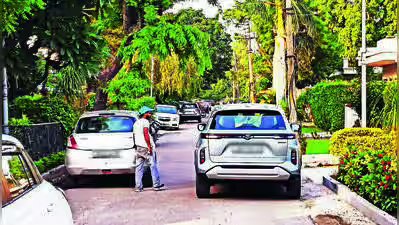
Chandigarh: While the Chandigarh administration and municipal corporation regularly crack down on street vendors, squatters and slum dwellers occupying public land, another form of encroachment continues to receive far less attention — residents extending gardens, hedges, fences and other structures into green belts and road berms outside their homes.Across nearly all residential sectors, public spaces have been landscaped or fenced as extensions of private properties. The encroachments not only eat into pedestrian space and parking areas but also gradually reduce the usable width of residential roads, raising concerns over access for ambulances and fire tenders.Small extensions, bigger problemResidents say individual encroachments may appear insignificant, but their cumulative impact can be substantial. Dense hedges raised flower beds, paving, grills and gates often extend close to the carriageway. When vehicles are parked on both sides, already narrowed roads can become difficult to negotiate.“If a vendor puts a table on public land, action is taken immediately. If a resident puts up a hedge, grill or flower bed and effectively takes over the same land, nobody seems to object. The law should not depend on who is occupying the space,” said Rajni Malik, a Sector 19 resident.Another resident said the problem becomes critical during emergencies, when even a few minutes’ delay for an ambulance or fire tender could have serious consequences.Parking pressure worsensThe encroachments are also adding to Chandigarh’s parking crisis. With many households owning multiple vehicles, roadside parking is already common. When the green strip outside a house is fenced or occupied, vehicles are pushed further onto the carriageway.“A small garden outside one house may not seem like a problem. But when 10 or 15 houses do it along a stretch, the road becomes narrower and parking spills onto the carriageway,” said a resident welfare association representative.Rules already restrict fencingUnder MC regulations governing hedges and fences, residents cannot freely occupy or fence municipal land adjoining their properties. Permission is required for certain hedges and fences along V-5 and V-6 roads, while such hedges are not permitted on V-3 and V-4 roads. The rules also prescribe setbacks based on road category.The issue has previously faced judicial scrutiny. The Punjab and Haryana high court has directed authorities to remove encroachments in front of houses, holding that the space between houses and metalled roads cannot be treated as private property. The MC had subsequently removed greenbelt encroachments in sectors including Sector 19.Demand for equal enforcementResidents question why homeowners occupying public land are not treated with the same urgency as vendors and slum dwellers.“Encroachment is encroachment, whether it is a jhuggi, a rehri or an expensive landscaped garden outside a house,” said a city-based urban planner.The MC recently proposed raising the penalty for greenbelt encroachment from Rs 50 to Rs 5,000 and increasing the annual licence fee for permitted hedges and fences on municipal land. It was rejected by the MC house, though residents, say higher penalties will have little impact without regular inspections. They want a sector-wise survey to identify unauthorised occupation and distinguish permitted landscaping from encroachment.The demand is for a uniform policy to reclaim public green spaces while keeping roads accessible, easing parking pressure and ensuring emergency vehicles can move unhindered.MC commissioner Amit Kumar said, “We regularly take action against illegal encroachments and will continue to do so.”