








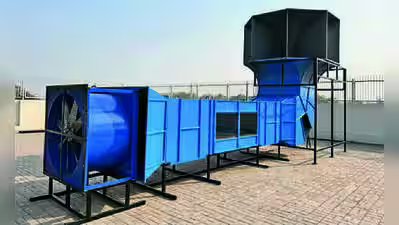
Ahmedabad: Wind turbines are usually pictured as tall mast structures on the seashore with large blades. They are meant to catch the steady breeze to generate electricity. But what if comparable electricity could be generated at much lower wind speeds?A team of researchers at Pandit Deendayal Energy University (PDEU) has developed an Archimedes wind turbine integrated with trumpet-shaped wind collector to advance decentralised renewable energy generation. The team also patented the design after the structure was installed on the PDEU campus recently.Prof Anirbid Sircar, director of the school of technology at PDEU, said that the innovation was spearheaded by Rohit Pawar, a research scholar in petroleum engineering department.“The idea is to explore whether wind can be harnessed in urban areas with a specialised design. The current design can capture wind even at 1 metre per second, compared to about 4-10 metres per second required for big turbines,” Sircar said. “Pawar’s efforts focused on developing an innovative aerodynamic configuration capable of capturing, accelerating, and efficiently utilising wind from multiple directions.”Prof S Sundar Manoharan, director general of PDEU, said that the development of compact, efficient, and adaptable wind energy systems has become increasingly important with the growing demand for decentralised and sustainable energy solutions.“Addressing this challenge, PDEU developed a system that improves overall energy conversion without increasing the rotor size or relying on complex mechanical tracking mechanisms,” he said.Researchers said that the system integrates four key aerodynamic innovations. First, an omnidirectional trumpet-shaped wind collector that captures wind from multiple directions. Second, a converging Venturi duct that accelerates airflow towards the turbine. Third, a honeycomb flow conditioner that improves airflow uniformity and reduces turbulence. Fourth, a three-bladed Archimedes spiral rotor with a 60° helix angle, coupled with a permanent magnet generator.“The integration of these components creates an enhanced aerodynamic pathway, directing and accelerating the incoming wind towards the Archimedes rotor,” Pawar said. “Unlike conventional wind turbines that generally require favourable wind direction and operating conditions, the omnidirectional configuration is designed to improve wind energy harvesting from varying directions, making it particularly promising for decentralised applications in urban environments.”Experimental validation of the fabricated prototype was conducted under controlled wind-tunnel conditions at PDEU, supporting the numerical investigations and demonstrating the system’s promising energy conversion performance, said researchers.