







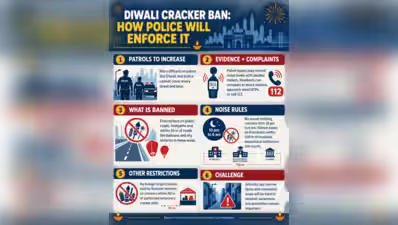
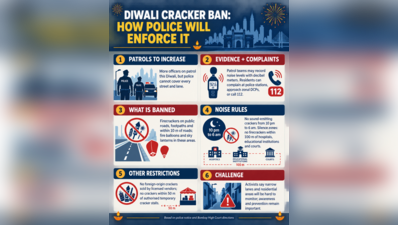
Pune: Police will step up patrols and act on citizen complaints to enforce the ban on bursting firecrackers on public roads and footpaths this Diwali in accordance with the Bombay high court order. Senior officers said, however, that posting personnel on every street and lane was not feasible.Additional commissioner of police (administration) Sanjay Patil told TOI that enforcement would rely on evidence gathered during patrols and complaints from residents. “Nearly every police station has decibel-measuring instruments, which personnel on patrol can use to record noise levels at different locations,” he said.“We cannot deploy police personnel on every road because there are so many roads in the city. We will, however, deploy more officers for patrolling this Diwali. Action will be based on evidence gathered during patrolling and complaints received,” the officer said.He said deputy commissioners of police (DCPs) in every zone had been authorised to initiate action. “Residents can approach the DCP concerned or lodge a complaint at any police station. Details, including noise readings taken at the location, would be forwarded to the zonal DCP for further action. Citizens can also report violations by calling on 112,” Patil said.The officer said police would focus on areas from where excessive-noise complaints were received. “Noise-pollution complaints would be dealt with under the Noise Pollution (Regulation and Control) Rules, 2000, with the zonal DCP initiating court proceedings after hearing the matter. Other violations could also invite penal action under applicable laws,” he said.Activist Kalyani Mandke, however, said enforcement would remain difficult. “It will be very challenging to monitor,” she said, adding that notifications alone would not alter long-standing practices and that sustained public awareness efforts were needed.Mandke said police patrols might struggle to detect violations across residential areas and narrow lanes. “No matter how much patrolling they do, people can burst firecrackers in narrow lanes, at turns and in residential areas. Often, it is only after the sound is heard that one realises crackers have been burst, and by then it may be difficult to identify the source,” she said, arguing that authorities should invest more in preventive measures and awareness campaigns rather than rely mainly on enforcement after violations are reported.A recent police notice reiterated that bursting firecrackers on public roads, footpaths and within 10 metres of roads is prohibited throughout the year, including on lanes and pathways used by the public. It also bans fire balloons and sky lanterns in such areas.The notice further prohibits bursting firecrackers within 50 metres of authorised temporary firecracker stalls, bars licensed vendors from selling foreign-origin crackers, prescribes noise limits, bans sound-emitting crackers between 10pm and 6am, and prohibits all firecrackers in silence zones within 100 metres of hospitals, educational institutions and courts.The measures are part of broader efforts to implement court directives on noise pollution and firecracker use.