









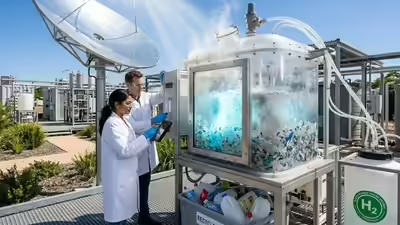
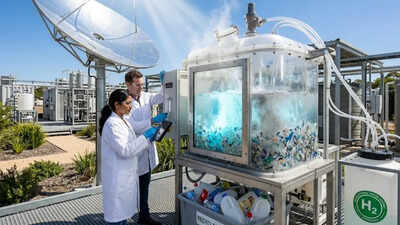
We usually discard plastic waste as it reaches its end-of-life for common people, but a research team at the University of Adelaide has made a major discovery that’s changing how the world deals with plastic waste. By harnessing solar energy, they’ve found a way to convert waste into valuable green hydrogen. This involves photocatalytic reforming, which breaks down everyday plastics like water bottles and food packaging at ambient temperature and pressure. Traditional recycling methods often lower the quality of materials, but this new technique uses a non-toxic, metal-free photocatalyst to trigger oxidative cleavage that generates clean fuel and useful chemicals. Not only does this provide a sustainable method for producing carbon-neutral energy, but it also addresses the problem of non-biodegradable plastics filling up landfills and oceans.
Scientists transform everyday plastic waste into green fuel using only sunlight
The core of this breakthrough is in a process called ‘photoreforming.’ In this process, scientists add materials that capture light, known as photocatalysts, to plastic waste. When sunlight hits these catalysts, they break down the polymer chains. In their experiments, researchers chose a catalyst made of carbon and free of metals. They used it on polyethene (PE) and polypropylene (PP), turning them into hydrogen and liquid fuels. Unlike pyrolysis, which needs temperatures over 500 degree Celcius and a lot of energy, this method offers a much more sustainable option.
How single-atom catalysts prevent secondary pollution
A study published in Nature explores the application of catalysts made from single atoms. These catalysts are designed on a molecular level to offer a vast surface area for chemical reactions. In some tests, they reached almost perfect selectivity for producing hydrogen. This impressive efficiency allows plastics to be transformed almost completely into high-value energy vectors, preventing them from turning into harmful byproducts.
Chemical upcycling ends the plastic life-cycle crisis
Traditional mechanical recycling can only be performed a few times before plastic loses its integrity. But this new chemical upcycling technique, backed by the Australian Research Council (ARC), tackles those tricky plastics that often end up as microplastics. It changes them into syngas, which is a mix of hydrogen and carbon monoxide. This method supports a circular economy and cuts down on the need for hydrogen from fossil fuels.
How pilot plants could revolutionise local power
The next step in the research, which has backing from several environmental groups, involves expanding these lab findings into industrial pilot plants. As the process runs at room temperature and relies on natural sunlight, modular plant deployment is expected to cost less than current waste-to-energy plants. This setup could help developing countries with abundant sunshine handle their plastic waste locally while also producing their own clean energy.