









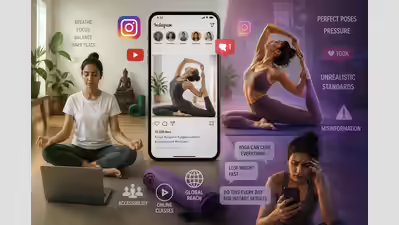
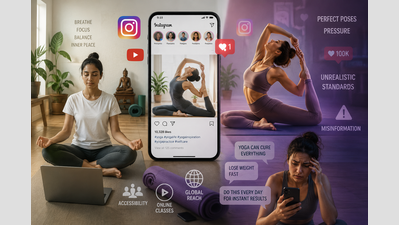
New Delhi: Not too long ago, mornings began with a yoga mat rolled out under the open sky, as practitioners stretched to the ‘Surya Namaskar’ in neighbourhood parks, under the guidance of a trained instructor. Today, that ritual has shifted indoors and onto screens — a quick scroll through Instagram or YouTube is all it takes to replace a scheduled session with a trained instructor. From short reels demonstrating stretches to hour-long guided routines, social media has reshaped how people — especially young professionals, students and homemakers — learn and practise yoga.The shift became evident during the Covid-19 pandemic, when lockdowns pushed instructors and studios online. Virtual sessions not only helped practitioners maintain continuity but also introduced yoga to many who had never entered a studio.Experts say yoga today serves as a much-needed pause button for tired urban minds. Platforms like Instagram and YouTube have helped bridge the gap between ancient practice and modern lifestyles, bringing wellness routines directly to the screens of young audiences. “In an age of burnout, people see yoga as a powerful tool for physical and mental wellbeing. Social media mainly inspires people to begin yoga from the comfort of home,” says yoga instructor Priyanka Koli, adding that it has amplified the reach, offering content with actionable steps for beginners.However, the digital transformation of yoga has also sparked concerns among practitioners and experts.Much of the content focuses on visually engaging postures, extreme flexibility and dramatic transformations. While these attract attention, practitioners say they risk reducing yoga to performance. Experts claim core elements such as breathwork, meditation and self-awareness often receive less attention than complex asanas that drive engagement.The pressure to emulate advanced practitioners can also discourage beginners. Experts warn that attempting difficult poses without supervision may cause injuries.“The content available online is designed for a wider audience and does not account for factors such as age, fitness level or existing health conditions. Without proper supervision, attempting complex poses can lead to injuries to muscles, ligaments and joints, and may aggravate underlying ailments,” says Dr Akhilesh Yadav, director of orthopaedics and joint replacement at Max Super Speciality Hospital.Another concern is misinformation. Social media is replete with unverified claims that yoga can cure illnesses or deliver instant results. Health professionals caution that while yoga supports overall well-being, it cannot replace medical treatment.“There is no such thing as two-minute yoga or quick fixes tailored to a desk job. Much of the content online ends up misguiding people. Yoga is a continuous learning process that requires proper guidance and consistency,” says Ambica Sood, founder of Panchakosha Yogashala.The challenge, according to experts, is that anyone can present themselves as a wellness expert online, making it difficult for users to distinguish credible guidance from misleading advice.“Without proper guidance, incorrect postures and alignment often go unnoticed. If practised over time, this can result in injuries. I have seen patients who fail to recognise the damage until it becomes difficult to treat,” says Dr Anju Puthanpurayil, an ayurveda specialist and yoga instructor.As yoga settles comfortably into the digital age, experts stress that social media can be a useful starting point — but not the destination. Whether practised under an open sky or guided by a screen, practitioners say the essence of yoga remains unchanged: breathing mindfully, stretching with awareness, tuning out the noise and finding your zen.