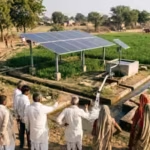








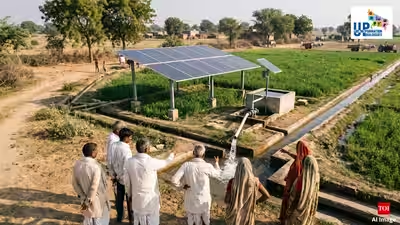
LUCKNOW: In Panchampur, a village nestled in the Birouna Panchayat of Naraini development block in Banda district in Uttar Pradesh, a new solar-powered community irrigation model is taking shape.Preparations involving command-area mapping and solar-pump design are underway so that a single solar installation can serve roughly ten farmers, a marked departure from the conventional one-pump-one-farmer system.The initiative, supported by the Yogi Adityanath government and aligned with the Pradhan Mantri Kisan Urja Suraksha evam Utthaan Mahabhiyan (PM-KUSUM) scheme, draws inspiration from the Agri-PV (agrivoltaic) model operating in Bahraich’s Ghumnabharu village.Farmers from Panchampur have visited the site to observe its functioning, after which local adaptation efforts began under district administration guidance.This development is the latest in a sequence of interventions that have sought to address the long-standing constraints of agriculture in Bundelkhand. For decades the region, including Banda, was defined by recurrent drought, high dependence on diesel pumps, unreliable grid electricity, low cropping intensity, and distress migration.Since 2017 the state government has prioritised water security, irrigation expansion, renewable energy, and connectivity as central elements of its Bundelkhand strategy.
From water scarcity to measured gains in conservation and irrigation
Banda’s recognition at the national level illustrates the shift. In 2024 the district received the Best District (North Zone) award at the 5th National Water Awards for efforts that included rejuvenation of ponds, construction of check dams and soak pits, expansion of micro-irrigation, and community participation in water budgeting.Earlier campaigns involving contour trenches, well desilting, and jal chaupals contributed to reported improvements in groundwater levels in parts of the district.Parallel infrastructure work has expanded physical access to irrigation. The Arjun Sahayak project, inaugurated in 2021, was designed to create and restore irrigation potential across Mahoba, Banda, and Hamirpur by utilising waters of the Dhasan river; official accounts note the creation of tens of thousands of hectares of irrigation potential in the broader Bundelkhand area under related schemes.Under the Per Drop More Crop component of PMKSY, more than 28,500 hectares in Banda alone have been covered by drip and sprinkler systems since 2015–16. Revival of government tubewells, some planned for hybrid solar operation, and construction of farm ponds and bunds have further supported the effort.In July 2026 the Chief Minister inaugurated and laid foundation stones for 229 projects worth over Rs710 crore in Banda and the Baberu constituency, encompassing roads, education, healthcare, drinking water, and irrigation-related works.
Renewable energy and the bahraich agri-pv precedent
Renewable energy has become a complementary strand. In 2024 Yogi Adityanath inaugurated a 70 MW solar power project in Banda developed by the Avaada Group, part of a wider push that also includes solar street-light schemes (in which Banda has reported full implementation under certain programmes) and the training of Solar Mitras.Under PM-KUSUM, Uttar Pradesh has installed more than 50,000 standalone solar pumps under Component B, placing the state among the top three nationally; Bundelkhand districts receive elevated subsidies, reaching up to 90 percent for Scheduled Caste, Scheduled Tribe, and priority-area farmers. District-level data indicate several hundred to over a thousand pumps installed in Banda itself.The Bahraich Agri-PV model provides a concrete template for community-scale application. In Ghumnabharu (Mihipurwa block), a 43 kW solar microgrid powers ten solar pumps that irrigate approximately 100 acres, benefiting around 100–200 families.Panels are mounted on raised structures so that shade-tolerant crops or other agricultural activity can continue underneath, generating both food and energy from the same land.Women’s self-help groups, including collectives such as Ambedkar Urja Samiti, manage the system. Irrigation costs have fallen sharply—from reported levels near Rs200 per hour under diesel to around Rs60 per hour—while productivity gains of several metric tonnes and additional marketable value have been recorded in recent seasons. Women farmers without male family members present can now irrigate independently.A senior central official who inspected the plant described it as an “oasis in the desert,” highlighting its combination of clean energy, cost reduction, and women’s leadership.
Design and expected benefits of the panchampur model
In Panchampur the technical process begins with command-area mapping to identify land that can be integrated into a shared irrigation system. Solar-pump capacity and pipeline layout will then be designed to match the assessed water demand of the fields.The core operational innovation is the multi-farmer model: one pump serving about ten cultivators rather than a single household. This multiplies the number of beneficiaries per installation and reduces the per-farmer capital and operational burden.Alignment with PM-KUSUM opens the possibility of substantial central and state subsidies, lowering the residual cost that farmers or groups must meet.Expected outcomes include reduced expenditure on diesel and grid electricity, more reliable water during critical growth stages, and scope for higher cropping intensity.Lower input costs can improve net farm income and create conditions for greater participation by women cultivators, supporting the Lakhpati Didi objective of raising the earnings of women in self-help groups. The model also advances environmental goals by displacing fossil-fuel use and promoting efficient water application.Because the system is community-managed, local ownership and maintenance arrangements will be essential to sustained performance.Connectivity, Institutions, and the Broader Regional ContextThese agricultural measures sit within a larger infrastructural framework.The 296-kilometre Bundelkhand Expressway, linking Chitrakoot through Banda, Mahoba, and Hamirpur to the Agra-Lucknow Expressway, has improved market access for farm produce and industrial goods while contributing to reported increases in land values along the corridor.Institutional capacity has expanded with the operationalisation of Maharani Durgavati Medical College, an agricultural university, an engineering college, and a polytechnic in the region. Plans for industrial development under the Bundelkhand Industrial Development Authority (BIDA), defence-corridor nodes, and natural-farming clusters further indicate an attempt to diversify the rural economy.In recent statements the Chief Minister has described the visible change in Banda compared with the situation nine years earlier, citing improved connectivity, irrigation reach, drinking-water supply, and employment opportunities under the double-engine government.
Outlook and implementation considerations
The Panchampur pilot remains at the preparatory stage of mapping and design. Its success will depend on accurate technical sizing, timely procurement and installation under PM-KUSUM, effective group formation, and clear rules for water allocation, cost sharing, and maintenance.Experience from Bahraich and from standalone solar-pump programmes elsewhere in Bundelkhand shows that utilisation can be seasonal and that community governance is critical to avoid under-use or conflict. If the model performs as intended, it can be replicated in other villages of Naraini and neighbouring blocks, adding a community layer to the existing individual-pump and canal-based irrigation infrastructure.Taken together, the initiative illustrates how the Yogi Adityanath government has sought to combine large-scale infrastructure (expressways, major irrigation projects, renewable-energy plants) with targeted, locally adapted solutions such as shared solar pumping and women’s group management.For farmers in Panchampur the immediate promise is lower irrigation costs and more dependable water; for the district it represents one more incremental step in the longer effort to convert Bundelkhand’s historical vulnerability into greater agricultural resilience and rural income growth.Continued monitoring of coverage, cost savings, productivity changes, and women’s participation will determine how far that promise is realised on the ground.