







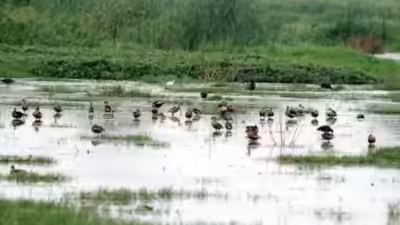
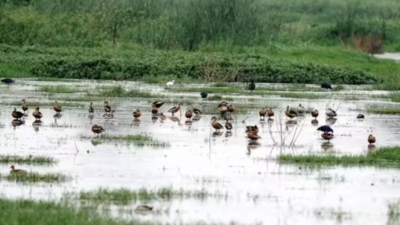
CHENNAI: More than one lakh patta holders across South Chennai have been pushed into an ownership and house development crisis after the Chennai Metropolitan Development Authority (CMDA) froze planning approvals around the Pallikaranai Ramsar site in Oct last year, the Confederation of Real Estate Developers’ Associations of India (Credai) said on Tuesday.At a news conference, Credai urged CMDA to revisit the demarcation of the 1km uniform Ramsar influence zone covering 3,358 hectares (8,397 acres), saying the move has rendered large parts of Velachery, Pallikaranai, Perungudi, Sholinganallur and Perumbakkam unsuitable for future construction.Addressing reporters, Credai Chennai vice-president Viswajith Kumar, flanked by eight other office-bearers, said the original Pallikaranai Swamp Reserve Forest covered 698 hectares and was notified in 2007 under the Tamil Nadu Forest Act. In 2022, an additional 550 hectares were brought under protection when the marsh was designated a Ramsar site, expanding the protected area to 1,248 hectares.The developers’ demand comes weeks after the Tamil Nadu govt cancelled the Brigade Morgan Heights project, a proposed 2,000-unit residential township spread over 14.7 acres. The project was alleged to fell within the Ramsar site. Brigade, however, had maintained that it was patta land.Quoting the National Green Tribunal’s Sept 24 order last year, Viswajith said the tribunal directed CMDA to treat a 1km buffer around the entire 1,248-hectare Ramsar site as an influence zone and halt construction activity. Acting on the order, CMDA stopped issuing planning approvals from Oct 9.“The entire South Chennai has been put in a spot since then. No construction is happening, no completion certification is given, and no projects are coming up,” he said, adding that the influence zone includes 1 lakh patta houses, besides key public infrastructure such as Velachery and Perungudi MRTS stations, 15 Chennai Metro Rail phase-II stations, Chennai One, the National Institute of Wind Energy (NIWE), the National Institute of Ocean Technology (NIOT) and ELCOT facilities.“Can you displace all these people? How can you remove all these institutions?” Viswajith asked. “House owners are worried if their ownership will be challenged. Land values are falling because of the planning freeze. People are facing delays in construction loans, housing loans are being withheld despite project approvals, and future redevelopment approvals remain uncertain.”Credai estimated the freeze has affected nearly Rs 1 lakh crore worth of business activity, while the state stands to lose Rs 19,995 crore in revenue from taxes, planning permission fees and labour-related economic activity.The association alleged that the influence zone was demarcated by merely juxtaposing old maps using GIS technology. “Instead of just overlaying old maps, the govt has to undertake ground-truthing, hydrology studies, drainage assessment, land-use analysis and survey number validation before finalising the boundary,” Viswajith said.Credai members argued that the freeze could undermine major public investments. They pointed out that nearly Rs 60,000 crore has already been invested in Chennai Metro Rail and warned that if future urban growth remains frozen, foreign banks could reconsider the feasibility of financing infrastructure projects in Tamil Nadu.Credai Chennai president Mehul H Doshi said the association was not opposed to protecting the original wetland. “We are not disputing the 698-hectare Pallikaranai Reserve Forest, notified in 2007 and protected under law. Our concern is only with the additional 550 hectares included when the marsh was designated a Ramsar site in 2022. Survey number demarcation, ground-truthing, public consultation and statutory notification under the Wetlands (Conservation and Management) Rules were not completed before the expansion. The govt must complete the demarcation process legally and with due process,” he said.