











Hyderabad: Telangana’s cropping pattern is becoming increasingly concentrated around paddy and cotton, with a new study showing that farmers are far more likely to stick with these two crops than maize, red gram and other traditional crops, raising fresh concerns over the state’s declining crop diversification.The study found that while 97 out of every 100 acres under paddy are likely to remain under the crop in subsequent seasons, the corresponding figure is only 52 acres for maize and 50 acres for red gram, indicating a gradual shift towards paddy and cotton cultivation.
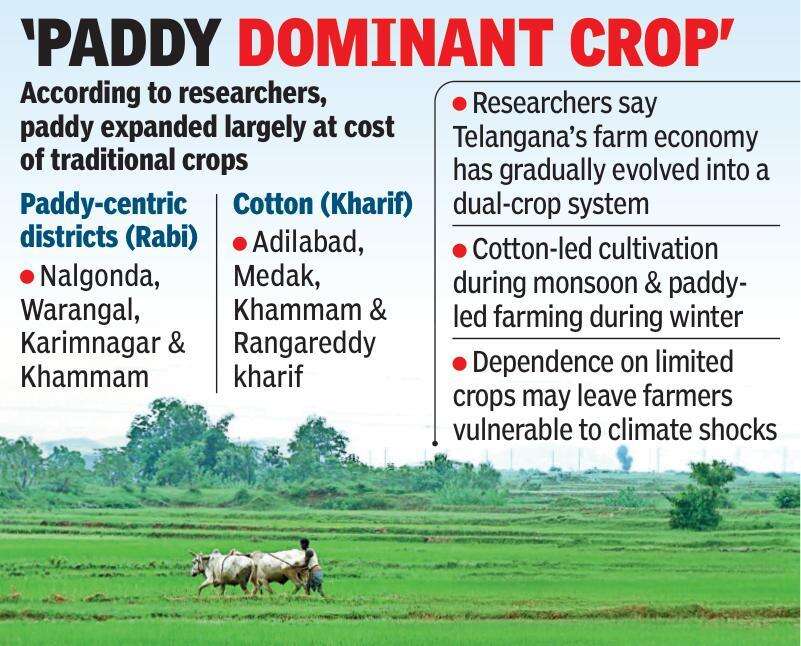
The findings are part of a study titled ‘Dynamics of crop diversification in Telangana: A Markov chain analysis of pre- and post-bifurcation cropping patterns‘, published this month in the journal ‘Frontiers in Sustainable Food Systems‘. The research was conducted by scholars from the department of agricultural economics at the College of Agriculture, Rajendranagar, and the department of statistics and mathematics at Professor Jayashankar Telangana Agricultural University.Researchers analysed district-wise data on major crops cultivated in Telangana between 2000-01 and 2022-23 to examine how cropping patterns evolved after the formation of the state in 2014 and whether agriculture had become diversified.The team used a statistical technique known as the Markov chain model, which measures the likelihood of land remaining under the same crop or shifting to another crop over time. A higher retention probability indicates farmers tend to continue cultivating a crop, while a lower probability suggests frequent shifts.The analysis showed that paddy has emerged as Telangana’s dominant crop, particularly during the rabi season, driven by expanded irrigation facilities, procurement support and improved market access. The crop recorded a retention probability of 0.97, meaning nearly all land currently under paddy is likely to remain under the crop in future seasons.Cotton also remained a highly stable choice during kharif, registering a retention probability of 0.90, indicating that about 90 out of every 100 acres under cotton are expected to continue with the crop.“Paddy-driven cultivation model causes damage but diversion from it needs operational mechanism. Apart from giving advisories, the govt should think of announcing bonus for other crops too,” Kenneganti Ravi of Rythu Swarajya Vedika explained.According to the researchers, paddy has expanded largely at the cost of traditional crops such as green gram, jowar, sugarcane, soybean, castor and black gram, underscoring the influence of irrigation expansion and changing market incentives after bifurcation.The study observed that districts including Nalgonda, Warangal, Karimnagar and Khammam have become increasingly paddy-centric, particularly during rabi, while cotton continues to dominate large parts of Adilabad, Medak, Khammam and Rangareddy during the kharif season.Researchers said Telangana’s farm economy has gradually evolved into a dual-crop system, characterised by cotton-led cultivation during the monsoon season and paddy-led farming during winter. While the shift has contributed to higher agricultural output, the study cautioned that dependence on a limited number of crops could leave farmers more vulnerable to climate shocks, groundwater depletion, and price volatility.The findings assume significance at a time when Telangana is grappling with erratic rainfall and renewed calls for crop diversification. Experts have long argued that a broader crop basket can help farmers reduce risks arising from drought, pest attacks, and market fluctuations.