








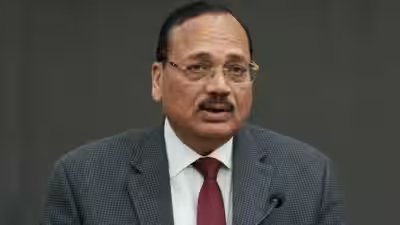
NEW DELHI: Chief Justice Surya Kant on Saturday proposed ‘Nyaya Setu’ for the BRICS+ bloc for seamless exchange of judgments of the highest courts of the bloc countries and allowing young judges to share dais with judges of partner country jurisdictions to learn the best practices.Speaking the BRICS+ Legal forum organised by Bar Association of India, CJI Kant placed a twin proposal: first, a BRICS+ judicial fellowship, allowing early career judges to sit, even briefly, in one another’s courts; and second, a shared jurisprudence repository, drawing on India’s own considerable investment in digitised case law, so that a judgment written in New Delhi or Brasilia or Pretoria need not wait years to inform a bench elsewhere facing an identical question.“Let it be ‘Nyaya Setu’, a ‘Bridge Of Justice’ that connects eleven legal traditions which have mutually agreed that trust should be cultivated deliberately rather than awaited passively. Let us, therefore, commit to a future where institutions are not fortresses of formality but bridges of trust, where our united efforts illuminate a path of mutual harmony and prosperity,” he said.Explaining the importance of rule of law in building a vibrant economy, CJI Kant said the marriage between the rule of law and favourable economic conditions engenders ‘Nyaya-nomics’, or economics of justice. “It is a fact that consistent adjudication and trust in the process reduce the cost of each transaction built upon it, thereby levelling the playing field for market forces, and in turn, making way for growth,” he said.He said when SC upheld the validity of the Insolvency and Bankruptcy Code (IBC), and later affirmed that the commercial wisdom of a Committee o Creditors deserved primacy over years of open-ended litigation, it was emphasising that “capital recycled quickly is capital that returns, and capital trapped in litigation for a decade rarely does.”
Share your thoughts in the comments
Be respectful · TOI community guidelines
The CJI said India rose from among the bottom quarter of the World Bank’s ease of doing business rankings into its top hundred, and enforcing a contract in this country stopped being a byword for delay. “To my mind, a courtroom that keeps its word quickly becomes a country the world is willing to trust with its capital,” he said.