









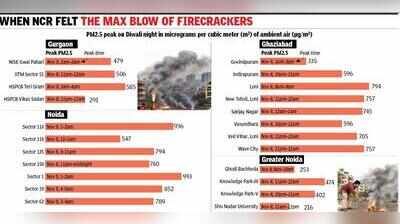
Gurgaon: With crackers still bursting well beyond Supreme Court’s 10pm deadline, pollution levels in Noida saw the sharpest Diwali-night spike among three cities to the east of Delhi, with Sector 1 recording a PM2.5 of 993 micrograms per cubic metre between 1am and 2am on Monday.Noida’s PM2.5 average across reporting stations had peaked earlier at 714.1 µg/m³ between 11pm and midnight, stayed above 650 for another hour and then eased as winds picked up towards dawn. But missing hourly readings at several monitoring stations left gaps in the picture, making it difficult to establish the full extent of the pollution surge.For almost eight hours, the city’s PM2.5 stayed above 300 µg/m³. It took 10 hours to fall below 200, the slowest clearance in five Diwalis. At 403, its Diwali-night average was the third-worst in five years.Ghaziabad’s average across reporting stations peaked at 559 µg/m³ between 11pm and midnight. Wave City recorded 757.8, while New Tehsil-Loni and Ved Vihar-Loni registered 706.3 and 705.6. The city average stayed high at 539.4 in the next hour before falling to 119.6 by 11am-noon.Greater Noida’s average peaked at 296.5 µg/m³ between 11pm and midnight. Knowledge Park-III recorded the highest individual reading at 474, Knowledge Park-V reached 402.3 between 10pm and 11pm. By 11am and noon, the average had fallen to 81.7.But gaps in monitoring left the full picture unclear. Across the 36 hours from midnight on Nov 8 to 11am on Nov 9, 75 of 720 possible hourly observations were missing — 10.4%. Greater Noida had 40 missing readings out of 180 across five stations (22.2%). Gaur Yamuna City reported no data for the entire period; the other four stations had one missing reading at Knowledge Park-III and three at Shiv Nadar University.Noida had 20 missing readings out of 252 across seven stations. Ghaziabad had 15 out of 288 across eight. In Noida, Sector 125 missed five readings, Sector 62 seven, Sector 110 four and Sector 39 four. In Ghaziabad, Sanjay Nagar had 10 missing readings, Loni four and Vasundhara one.Each gap represents a station’s hourly observation, not an entire station being offline.The gaps are crucial because a city’s hourly average uses only stations reporting at that time. When readings are missing, fewer locations contribute to the average data, leaving those areas out of the calculation. The average may not capture the full spread of pollution, making comparisons between cities or hours less reliable. A missing reading alone does not prove pollution was higher or data deliberately withheld. It means there is less evidence to assess the air.PM2.5 refers to particles no larger than 2.5 microns — about one-thirtieth the width of a human hair. They travel deep into the lungs and can enter the bloodstream, leading to asthma, bronchitis, respiratory infections, reduced lung function and cardiovascular disease in the long run.“PM2.5 is a real public health issue, particularly in densely populated areas. Fine particles penetrate deep into the lungs and enter the bloodstream, affecting several organs,” said Arunesh Kumar, director and head of pulmonology at Paras Health in Gurgaon.Children, older people, pregnant women and those with existing heart or lung conditions are the most vulnerable, he said.Kumar advised people to avoid outdoor activity and strenuous exercise when pollution is high, use a well-fitting N95 mask when necessary and ensure suitable indoor air filtration. “Air pollution is not just a seasonal issue. It is a chronic health concern. Reducing emissions requires a collective effort,” he said.