









How Noida Airport will grow
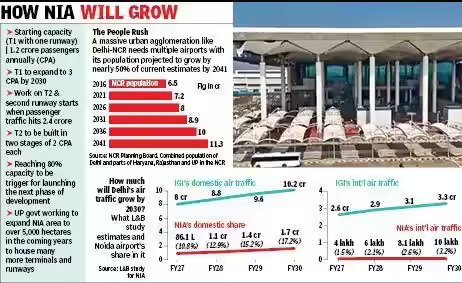
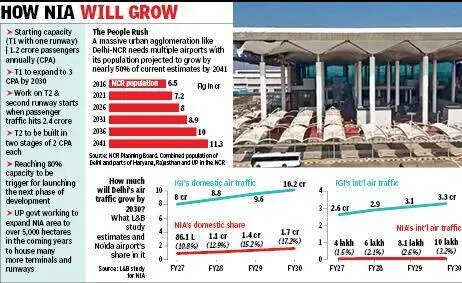
NIA, however, will have to compete for flights with the hugely better-connected IGIA. Especially during the ongoing West Asia crisis when airlines are cutting flights left, right and centre as operating costs spiral and the rupee falls.The NIA developer had appointed Landrum & Brown (L&B), one of the world’s oldest aviation planning consultancy firms, to conduct a traffic study. To determine that, L&B first did so for the Delhi region as a whole. The study projects NIA will account for about 8% of Delhi-NCR’s air traffic demand this fiscal, with that share rising to almost 14% in the fiscal ending March 2030. IGIA will “continue to be favoured by airlines during the initial years post commencement of operations at NIA... once traffic at IGIA nears its ultimate capacity, it is expected that there will be spillage of traffic to NIA,” it says.NIA opens with an initial capacity of 1.2 crore passengers per annum (CPA), which is the capacity of IGIA’s oldest and smallest terminal, T2. So with no capacity constraints, what the long-awaited second commercial airport in the short term means for Delhi-NCR fliers is more options, especially in peak hours as IGIA has no spare slots in highly sought morning and evening time slots of 6-9 am/pm. People who need to reach Delhi or other big cities in time for morning business meetings and be back in time to sleep at home will have more early morning and late-night flights.While it sounds easy, NIA has not had it easy since inception. It was to have three launch airlines — IndiGo, Akasa and Air India Express. But due to massive losses of the AI Group last fiscal, the Tata group budget carrier has pulled out of NIA. So Noida will primarily be an IndiGo airport with some flights by Akasa to begin with. Regional flights, which so far didn’t get IGIA slots, could make a beeline for Noida unless Delhi airport changes its stance.Moreover, airlines have no cost advantage at NIA. Delhi govt has temporarily cut VAT on jet fuel to 7%, dimming the shine on Noida’s 1% VAT advantage. Connectivity will also be a major issue in initial years as long as going by road is the only option for passengers and till NIA gets a metro link.“NIA has been bid out on revenue-sharing, which is per passenger basis and there’s no revenue share for cargo. Almost a quarter of air cargo destined to and from NCR comes from NIA’s catchment area. However, in India, 70-75% cargo goes in the belly of passenger planes. So, unless you have enough commercial flights, cargo buildup can’t happen,” said an industry insider. NIA is betting big on cargo.Taking off amid turbulence, this could have financial implications. But NIA’s long-term story is rock solid. So much so that other big private airport operators in India are already seeing a role for themselves when and if Flughafen Zürich AG decides to dilute its stake in Noida Airport.The reason is the population growth of the Delhi-NCR megapolis, which will become the most populous urban conglomerate globally by overtaking Tokyo by 2030 when population touches the 9-crore mark, according to NCR Planning Board. That is the time when NIA is projected to be completing the first of its three phase-wise expansions. Phase 1 expansion will see NIA T1 growing to a capacity of 3 CPA. The current plans are for two runways and as many terminals to reach a peak capacity of 7 CPA.An airport is a long-term story. The Palam Airfield was established by the British in the 1930s and expanded to be used as an airbase during World War II. Commercial flights here started in 1962 when the same were moved from Safdarjung Airport due to increase in traffic. In its nineties, IGIA is yet to see the final chapter in its evolution, which will be the replacement of T2 with T4 sometime in the next decade.An airport is a long=term story. The Palam Airfield was established by the British in the 1930s and expanded to be used as an airbase during World War II. Commercial flights here started in 1962 when the same were moved from Safdarjung Airport due to increase in traffic. In its nineties, IGIA is yet to see the final chapter in its evolution which will be the replacement of T2 with T4 sometime in the next decade.