










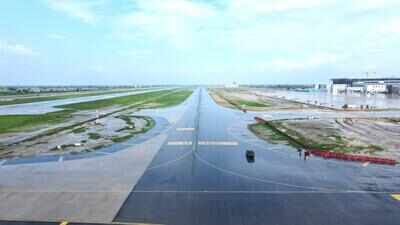
Noida: Every winter, dense fog at Delhi’s IGI Airport triggers flight delays, cancellations and diversions that disrupt schedules across India because of its role as a major aviation hub. Noida International Airport, recently renamed Narendra Modi International Airport, could ease some of that pressure by giving NCR a second airport capable of operating in low visibility conditions.The airport, which began operations on June 15, is now working towards DGCA certification for CAT III landings, which allows aircraft to land in extremely low visibility conditions, reducing flight diversions, delays and cancellations caused by dense fog.Noida International Airport vice-chairperson Christoph Schnellmann told TOI on Friday that the airport has a 3,900-metre runway supported by an Instrument Landing System (ILS) and a complete aeronautical ground lighting system needed to facilitate CAT III operations.“With the systems in place, we are working through the certification process with DGCA for CAT III operations,” he said.NIA, however, did not comment on how soon the certification is likely. So, it remains unclear whether flight operations under extreme fog conditions will commence this winter.DGCA has to conduct inspections and trial runs to ascertain the infrastructure readiness — whether the runway, lighting, instrument landing system, aircraft operations and air traffic control can safely support landings in extremely poor visibility conditions — before issuing the certificate. The end-to-end process typically takes threeto four months depending on infrastructure readiness and regulatory flight calibration schedules.Rule 78 of the Aircraft Rules, 1937, which provides for aerodrome licensing, does not make CAT III ILS certification a prerequisite for a DGCA aerodrome licence. Airports can be licensed to operate with lower-category instrument landing systems or visual flight facilities, depending on their infrastructure and approved operations. CAT III capability is necessary only for landing operations in extremely low visibility, such as dense fog, and requires additional runway infrastructure, ILS equipment, approach and runway lighting, visibility-measuring systems, operational procedures and DGCA approvals.Across India, six airports, including Delhi, Lucknow, Jaipur, Amritsar, Kolkata and Bengaluru, have one or more runways DGCA-certified for CAT III operations. All four runways at IGI Airport are CAT III-compliant.NIA, meanwhile, is also coordinating with airlines and agencies on visibility monitoring, lighting and navigation aids, and timely passenger information. It is set to commence international cargo operations in the coming weeks.While there is no confirmed date for international flight operations yet, NIA has begun discussions with several airlines across the Middle East and Southeast Asia. “The timelines and scope of international passenger operations will be guided by regulatory approvals, market dynamics and the network plans of our airline partners. We are working closely with regulatory authorities and airline partners to facilitate this next phase,” Schnellmann said.At present, IndiGo and Akasa Air operate 35 daily flights connecting NIA to 16 cities such as Bengaluru, Kolkata, Mumbai, Hyderabad, Lucknow, Ahmedabad, Pune, Amritsar, Jammu, Srinagar, Jaipur, Dehradun and Bhopal. In the first 15 days since domestic flight operations began on June 15, the airport recorded a passenger footfall of 20,522, Airports Authority of India (AAI) data shows. In July, it saw 76,593 passengers, before numbers fell to 58,520 in Aug and 55,890 in Sept. Oct figures have not been released yet.