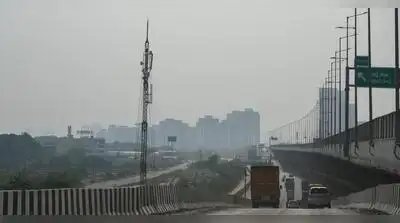









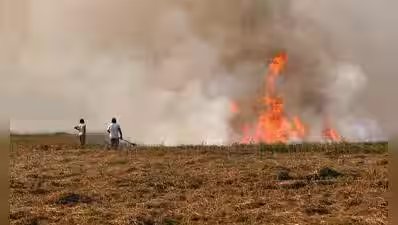
Gurgaon: Haryana recorded just eight incidents of stubble burning between Sept 15 and Oct 15 this year, an almost 99% plunge from 702 during the same period in 2020. But there’s a catch.According to officials, dense cloud cover and wet spells may have affected satellite detection, making the sharp decline encouraging but not conclusive as Delhi-NCR enters its peak pollution season.The paddy harvesting season runs from Sept 15 to Nov 30. Damp straw is harder to burn, but incidents could rise once conditions turn dry. The latest tally was also 68% lower than the 25 fires recorded during the corresponding period last year.Several traditional hotspots recorded no fires. Kaithal registered zero against 115 in 2020, Karnal none against 214, and Kurukshetra none against 151. Jind, which reported 20 incidents in 2020 and nine last year, also recorded none. Gurgaon had no detected fires.The eight incidents were reported in Palwal (2), Sonipat (2), Faridabad (1), Hansi (1), Panchkula (1) and Sirsa (1).Anumita Roychowdhury of the Centre for Science and Environment (CSE) attributed the decline to govt-backed methods of managing crop residue, along with better monitoring and compliance.“Both in-situ and ex-situ strategies supported by govt are now beginning to take root. The scope of implementation has expanded, bringing a lot more farmers within their ambit. More importantly, compliance and monitoring have also improved over the last couple of years,” she said.Roychowdhury said the trend showed that stubble burning could be curbed through sustained implementation. “If we have been able to achieve such a drastic reduction, this shows that the problem is solvable. We can actually eliminate it if implementation remains very stringent and reaches all farmers across the region,” she said. “We really need to ramp up further so that we are able to eliminate the problem.”The year-wise figures underline how sharply the numbers have fluctuated. Haryana recorded 702 fires in the period in 2020, rising to 850 in 2021 before falling to 168 in 2022. The count rebounded to 542 in 2023 and 559 in 2024, then plunged to 25 in 2025 and eight this year.However, fewer farm fires alone will not guarantee cleaner winter air. “With the share of stubble burning going down, the contribution of other regular, continuous emission sources is going to show up even more. Vehicles, industry and road dust are among them. We cannot hide behind the smoke of crop fires anymore,” Roychowdhury said, calling for stricter action against these sources.She also flagged El Niño as a concern. “Scientists are cautioning that El Niño is likely to aggravate the trapping of pollution. This is a double jeopardy for us,” she said, adding that its impact was yet to be understood.Across Punjab, Haryana, Uttar Pradesh, Delhi, Rajasthan, Uttarakhand and Madhya Pradesh, satellites detected 793 residue-burning incidents between Sept 15 and Oct 15. Madhya Pradesh accounted for 350, Punjab 185, Uttar Pradesh 134, Rajasthan 99, Uttarakhand 16, Haryana eight and Delhi one.On Oct 15, 15 fires were detected across the region — seven each in Rajasthan and Madhya Pradesh, and one in Punjab. None was detected that day in Haryana, Uttar Pradesh, Delhi or Uttarakhand.