











CHENNAI: Three years ago, S Hameed, 24, stepped out of Chennai Central with a backpack, a job offer and the hope of building a better future. He had come from Puttur in Andhra Pradesh, after his UG. But finding a place to stay in the metropolis turned out to be the biggest test. “My parents are farmers and we have no relatives in Chennai. A friend and I searched for houses with ‘to-let’ boards, but nobody rents to bachelors. That’s when my friend suggested I try a paying guest (PG) facility,” he said. Three years later, Hameed is still living in a PG near Karapakkam.Every year, thousands of students and young professionals arrive in Chennai. For many, renting a house becomes daunting due to rising rents. So, PG accommodation is the default choice. Chennai’s PG sector, however, operates without any licensing framework or uniform operational standards. There are no prescribed minimum room sizes, occupancy limits, mandatory electrical and fire safety audits or grievance redress systems.
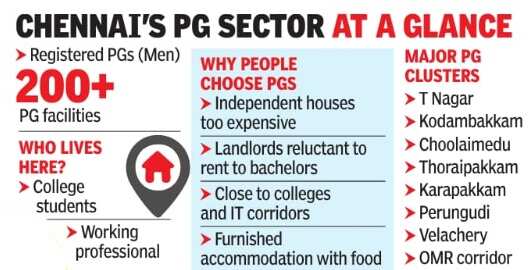
Chennai’s PG sector at a glance
Chennai does not even issue a separate licence for PG accommodation. “Most operators obtain a trade licence from GCC under categories such as lodging houses, mansions, guest houses or service apartments. The annual licence fee ranges from Rs 5,000 to Rs 25,000,” a GCC official said.“At a T Nagar PG where I have been staying for more than two years, the food quality has deteriorated. When we complained, the manager warned that if we skipped the onemonth notice before vacating, our security deposit would be forfeited,” said a student, T Karthikeyan.S Malathi Helen, Chennai district collector, said only women’s hostels and homes came under TN Hostels and Homes for Women and Children (Regulation) Act, 2014. “We have the power to inspect, suspend or cancel licences if rules are violated. Men’s PGs and hostels do not come under this Act or our jurisdiction,” she said.
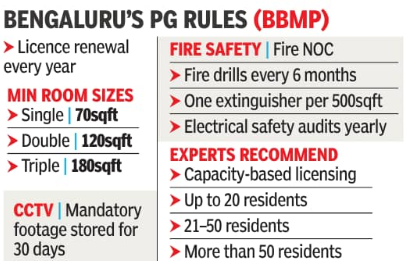
Bengaluru’s PG rule (BBMP)
Over the past few years, the average rent for a threesharing room has risen from around Rs 9,000 to Rs 11,000 a month, while double-sharing accommodation now costs nearly Rs 14,000 compared with Rs 12,000 earlier. “A 1BHK near Kodambakkam would cost Rs 14,000 for a family, and Rs 20,000 for a bachelor, excluding electricity and water charges,” said a student, S Dhanvanth. “Every month, I get a bill of Rs 4,000 for an AC room, which I shared with my roommate. After he moved out, I hardly used the AC, but my bill came to Rs 3,800,” Dhanvanth said.In neighbouring Bengaluru, the Bruhat Bengaluru Mahanagara Palike (BBMP) introduced an SOP and licensing system for PGs in 2023. “The SOP was to control the drastic increase in PG facilities. At least 20,000 tenants lived in these facilities, and the civic body had to ensure minimum living standards,” BBMP Commissioner Maheswara Rao said.GCC commissioner G S Sameeran said the corporation would study the Bengaluru model. “We have so far issued notices to 900 buildings registered as residential buildings but operating as PGs.”