









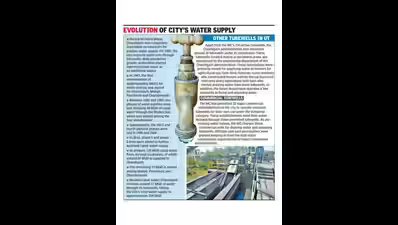
Chandigarh: With the Municipal Corporation (MC) having rejected the proposed 24×7 water supply project, the city will continue to depend on its existing network of tubewells. No further closures of operational tubewells are planned, sources said. Officials indicated that the decision has brought relief to several areas that rely heavily on groundwater for daily water supply.Out of 289 tubewells in Chandigarh, around 59 were closed over the past three years as part of preparations linked to the now-scrapped 24×7 water supply plan. However, with the project no longer on the table, the remaining 230 functioning tubewells will continue operating and supplying water to consumers according to the current schedule and practice.Sources said these tubewells are spread across different parts of the city, with a significant concentration in colonies and villages. In many such localities, tubewells remain the primary source of potable water, catering to thousands of residents every day. Officials added that instead of shutting them down, the MC is now exploring plans to strengthen existing tubewells wherever required. Financial estimates for upgrades, repairs and improvements are reportedly being prepared at different administrative levels.“The city is receiving approximately 17 million gallons per day (MGD) of water from more than 200 tubewells. They are a prime source of water supply in several areas. Special manpower has also been deployed at these tubewells to ensure timely water supply and provide security to the installations,” sources said.Under the original 24×7 water supply project, all tubewells were to be closed in a phased manner after identifying priority areas. The project envisioned a complete shift to canal water, with increased usage and re-channelisation to ensure uninterrupted round-the-clock supply across the city. Tubewells were to be gradually decommissioned as canal water infrastructure expanded.However, with the MC rejecting the project, the city will continue with a mixed supply system involving both canal water and tubewells. Officials said this will help ensure that areas dependent on groundwater do not face disruption, especially during peak demand periods or maintenance-related interruptions.According to records available with the MC, the public health wing of the engineering department spends approximately Rs 22 crore to Rs 24 crore every year on operating tubewells across Chandigarh. This expenditure includes electricity bills, purchase of materials required to run the tubewells, routine repairs, maintenance work, and manpower costs. The manpower is deployed through a mix of contractual staff and outsourced agencies.In addition to operational expenses, the MC also spends on chemicals and other consumables required for maintaining water quality. Contracts with private agencies have been signed for immediate maintenance and operational support to ensure uninterrupted functioning of the tubewells.Officials said that with the 24×7 project no longer under consideration, the focus will now remain on maintaining existing infrastructure, ensuring operational efficiency, and continuing supply as per current arrangements. The decision is expected to particularly benefit residents in colonies and village pockets, where canal water alone may not be sufficient.Box | Evolution of Chd’s water supply — During its initial phase, Chandigarh was completely dependent on tubewells for potable water supply. Till 1983, the city received water only through tubewells. With population growth, authorities started exploring canal water as an additional source — In 1983, the first memorandum of understanding (MoU) for water sharing was signed for Chandigarh, Mohali, Panchkula and Chandimandir — Between 1983 and 1989, two phases of water pipeline were laid, bringing 20 MGD of canal water through the Bhakra line, which was shared among the four stakeholders.— Subsequently, the third and fourth pipeline phases were laid in 1996 and 2004 — In 2019, phase 5 and phase 6 lines were added to further augment canal water supply — At present, 120 MGD canal water flows through six phases, of which around 87 MGD is supplied to Chandigarh — The remaining 33 MGD is shared among Mohali, Panchkula and Chandimandir — Besides canal water, Chandigarh receives around 17 MGD of water through its tubewells, taking the city’s total water supply to approximately 104 MGD Box | Other tubewells in UTApart from the MC’s 230 active tubewells, the Chandigarh administration also maintains around 30 tubewells under its jurisdiction. These tubewells, located mainly in peripheral areas, are maintained by the engineering department of the Chandigarh administration. These installations were primarily meant for supplying water to farmers for agricultural use. Over time, however, some residents who constructed houses outside the Lal Dora (red line) area along agricultural land have also started drawing water from these tubewells. In addition, the forest department operates a few tubewells in forest and adjoining areas.Box | Commercial tubewellsThe MC has permitted 32 major commercial establishments in the city to operate exclusive tubewells for their own use under the industrial category. These establishments meet their water demand through these permitted tubewells. As per existing water byelaws, the MC charges these commercial units for drawing water and operating tubewells. Officials said such permissions were granted keeping in mind the high water consumption requirements of major commercial establishments.MSID:: 130335422 413 |