






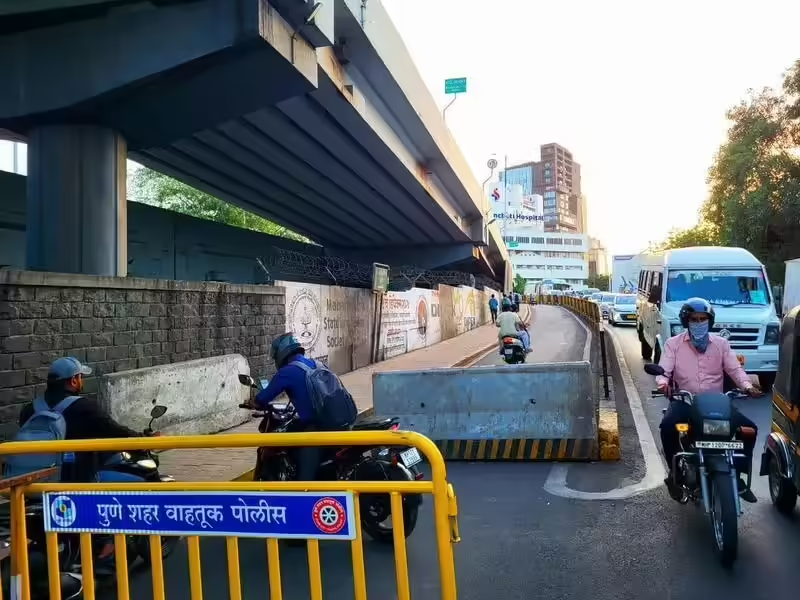
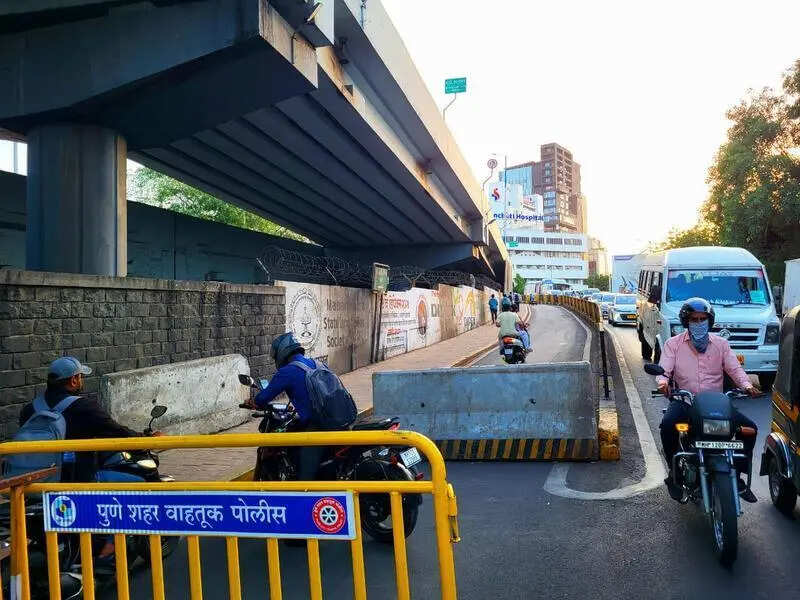
Pune: A recent traffic change near CoEP flyover, where access from the road below towards Jangli Maharaj (JM) Road has been barricaded, is leading to slow-moving traffic and forcing commuters into long detours, said regular users of the stretch.Under the new arrangement, vehicles approaching from Sangamwadi and the Pune-Mumbai Old Highway road side can no longer take a direct right turn towards Sancheti Chowk below the flyover. Instead, they are required to continue till near the Sangam bungalow almost till RTO Chowk, take a U-turn, and then rejoin the route — often ending up back near the flyover.Commuters said the change has shifted congestion rather than eased it. “Earlier, the chaos was at the chowk near CoEP. Now it has simply moved to the U-turn point as well as on the flyover,” said Mahesh Shindikar, a professor who uses the route daily. He added that the situation remains problematic throughout the day, turning “chaotic” during peak hours around 10am and then 5–6pm.Residents living in the area said the barricading has removed a crucial relief route for local traffic. Ameet Singh, a regular commuter, said the small connecting stretch under the flyover earlier helped distribute traffic. “By blocking that, the spillover traffic has nowhere to go but onto the flyover, increasing the load and slowing movement,” he said.The issue is compounded by heavy merging traffic near the Sancheti junction, where vehicles from Shivajinagar, including buses, and traffic heading towards JM Road, intersect. Commuters pointed out that buses often have to weave through Metro pillars before merging, further slowing movement and causing backups that extend onto the flyover.Singh also flagged pedestrian safety concerns, especially for students of the College of Engineering Pune, whose hostels are located across the road. “Students are forced to cross through chaotic traffic, often walking in the middle of the road. It is risky and someone could get knocked down,” he said.The barricading has also affected internal connectivity between CoEP’s two campuses. “We cannot travel by vehicle from one campus to the other anymore. It has become very difficult, especially for physically challenged students and staff,” Shindikar said, adding that some are forced to violate traffic rules to navigate the stretch.Commuters further pointed to the absence of proper signage. Several said they only realise the road is blocked after reaching the barricade, by which time taking a safe U-turn becomes difficult due to oncoming traffic.Shivani Mathur, another commuter who earlier used the same route to JM Road, said, “I recently skipped the flyover and took the alternative route. Vehicles were taking a right but ended up reaching the barricade abruptly. Traffic police were present but did not stop or guide them in advance. At the barricade, it became difficult to take a U-turn. While trying to turn, vehicles from the other side did not allow space, and instead of helping, a policeman started yelling at me.“Traffic police, however, maintained that the move was aimed at easing congestion caused by multiple traffic streams merging near the junction. A senior police officer said traffic from areas such as Bremen Chowk, FC Road, Shivajinagar Metro station and elsewhere all converge at the stretch, creating bottlenecks, especially on the uphill two-lane road.“To reduce congestion, we have diverted vehicles that used to take a right turn below the flyover and directed them towards a U-turn near the old CID office. This is to ensure smoother flow on the main stretch,” the officer said, adding that the flyover is seeing “slow-moving but continuous” traffic rather than complete jams.He also said signboards had been installed but were repeatedly removed by locals, prompting authorities to place a cement barricade to enforce the restriction.However, commuters insisited that the change has aggravated problems instead of solving them. “Instead of managing traffic intelligently, one entire movement has been choked. The result is a larger bottleneck on the flyover and surrounding roads,” Singh said.Shindikar added, “The situation calls for a proper scientific study and traffic modelling rather than ad-hoc changes. Measures such as reducing the size of plantation islands at the junction or installing and managing signals effectively could help streamline movement. At present, instead of channeling traffic, the changes are encouraging rule violations, with many commuters forced to take the wrong side.”