







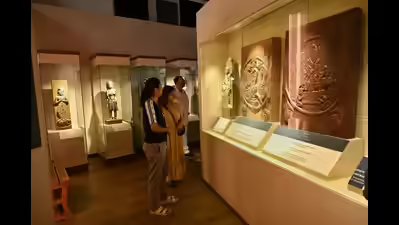
Technically, there was no glass barrier in the 6th-century setting where Gautama Buddha is believed to have delivered his first sermon at Sarnath. So why does one exist behind the statues of his disciples and deer on the first floor of the cylindrical Nehru Centre building in Worli? The answer becomes clear a little further ahead, when a young boy runs his fingers along the carvings of a massive 7th-century rock relief replica from Tamil Nadu—only to be gently pulled aside and told to admire it from a distance.“I don’t know why we tend to touch our historical sculptures,” says Satish Sahney, advisor, Discovery of India exhibition at the Nehru Centre, gesturing toward the towering replica of the Descent of the Ganges, also known as Arjuna’s Penance. The installation anchors a major revamp of the gallery that was three years in the making.Opened to the public recently, the first phase of the reimagined exhibition positions itself as an immersive exposition—tracing the role of history in shaping the subcontinent across epochs, from prehistory to the Chola period. Each epoch has been constructed to highlight the significant aspects of that period which helped shape our cultural history. Through lighting, models, paintings, information panels, interactive maps of ancient trade routes and touchscreen displays, the galleries seek to recreate not just events, but entire historical environments.“Otherwise, history becomes all dates,” says Radha Kumar, Head of Department of Ancient Indian History, Culture and Archaeology at St Xavier’s College, trained Bharatanatyam dancer and sitar player, and the exhibition’s curator. “What we’ve tried to do is bring in the social, philosophical and economic dimensions of our ancient Indian heritage as well.” The journey begins in prehistory, inside a deliberately darkened cave that children sometimes hesitate to enter. Dioramas trace how stone tools were made, alongside depictions of tribal societies. “We are trying to show a long transition—from microlith to microchip,” Kumar explains. In the Neolithic section, the agriculture diorama deliberately foregrounds the contribution of women to the evolution of societies—roles, Kumar notes, that are too often overlooked.Further along, the Harappan gallery situates familiar artefacts within a broader context, including reworked models and a jharoka offering a peek into the Lothal civilisation. “It’s not just about objects like the priest-king,” she says. “We are also looking at the economic, political and geographical aspects. This is a living culture, not something entirely in the past.”The Vedic section, which Kumar describes as the most challenging to curate, reorganises material into thematic strands—spiritual, social, economic and political. Central to this is the Panchamahabhutas, the five natural elements, alongside the Bhumi Sukta, a Vedic hymn celebrating the glory of the land, the four ashramas, and a meditation on mortality through the conversation between Nachiketa and Yama. “It’s about time we recognise how systematically life was thought through,” she says.From this philosophical grounding, the exhibition moves into narrative tradition—scenes from the Ramayana and Mahabharata woven in through painted panels, bridging mythology and lived tradition. “Though they are mythologies, they are very significant,” Kumar says.For Sahney, the project’s strength lies in its collaborative nature. “Historians, artists, designers—everyone has contributed. The idea is to create something three-dimensional, something that helps people grasp history better.” Kumar envisions the space evolving further, with workshops and postgraduate sessions turning the gallery into what she calls “a classroom of its own.” It is the dancer and the curator in her, both, that feel rewarded when she sees children stop before the Dharmachakraparivartana mudra.