









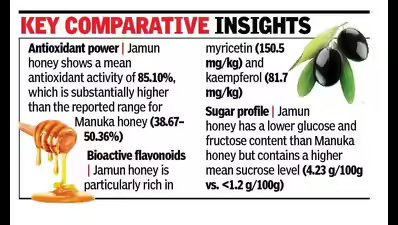
Pune: Scientists at the CSIR-National Chemical Laboratory (NCL) have provided scientific evidence confirming that authentic jamun honey is a healthier natural sweetener, characterised by low glucose levels and a rich antioxidant profile.The study analysed 82 authentic samples collected from Mahabaleshwar region using advanced techniques, including nuclear magnetic resonance (NMR) and mass spectrometry (MS). The findings suggest that India’s indigenous honey varieties may be significantly undervalued on the global stage.“Antioxidant-rich jamun honey, which retails in India for approximately Rs1,000 to Rs1,200 per kg, has health-promoting properties comparable to Manuka honey imported from New Zealand,” said Dr Ashish Lele, director, NCL. “Manuka honey often sells for eight to ten times the price. This vast price gap is primarily due to a lack of branding, consumer awareness, and scientific characterisation of our local honey.”Currently, India lacks a national repository for honey profiles and frequently sends samples abroad for scientific authentication. To address this, NCL is developing a national database of indigenous honey varieties. This project aims to create “chemical fingerprints” for different types of Indian honey to bolster quality control and research.NCL scientist Udaya Marelli, who led the Jamun honey study, emphasised the importance of NMR spectroscopy in this process. “NMR is a fundamental technique used to identify every chemical compound in a product. While it is mandatory for medicines and many food products, honey is rarely tested via NMR in India. Most of that data currently resides in European databases,” Marelli said.By establishing a master database in India, the NCL hopes to prevent loss of national biological data and curb sale of fraudulent products. Honey is currently ranked as the third most adulterated food item globally. “We have already developed a prototype platform at NCL to test for authenticity, detect adulteration, and establish metabolic fingerprints,” Marelli added.NCL has received approval to establish a dedicated NABL-accredited laboratory for testing the quality and authenticity of honey and other FDA-regulated products. The facility is expected to be operational within a year.“Once accredited, this laboratory will issue certificates verifying the authenticity of Jamun honey and detecting sophisticated adulteration,” said Dr Lele. “While this isn’t a regulatory requirement yet, if the FSSAI decides to recognise NABL-certified reports for honey authentication, it could become a vital part of the national regulatory framework.”The study also examined Karvi honey, produced from the Strobilanthes callosa flower, which blooms only once every seven to eight years in the Western Ghats. Researchers found that Karvi honey also boasts high antioxidant activity.“Interestingly, Karvi honey has a distinct fluorescent marker. Under UV light, it fluoresces,” said Marelli. “This unique metabolite profile serves as a natural ‘signature’ that makes authenticating Karvi honey much easier.”Ravindra Sathe, chairman, Maharashtra State Khadi and Village Industries Board, announced that a proposal has been sent to the state government to launch a registration portal for all honey producers.“Currently, there is no centralised tracking of producers. This portal will help regularise the industry, maintain high quality, and facilitate training,” Sathe said. He added that a second proposal will be sent to the Central govt requesting that scientific testing of honey be made mandatory across the country.