






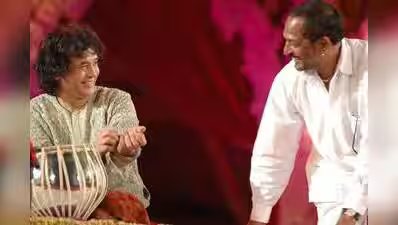
Pune: Long before his voice could slice through silence and his intensity could own the screen, Nana Patekar was a restless young actor fighting for space on the Marathi stage. Those who knew him then don’t remember a star in the making, just a hungry performer driven by instinct, grit and stubborn commitment to his craft.Veteran actor Ashok Saraf recalled those early days with a mixture of affection and admiration. When Patekar first walked into Hamidabaichi Kothi, Anil Barve’s celebrated play directed by Vijaya Mehta, he was still inexperienced. But slowly, scene by scene, performance by performance, Patekar seized the stage and made it his own.“He started with acting and never looked back. He was good to those who were good to him and tough with those who were not. I can never forget him,” Saraf recalled.Their friendship was forged in hard times. Saraf earned Rs 250 per show while Patekar earned Rs 50. Between rehearsals, they passed hours playing cards to distract themselves from an uncertain future. When Patekar hit serious financial trouble, Saraf silently gave him a blank cheque and said, “Withdraw whatever you need from the Rs 15,000 in my account.” Patekar withdrew Rs 3,000.Years later, when he returned the money, Saraf joked that success had finally made him wealthy. Patekar’s reply stayed with him forever: “I am returning only the money. I can never return the time you gave me.”That was Patekar. Fiercely independent, deeply grateful and never one to forget those who stood by him.His years under theatre legend Vijaya Mehta shaped his understanding of acting. He learnt that a character’s true drama lies not in dialogue but in the conflicts simmering beneath it. That lesson stayed with him when he made his film debut with ‘Gaman’ in 1978.Whether portraying an outsider, a rebel, a police officer or a real-life figure, Patekar never merely performed roles. He searched for the human being behind them. That approach found its fullest expression in ‘Natsamrat’. As Ganpat Belwalkar, the aging theatre titan at the centre of VV Shirwadkar’s classic, Patekar delivered one of the defining performances of Marathi cinema. His portrayal of pride, loneliness, aging and loss felt so lived-in that it seemed less like acting and more like a man confronting the ghosts of an entire lifetime.Director Mahesh Manjrekar, who knew Patekar since their theatre days and later directed him in ‘Natsamrat’, spoke of the loss with visible emotion. “This is my biggest loss after my parents. We have lost two pillars of Marathi cinema, Vikram Gokhale and now Nana. I still cannot believe he is no more. I was hoping to work with him again, but could not find a subject worthy of his talent,” he said.From ‘Deool’ and ‘Pak Pak Pakaak’ to ‘Dr Prakash Baba Amte: The Real Hero’ and ‘Aapla Manus’, Patekar returned repeatedly to Marathi cinema, even after Hindi films had turned him into a national icon. His portrayal of Dr Prakash Amte was another example of a rare gift that defined his career — he did not impersonate people, he inhabited them.Actor-director Amol Palekar’s memories reveal another side of Patekar. He remembered long conversations at Mumbai’s Ravindra Natya Mandir, where the two friends would discuss acting, life and the endless process of self-discovery. To Palekar, Patekar was an artist who never stopped working on himself.Palekar said only a day and a half before his passing, Patekar had called him up, expressing regret for missing the opening of his new play. “When I heard the news this morning, I felt completely numb. I remember how Nana (Patekar) had once fought with me for a role in one of his films, such was his determination to take on the part and build it from within,” Palekar said.“He was an extraordinarily gifted actor. He stood by me like a younger brother whenever I called,” Palekar added.Actor Sayaji Shinde struggled to process the news and remembered speaking to him only a day earlier. Beyond cinema, they worked together through NAAM Foundation, supporting farmers and drought-affected communities across Maharashtra. “We were talking so well yesterday and suddenly this happened. I do not know what to say. I kept wondering whether the news I was seeing was even true,” Shinde said.For singer Rahul Deshpande, Patekar was family. He spoke of Patekar’s affection for his grandfather and the way the actor later embraced him like a younger brother, offering guidance, encouragement and honest criticism. Patekar also took a personal interest in Deshpande’s Vasantotsav festival, pushing him to think bigger and international.“What many may not know is that Nana had an exceptionally sharp ear for music. Whether it was a ghazal, natyasangeet or a raga, his observations could be remarkably perceptive,” Deshpande said, adding, “The greatest lesson I learnt from Nana had little to do with music. It was about how to live. Despite everything he had achieved, there was no pretence about him. He remained simple, grounded and extraordinarily generous.”In many ways, Patekar never left the stage that shaped him. Even after becoming one of India’s most formidable actors, a part of Patekar remained that hungry young performer from Marathi theatre, fighting for every role, every scene and every opportunity.