

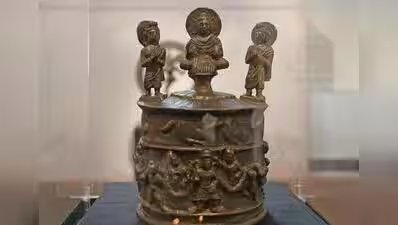
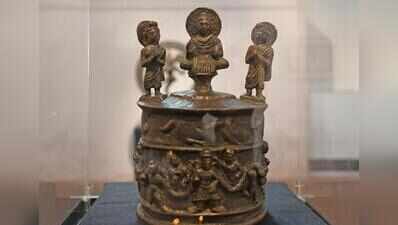
Kolkata: Ahead of the country’s 80th Independence Day, two of Kolkata’s premier museums are opening their collections to tell two distinct but interconnected stories of India. The Indian Museum and Victoria Memorial Hall (VMH) have unveiled special exhibitions that journey through India’s civilisational and national history.Some of the exhibits are relics from the Harappan Civilisation. Some exhibits showcase the philosophical transformation of Buddha, a heroic Chhatrapati Shivaji Maharaj on horseback, Bharat Mata and portraits of Netaji Subhas Chandra Bose and Swami Vivekananda, among other items. Part of the Har Ghar Tiranga campaign, the exhibitions assume added significance as the country celebrates the 150 years of Vande Mataram.The Indian Museum’s exhibition, “Bharata Bhagya Vidhata: Land, Legacy & Living Heritage”, looks beyond the emergence of the modern nation to explore the civilisation that preceded it by millennia, right from Indus Valley Civilsation. Beginning with the Harappans and their sophisticated urban achievements, the exhibition moves through the philosophical transformations associated with Buddha, the devotional traditions of Saiva and Sakta faiths, and the knowledge systems of indigenous communities.Artefacts have been brought together to demonstrate how ideas, innovations, beliefs and lived experiences contributed to the making of Indian civilisation. Rather than offering a single linear narrative, the exhibition presents India as an evolving confluence of cultures, communities and philosophies. It portrays India as a land of living heritage, where legacy has been created through centuries of cultural exchanges. Across the Maidan, Victoria Memorial Hall takes the story closer to the making of modern India. Its exhibition, “Bharat: The Making of a Nation”, brings out several rare treasures from VMH’s reserve collection, some being displayed for the first time, to trace the ideas, personalities, resistance and sacrifices that contributed to India’s emergence as an independent nation. Among its highlights is an oleograph printed by the Ravi Varma Press, showing Chhatrapati Shivaji Maharaj on horseback with his cavalry and portraying him as a symbol of courage, leadership and resistance.Another striking exhibit depicts Bharat Mata, holding the Indian flag and accompanied by a lion and an elephant, symbolising strength and courage. Three works by artist Atul Bose provide an intimate encounter with figures central to India’s intellectual and nationalist history. These works include a pencil sketch of social reformer Raja Rammohun Roy, a pencil portrait of Netaji Subhas Chandra Bose, and a half-bust oil painting of Swami Vivekananda, signed and dated 1952. The exhibition places such personalities alongside a broader trajectory of resistance, from powerful Indian kingdoms and the Revolt of 1857 to social reform, intellectual awakening and the organised freedom movement.“The exhibitions and subsequent activities will help to rediscover the ideas, memories and shared heritage that bind us as one nation,” said Dr Sayan Bhattacharya, director, Indian Museum, and secretary and curator, Victoria Memorial Hall. The Indian Museum is also hosting a week-long programme, featuring a special performance on the Santhal Bidroho, activities for Partition Horrors Remembrance Day, interactions with schoolchildren and public outreach programmes.