







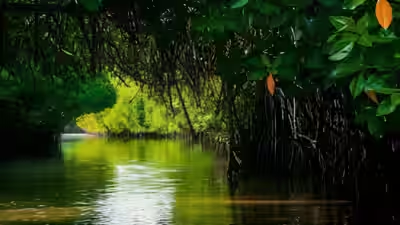
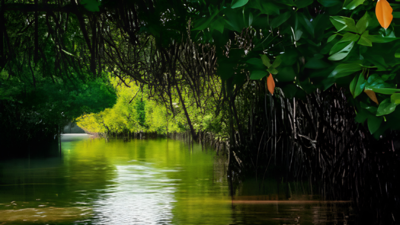
MUMBAI: The city has lost nearly one-fifth of its mangrove cover in 18 years, raising concerns over the survival of natural fish nurseries that sustain coastal biodiversity and support fishing communities.Between 2006 and 2024, mangrove cover along the city’s coastline declined by 17.41%, with researchers mapping 30.20 sq km of mangroves lost against just 11.32sqkm of new growth.The findings of a study published online on October 26 in Elsevier journal ‘Total Environment Advances’ highlight the growing ecological vulnerability of Mumbai’s coastal landscape.The loss is significant not merely because the city is losing its green buffers, but because mangroves perform an important, less visible function: their intricate root systems provide shelter, food and nursery habitats for juvenile fish, prawns, crabs and other aquatic organisms.For Mumbai’s fishing communities, the degradation of these habitats raises questions about the long-term health of nearby fishing waters.Mangrove ecosystems support the early stages of aquatic life, provide feeding grounds and contribute nutrients and organic matter to adjoining creeks and coastal waters. Their degradation can disrupt these ecological processes and potentially affect fish recruitment and the wider food chain.The study, Multi-temporal assessment of mangrove dynamics along the Mumbai coastline using satellite imagery and machine learning, by Vinod Kumar Yadav and Durgesh Kumar Jha, assessed four coastal sectors — Versova-Madh Island-Malad (VMM), Gorai Creek, Thane Creek and Sewri-Chembur-Trombay — using satellite images from 2006, 2012, 2018 and 2024.The researchers found that mapped mangrove area declined from 75.07sqkm in 2006 to 61.99sqkm in 2024.Their common-resolution transition analysis recorded 30.20sqkm of loss and 11.32sqkm of gain, resulting in a net reduction of 18.89sqkm. The largest net decline occurred between 2012 and 2018.The damage is not limited to the disappearance of mangrove patches.The composition of the surviving vegetation has also changed. Open mangrove cover declined by 76.80% and sparse mangrove cover by 19.28%, indicating substantial changes in the density and structure of the ecosystem.This matters because the ecological functions of a mangrove forest depend not just on its geographical spread but also on its health, density and continuity.For fisheries scientists, this raises an important question: how much of the loss and degradation of mangrove habitats is affecting the availability of breeding and nursery grounds for fish and shellfish in Mumbai’s creeks?A decline in suitable juvenile habitats can potentially affect recruitment into adult fish populations, although the extent of any impact on fish stocks or fishing yields would need to be established through independent fisheries surveys.The study itself does not measure fish populations, species diversity or fishing catches.Its contribution is to establish the scale and geographical pattern of mangrove change, providing a scientific basis for further investigation into its consequences for aquatic biodiversity and fisheries.The researchers used four machine-learning methods — Classification and Regression Trees, Random Forest, Gradient Boosted Trees and Support Vector Machine — to classify satellite imagery and map changes in mangrove cover. They also examined the effect of differences in satellite resolution.Between 2018 and 2024, the estimated decline was 5.03% at the native 10-metre resolution of Sentinel-2 imagery and 6.75% after aggregation to a common 30-metre resolution. Despite the difference in estimates, both analyses indicated a continuing decline.The implications extend to the city’s protection against climate-related risks.Mangroves stabilise shorelines, trap sediments, help regulate nutrient cycles and reduce the force of waves and storm surges. Their degradation can leave coastal stretches more vulnerable to erosion and flooding, particularly as Mumbai faces increasingly intense rainfall and rising coastal risks.The findings also call for a closer examination of restoration efforts. A previous assessment cited in the paper found that 13 of 25 mangrove restoration sites assessed in Mumbai showed no growth between the start of restoration and 2022.This underlines why conservation cannot be measured merely by the number of saplings planted. Restoring tidal connectivity, suitable sediment conditions and the ecological processes that allow mangroves to regenerate is equally important.For Mumbai, the challenge is therefore twofold: prevent further destruction of existing mangrove forests and ensure that restoration produces functioning ecosystems capable of sustaining marine life.The latest satellite assessment provides a warning that the city’s coastal green cover is under pressure, and that the consequences could reach far beyond its shoreline.