









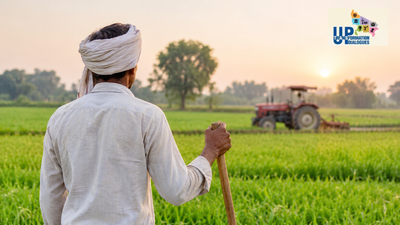
LUCKNOW: The Mukhyamantri Krishak Durghatna Kalyan Yojana is an important social-security initiative of the Yogi Adityanath government, aimed at providing financial assistance to farmers and their families in the event of accidental death or disability. The scheme recognises that farming involves occupational risks and that an accident can push an entire farming household into financial distress.Its significance lies in extending a safety net beyond conventional landownership and ensuring that agricultural families have access to financial support when an unforeseen tragedy affects their earning member.
From landowners to a wider farming community: Expansion of eligibility
One of the most significant features of the scheme is the broad definition of an eligible farmer. Its benefits are not restricted to the person whose name appears in the land records.
The scheme covers:
- Recorded landholders and co-landholders: Farmers whose names appear in the Khatauni.
- Earning members of farming families: Family members whose principal source of livelihood is agricultural income from land recorded in the name of a landholder or co-landholder.
- Tenant and sharecropping farmers: Eligible landless farmers cultivating agricultural land on lease or through sharecropping arrangements.
This wider coverage is important in Uttar Pradesh, where agricultural operations often involve several members of a family, including those who cultivate land without formally owning it. By recognising these different relationships with agriculture, the scheme seeks to extend social protection to a larger section of the farming community.
Financial assistance: Up to Rs 5 lakh
The scheme provides financial assistance of up to Rs 5 lakh in cases of accidental death or disability.
The assistance structure includes:
- Accidental death: Up to Rs 5 lakh.
- Complete disability: Up to Rs 5 lakh.
- Partial disability: Assistance according to the prescribed disability category, with benefits of up to Rs 2.5 lakh in specified cases.
The scheme is funded by the state government, without requiring farmers to pay an insurance premium. This makes it an important public-funded safety net for eligible farming households.
Budget expansion: A stronger financial commitment
The expansion of the scheme is reflected in the increasing budgetary allocation made by the Yogi government.Annual budget allocationYear-on-year increaseRs 100 crore (9.5%)According to the Revenue Department figures reported in August 2026, approximately 21,659 dependent families benefited during 2025–26. In the current financial year, around 17,152 families had already benefited by August 2026. The government had received financial approval for Rs 862.50 crore in two instalments and allocated Rs 813.81 crore to districts according to their requirements.
Digital monitoring for faster and transparent delivery
The Yogi government has also focused on improving the implementation mechanism so that financial assistance reaches eligible families without unnecessary delays. The scheme’s online portal has been integrated with the Chief Minister’s Dashboard. This enables the Revenue Department and district administration to monitor applications, approvals, pending cases and the progress of financial assistance.
How can farmers’ families apply?
The application process is handled through the state revenue administration. Families of eligible farmers can approach the concerned Tehsil office and submit the prescribed application with supporting documents.
Important documents generally include:
- Death certificate or medical records, as applicable.
- Post-mortem report in cases of accidental death.
- FIR, police report or relevant accident documentation, wherever applicable.
- Khatauni or other documents establishing eligibility under the scheme.
- Aadhaar and bank account details of the claimant.
- Proof of relationship with the deceased farmer.
- Disability certificate in cases involving disability.
The prescribed application deadline is generally 45 days from the accident or death. The District Magistrate can grant an extension of up to one additional month in appropriate cases, subject to the scheme’s rules. The overall permissible period is 75 days.(Scheme Explainer)