









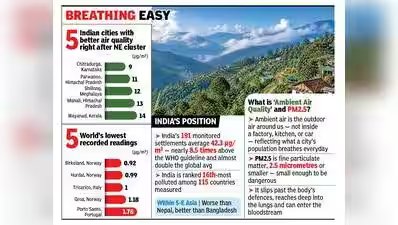
Guwahati: If asked to name the places with India’s cleanest air, most people would probably choose Shimla, Ooty or a remote Himalayan retreat. Almost no one would say Lunglei or Kolasib in Mizoram. Few would mention Tura, Nongstoin, Dawki or Khliehriat in Meghalaya.Yet these little-known northeastern towns have emerged as India’s unlikely clean-air standouts in the World Health Organization’s latest ambient air quality database.WHO’s Ambient Air Quality Database, Version 8.0 covering over 8,000 towns and cities in 127 countries, with annual mean measurements collected between 2010 and 2024, shows that the northeast cluster recorded annual mean PM2.5 levels of just six to eight micrograms. Though nominally above WHO’s annual guideline for PM2.5 of 5 micrograms per cubic metre, they are well below India’s national average of 42.3 µg/m³.One layer deeper into the WHO data shows that Shillong, Meghalaya’s capital and by far the largest urban centre in this group, records 12 µg/m³, and Khliehriat, headquarters of Meghalaya’s East Jaintia Hills district, comes in at 16 µg/m³.In contrast, Delhi chokes at 107 micrograms of fine particulate matter per cubic metre of air, and Ghaziabad and Bhiwadi cross 110.A closer look at geography shows that these NE places are not sprawling metros and have minimal traffic congestion, little to no heavy manufacturing, and terrain that doesn’t trap pollutants the way the flat, densely built Indo-Gangetic Plain does around cities like Delhi, Ghaziabad, and Noida, which is the most plausible explanation for why this belt of India records such low PM2.5 levels compared to the rest of the country.All seven places sit within the hilly, forested terrain of the Meghalaya Plateau or the Mizo Hills, at elevations mostly between 1,000 and 1,500 metres. Barring Shillong, the state capital, they are small district or sub-district headquarters rather than major urban centres. Lunglei and Tura are their states’ second-largest towns, while Nongstoin, Dawki, Kolasib and Khliehriat are modest administrative hubs.Also, Lunglei, in southern Mizoram, sits at over 1,200 metres in hilly, forested terrain near the Bangladesh border. Tura, headquarters of Meghalaya’s West Garo Hills, nestles at the foothills of the Garo range. Dawki, better known to travellers for the crystal-clear Umngot river than for its air quality, lies close to the border, far from heavy industry.Meghalaya chief minister Conrad K Sangma welcomed the recognition on X, framing it as a reflection of the state’s “clean, green and naturally pristine environment,” sustained by communities that have valued and protected nature as part of their way of life.He urged citizens to continue safeguarding the state’s forests, rivers and air for future generations — a message that, coming just as the WHO data drew national attention, doubled as both celebration and a call to keep it that way.WHO cautions that the readings from the northeast cluster are specifically from 2021, meaning they should not be interpreted as current 2026 air-quality readings. WHO also cautions that its database is not comprehensive and that monitoring coverage and measurement methods vary between places. WHO also underlined that these are not cities that it has officially ranked as India’s cleanest, but the lowest PM2.5 concentrations recorded among Indian entries are findings that emerge only from analysing the raw dataset.