









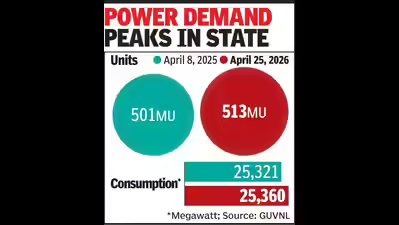
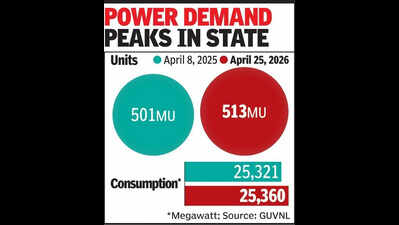
Ahmedabad: As mercury stayed well above 40°C in Ahmedabad and many parts of Gujarat for the past coupel of weeks, the demand for electricity rose to record-high levels. On April 25, Saturday, the peak power demand in the state was at 25,360 megawatts (MW). The ongoing heatwave-like conditions are impacting the power consumption patterns across the state.Daily energy consumption also climbed to 513 million units (MUs) on Saturday, marking the highest level recorded for April, according to data from state load dispatch centre (SLDC), Gujarat. On Saturday, the maximum temperature in Ahmedabad settled at 43.8°C, whereas Sunday was the hottest at 44.8°C in the city. Kandla reported a temperature of 45.4°C on Sunday. The latest peak surpasses the previous April high of 25,321MW recorded on April 8, 2025, when consumption stood at 501MUs, indicating a steady year-on-year rise in power demand. Industry experts attribute the spike to sustained high temperatures, with mercury levels remaining above 40°C through the past week, triggering a sharp increase in cooling requirements. “Power demand in Gujarat has been rising steadily, led primarily by industrial consumption, with commercial and domestic segments also witnessing a sustained uptick,” said an official of Gujarat Energy Transmission Corporation Limited (Getco). The official further explained, “The summer has sharply accelerated cooling demand not just in households but at commercial and industrial levels as well, thus causing a sudden spike in load. On the supply side, evacuation has become more manageable compared to earlier, though it is still not entirely adequate, and expanding transmission infrastructure remains a challenge. We witnessed consistent growth over the past year, and improvements in evacuation are now facilitating higher integration of renewable energy, which is also increasing. “Additionally, the growing penetration of electric vehicles, particularly in commercial usage, is beginning to add to the overall demand. Even the farm sector has seen higher reliance on electric pumps for irrigation amid rising evapotranspiration levels.” Power sector officials said the grid has so far managed to handle the elevated demand without major disruptions, aided by advance planning and adequate generation tie-ups. However, the sharp uptick in April, typically a pre-peak month, signals heightened pressure in the weeks to come, as May and June historically register the highest loads with the rising mercury. Sources said the actual consumption is even higher, given the rising penetration of renewable energy sources in households, particularly solar with the PM Surya Ghar Yojana. Increased urbanisation, wider penetration of electrical appliances, and climate variability are collectively reshaping demand curves.