










Researchers at Biohub, an organisation backed by the Chan Zuckerberg Initiative co-founded by Priscilla Chan, have identified potential new drug targets for psoriasis by combining AI with genetic screening. The study, published in Nature Communications, discovered 2 biological pathways that could help control the skin inflammation associated with this chronic condition. When researchers developed topical gels targeting these pathways and tested them in mice, the treatments reduced disease severity and produced results comparable to an existing injected therapy, opening a possible route towards more localised treatment.
How AI and CRISPR revealed new psoriasis drug targets
The research, led by Shana Kelley, president of Biohub, and Abdalla M. Abdrabou, leader of its Functional Immunogenomics group, focused on keratinocytes. These are the main cells in the outer layer of the skin and play a central role in the development of psoriasis lesions.According to the Biohub, the researchers wanted to understand how inflammation begins in these cells and identify ways to interrupt it without affecting the immune system more broadly.To investigate this, the team used CRISPR, a genetic editing technology that allows scientists to disable individual genes and observe the effects. The researchers examined approximately 19,000 genes in human skin cells using a library of around 77,000 guide RNAs. They then measured changes in IL17RA, a protein that helps skin cells respond to inflammatory signals associated with psoriasis.The experiment identified hundreds of genes that influenced IL17RA levels. However, determining which discoveries were genuinely new required another layer of analysis.As explained in the Northwestern University Feinberg School of Medicine report, the team developed an AI tool called VirtualCRISPR to compare the experimental findings with existing scientific literature and prioritise genes that had received little attention in previous research.
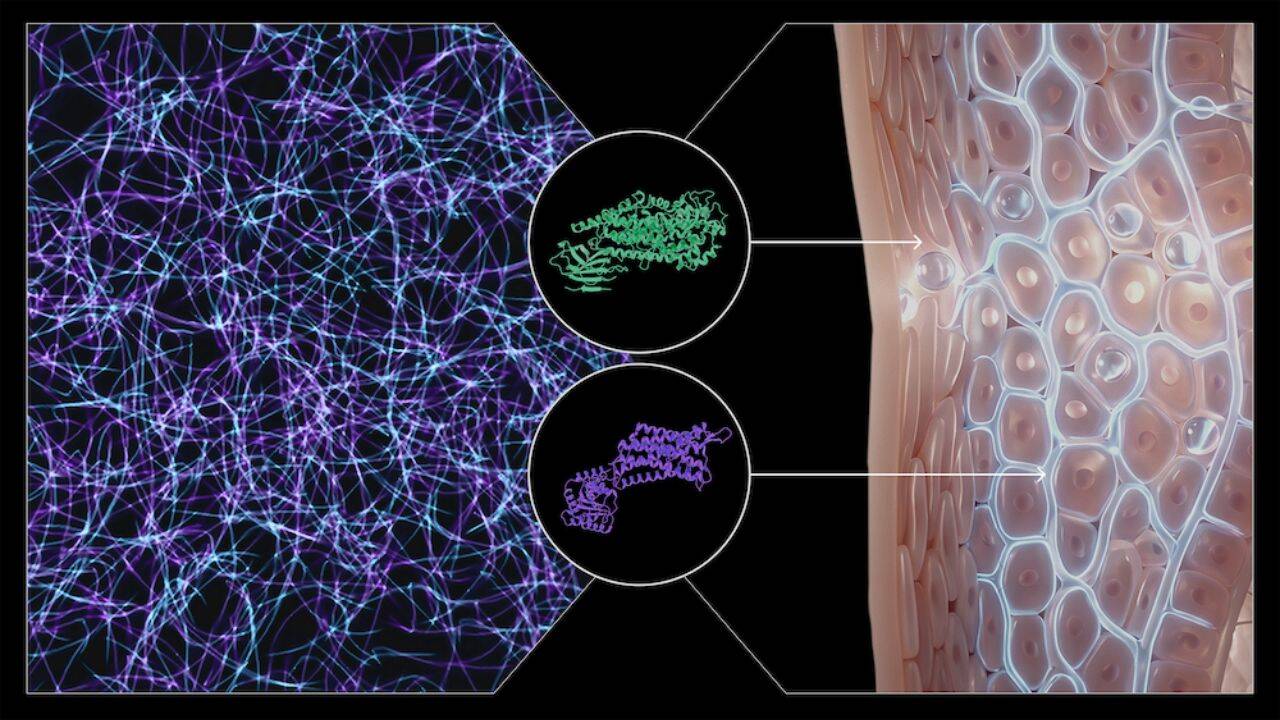
AI-guided network analysis of genomic data (left) highlights two protein targets, including the oxytocin receptor, identified through Biohub’s CRISPR screen in primary human skin cells (right). Image Credit: Biohub
Two promising pathways emerged from the screening
The AI-guided analysis highlighted 2 genes with potential for drug development, ALOX5 and OXTR. Both had limited previous connections to the regulation of IL17RA in skin cells.ALOX5 produces an enzyme involved in inflammatory processes. It is already targeted by zileuton, a drug approved by the US FDA for treating asthma.The second target, OXTR, produces the receptor through which oxytocin acts. Oxytocin is widely associated with childbirth and social bonding, but its receptor has not been established as a significant regulator of psoriasis-related skin inflammation.The researchers identified cligosiban as a compound that blocks this receptor.According to the study published in Nature Communications, experiments in human skin cells showed that interfering with either pathway reduced IL17RA levels and lowered the production of inflammatory substances.The team also used 3D skin cultures to investigate how the compounds affected skin tissue. These models reproduce important features of human skin and helped researchers examine the effects of the treatments more closely.
Topical gels reduced inflammation in mice
After identifying the targets, the researchers reformulated zileuton and cligosiban into gels that could be applied directly to the skin. They then tested the treatments in mice with psoriasis-like inflammation.The results were encouraging. As reported by Biohub, both gels reduced disease severity within 5 days. By the 7th day, their effects were comparable to those of an injected anti-IL17RA drug used as a comparison in the experiment.The treated mice also showed improvements in skin thickness, which had increased because of inflammation. Cligosiban produced particularly broad improvements in the restoration of skin characteristics.The findings suggest that targeting the skin cells involved in psoriasis may help control the condition without requiring drugs to act throughout the body. However, the experiments were conducted in mice, not people. The findings demonstrate potential rather than an established treatment for patients.
Importance of these findings for future treatment
Psoriasis affects more than 125 million people worldwide, according to the research published in Nature Communications. Existing treatments can help manage the condition, but some options have limitations.Mild cases can often be managed with topical treatments, including steroid creams. People with moderate-to-severe psoriasis may need medicines that act throughout the body, including biologic drugs that target immune signalling proteins. These treatments can be expensive, require injections and carry risks associated with suppressing immune activity.Researchers hope topical formulations could eventually provide effective treatment with fewer effects beyond the affected skin.Biohub’s wider inflammation research programme aims to understand how inflammatory processes develop and change inside human tissues. The psoriasis study also demonstrates how AI can help scientists make better use of large experimental datasets.