









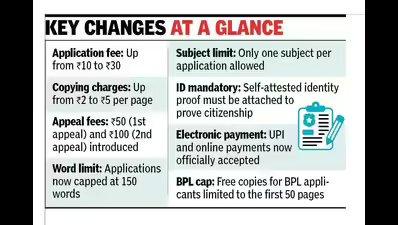
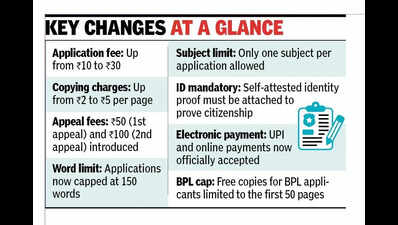
Pune: Right to Information (RTI) activists and regular users have raised an alarm over the state govt’s newly notified RTI Rules, 2026. Critics alleged that several provisions will create significant barriers for citizens, effectively diluting the spirit of the landmark 2005 transparency law.The new rules, notified on June 12, replaced the previous framework governing RTI applications in Maharashtra. While the state maintained that these changes were designed to streamline processes and prevent “misuse,” activists argued they imposed unnecessary hurdles on information seekers.Among the most significant changes is a threefold increase in RTI application fee from Rs10 to Rs30. Charges for obtaining copies of documents have also been raised from Rs2 to Rs5 per page. Citizens seeking to inspect records will have to pay Rs50 per hour after the first free hour, while appeals against decisions of public information officers will now attract fees of Rs50 for first appeals and Rs100 for second appeals before the State Information Commission.Beyond fees, the 2026 rules introduce strict structural constraints. Every RTI application must now be restricted to a single subject limited to approximately 150 words. Under the new guidelines, if an application contains multiple queries, the Public Information Officer (PIO) may process only the first issue and direct the applicant to file separate applications for the rest.Furthermore, applicants are now required to submit self-attested photo identification to establish citizenship with every application. Failure to provide ID may result in the application being returned.Activists argued these requirements contradict the RTI Act’s core objective: providing a simple, citizen-friendly mechanism for accountability.“No amendment can be made that goes beyond the basic tenets of Section 6(2) of the RTI Act, which states that an applicant shall not be required to give any reason for requesting information,” said activist Vihar Durve. “Mandating citizenship proof at the application stage and imposing word limits will only increase litigation and discourage the common man.”The rules also grant PIOs more discretion to deny copies. If information is already available on a government website, authorities can simply direct the applicant to the link rather than providing physical or digital copies. Additionally, “repetitive” applications can now be disposed of without a detailed hearing.The 2026 rules do include some modernising touches. RTI fees can now be paid via UPI and other electronic modes, and communication through email is now formally recognised. Citizens below the poverty line (BPL) remain exempt from fees, though this is now capped—only the first 50 pages of voluminous information will be provided free of cost.Activists contend that the cumulative effect of higher fees, word counts, and identity requirements will stifle transparency. “The RTI Act was designed to make information accessible. Any measure that increases costs and procedural barriers risks weakening the public’s ability to hold the govt accountable,” said another veteran activist.The rules are now in force across Maharashtra. Legal experts and RTI unions are currently examining the provisions to determine if they can withstand a challenge in the high court for potentially overstepping the parent RTI Act of 2005.