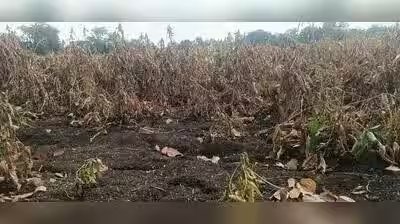







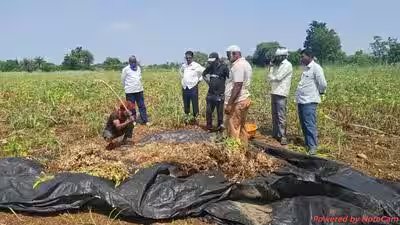
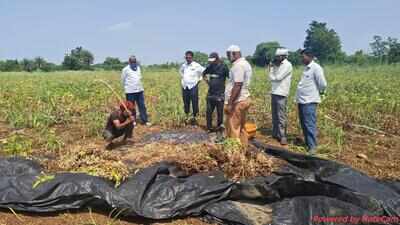
Pune: Farmer MA Qureshi, in Maharashtra’s Dharashiv district, spent weeks worrying about his soybean crop. On Tuesday, he was given devastating news by govt assessors: his farm, in Kendurmala village, had yielded only 2.2 quintals per hectare, compared to the 6-8 quintals he gets in a good year.2026 is fast turning out to be among the worst years for soybean in Maharashtra – the state’s principal kharif crop. This year, it was planted across 49.5 lakh hectares in the state; nearly 50% of it was in the eight districts of Marathwada, all now declared drought-hit.In fact in some farms, assessors carrying out crop-cutting experiments (to determine yield) found the harvest to be literally nil.“We’re shocked. Many farmers won’t even get a quintal of soybean harvest from an acre. In some fields, we only found empty soybean pods,” said DP Birajdar, deputy agriculture officer of Tuljapur tehsil, where Qureshi has his farm.Qureshi told TOI on Tuesday he now faces serious financial uncertainty. “I spent money on seeds, fertiliser, labour and pesticides. I have hardly any soybean left to harvest. Crop-cutting tests showed as much,” he said.Agriculture expert Milind Deshmukh, who has developed three soybean varieties and is familiar with soybean cultivation in Marathwada, said the crop is particularly sensitive to moisture stress during flowering, pod formation and grain filling stages. “Rainfall received during sowing or early vegetative growth cannot compensate for prolonged moisture stress in these later stages,” he said.Data shows Marathwada’s eight districts received only 445mm of rainfall during the four-month monsoon period, compared to 679.5mm normal. Last year, the region received 947mm, or 138.9% of normal rainfall.Latur is the worst-hit. It received only 362.7mm against its normal 706mm, or 51.4% of normal rainfall. Parbhani got 56.8%, Dharashiv 62.2% and Beed 63%. Districts with slightly better levels include Hingoli (69%), Nanded 73.3%, Chhatrapati Sambhajinagar 74% and Jalna 74.7%.But Jalna collector Ashima Mittal said crop-cutting experiments indicated the soybean situation in her district, despite relatively better rain, has been dismal.“Crop-cutting harvest is extremely low. In some places, shockingly, it is nil. We are getting this picture from multiple tehsils. It shows the severity of the current situation. The increasing heat is making matters worse,” she told TOI.Ashok Salve, district agriculture officer of Beed, said several crop-cutting tests showed extremely poor harvest. “These assessments, which show the true ground picture, are still on. Those affected will receive crop insurance benefits,” he said.Rohit Mane, a soybean farmer in Dharashiv, said early on his crop seemed normal. “But then came the long gaps without any rain. By the time my plants needed moisture, the soil itself had dried up,” he said.Dharashiv-based activist Sardarsingh Thakur said a large portion of Marathwada’s soybean cultivation remains completely dependent on falling rain, with several regions lacking backup irrigation systems.“So farmers have no choice but to depend on timing and distribution of monsoon rain. We have very limited irrigation options here,” he said.A total soybean failure in Marathwada will have severe economic consequences for the region. It’s grown by small and marginal farmers. A sharp fall in yields, experts said, will hit incomes, repayment capacities, economic demand, supply and rural demand, essentially paralysing local commerce.Deshmukh said the crisis highlights vulnerability of rain-dependent monocropping during poor monsoon. “Farmers need access to drought-resilient varieties, better soil-moisture conservation and contingency cropping plans. But these measures cannot substitute for immediate relief when a standing crop has already failed,” he said.